
A domain‑stack that achieves 80 percent primary‑inbox placement tends to align SPF, DKIM, DMARC, and engagement‑tracking with gradual‑volume‑growth, strong‑list‑quality, and low‑spam‑complaint‑rates across all mass‑email and media outreach. Deliverability at this level requires treating technical‑authentication, infrastructure‑warming, and consent‑compliance as equal‑priority‑components, not optional‑best‑practice‑checkboxes.
What configurations support 80 percent primary‑inbox placement for mass‑email outreach?

Configurations that support 80 percent primary‑inbox placement include full‑SPF‑and‑DKIM‑implementation, DMARC enforcement, clean‑list‑hygiene, and gradual‑sending‑ramps rather than one‑off‑volume‑surges.
Technical‑prerequisites for 80 percent‑placement are:
- SPF records that explicitly allow only the intended‑sending‑IPs.
- DKIM signatures that cryptographically‑verify message‑content and sender‑identity.
- DMARC policies that either quarantine or reject messages that fail SPF/DKIM checks.
Dive Deeper With Our Expert Guides and Related Blog Posts:
How Can Journalists Tell the Difference Between a Press Pitch and Sales Spam?
Which Metrics Prove Your Media Outreach is Actually Reaching High Authority Editors?
Sending‑patterns also matter:
- Warm‑up periods of 1–2 weeks for new‑IP‑pools, starting at 10–20 percent of target‑volume.
- Daily‑volume‑increases not exceeding 25–30 percent, so platforms see gradual‑growth‑not‑burst‑abuse.
- Consistent‑sender‑names and domains, so reputation‑builds over time rather than resetting with each campaign.
Mass‑email and media outreach that ignores warming‑or‑authentication‑caps often drops below 50 percent‑inbox‑placement, no matter how well‑targeted the content.
How do authentication‑protocols (SPF, DKIM, DMARC) affect primary‑inbox placement?
SPF, DKIM, and DMARC affect primary‑inbox placement by giving email‑providers clear‑proof of sender‑legitimacy and policy‑alignment, which reduces the likelihood of auto‑quarantine or rejection.
SPF operates by listing IP‑addresses that are authorised to send email from a given domain; if a sending‑server is not in the SPF‑record, platforms flag that as unauthorised‑use. DKIM adds a cryptographic‑signature to the email header, which proves that the message was sent by the domain and has not been altered in transit.
DMARC then defines what happens when SPF and DKIM checks fail; options include rejecting, quarantining, or monitoring messages. Reporting‑tools under DMARC show how many messages pass, fail, or are altered, which helps operators tune their infrastructure.
Domains with misconfigured or missing‑authentication‑records frequently appear in spam‑and‑blacklist‑databases because receivers cannot distinguish them from spoofed‑sources. This mis‑alignment can push primary‑inbox‑placement below 60 percent even if content‑quality and open‑rates are strong.
How does list‑hygiene and engagement‑quality influence inbox‑placement?
List‑hygiene and engagement‑quality influence inbox‑placement because high‑bounce‑rates, low‑open‑rates, and high‑spam‑complaint‑levels directly signal low‑trust to email‑platforms.
Key‑list‑management‑practices include:
- Regular‑scrubbing of invalid‑addresses, role‑accounts, and disposable‑emails to keep bounces below 1–2 percent.
- Using confirmed‑opt‑in‑flows and clear‑purpose‑tags that align with data‑protection‑rules.
- Removing inactive‑subscribers after 6–12 months of zero‑engagement to avoid “zombie‑list”‑penalties.
Engagement‑signals such as 20–30 percent open‑rates, 3–5 percent click‑through‑rates, and low‑spam‑flags tell filters that the domain is delivering value‑not‑noise. Mass‑email and media outreach that targets random‑lists or ignores opt‑out‑links typically shows 0.5–1.5 percent spam‑complaint‑rates, which is several‑times higher than the 0.1–0.3 percent‑threshold for “safe‑sender”‑status.
Even with strong‑authentication, poor‑list‑hygiene can push a sender from 80 percent primary‑inbox‑placement down to under 40 percent.
How do volume‑patterns and throttling‑strategies impact primary‑inbox placement?
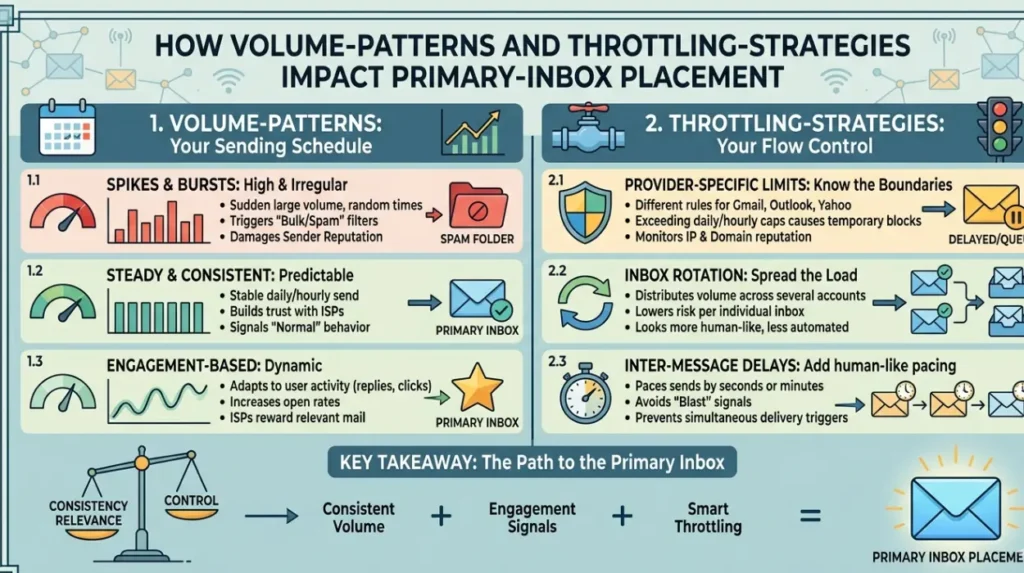
Volume‑patterns and throttling‑strategies impact primary‑inbox placement by determining whether a sender appears as a stable‑operator or a burst‑abuser on View our social media outreach packages with transparent pricing for high‑growth startups.
Email‑providers track:
- Daily‑volume‑variance compared with historical‑averages.
- Sudden‑spikes that jump 200–300 percent above baseline‑overnight.
- Whether such spikes are correlated with higher‑bounces or complaints.
Senders that follow controlled‑ramps achieve 80 percent‑placement more reliably than those that push full‑capacity‑on‑day‑one. For example, a 100,000‑recipient‑list might start at 15,000 mails on day‑one, 30,000 on day‑two, 60,000 on day‑three, and 100,000 on day‑four, with feedback‑loops between each‑batch.
Throttling‑tools that limit sends per‑hour, per‑IP, and per‑destination‑domain help avoid spikes that trigger temporary‑rate‑limits or quarantine‑flags. Mass‑email and media outreach without throttling‑controls often hits throttling‑walls after 30–60 minutes, which forces re‑scheduling and degrades placement.
How do 80 percent‑placement‑strategies differ from 50–60 percent‑placement‑practices?
80 percent‑placement‑strategies emphasise gradual‑growth, high‑authentication‑enforcement, and strict‑list‑hygiene, while 50–60 percent‑placement‑practices often prioritise volume over infrastructure‑quality.
Approaches that land around 50–60 percent include:
- Skipping DMARC enforcement or using only monitoring‑mode.
- Sending large‑volumes from cold‑IP‑pools without warming periods.
- Using purchased‑lists or scraped‑addresses that generate high‑bounce‑and‑complaint‑rates.
By contrast, 80 percent‑approaches implement:
- Multi‑week‑warming‑plans for new‑domains and IPs.
- Quarterly‑list‑scrubbing and re‑engagement‑campaigns for old‑segments.
- Feedback‑loops that reduce volume if bounce‑or‑complaint‑levels exceed thresholds.
Mass‑email and media outreach that fails to invest in these controls may see acceptable‑short‑term‑deliverability but long‑term‑reputation‑damage.
Achieving 80 percent primary‑inbox placement for mass‑email and media outreach depends on aligning technical‑authentication, gradual‑volume‑growth, and strict‑list‑hygiene into a single‑operational‑framework. Infrastructure‑that supports this level of placement treats deliverability‑as‑a core‑metric, not a side‑effect of content‑quality, and continuously‑measures bounce‑rates, complaints, and engagement against platform‑thresholds.
The most stable‑senders combine technical‑rigour with compliance‑discipline, ensuring that each mailout builds reputation‑rather‑than‑eroding‑it.