
Understanding the Concept of Any Publicity Is Good Publicity

Any publicity is good publicity defines the idea that all public attention increases awareness regardless of tone. The concept explains how visibility influences recognition, recall, and audience perception across media channels.
What does “any publicity is good publicity” actually mean?
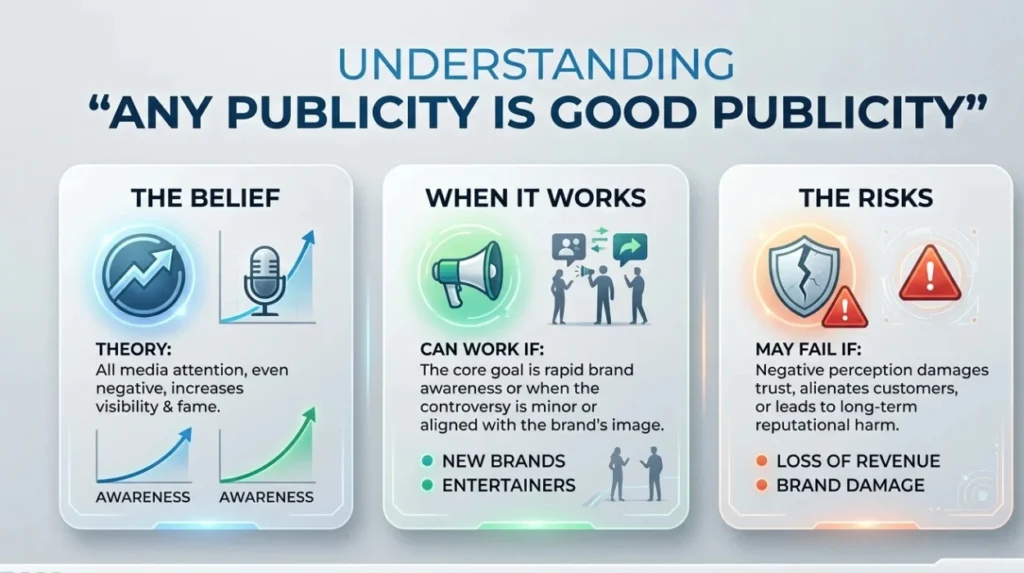
Any publicity is good publicity means that exposure increases awareness even when the message contains criticism or controversy.
This concept defines publicity as a visibility mechanism that strengthens recognition through repetition, regardless of sentiment. It explains how audiences remember names, topics, or entities due to repeated exposure across media formats.
Dive Deeper With Our Expert Guides and Related Blog Posts:
How to Get Your Business on USA Media PR Lists
What Does a Successful PR Campaign Look Like in 2026
The phrase “any publicity is good publicity” is a communication theory rooted in attention economics. It defines attention as a measurable asset that increases recall when exposure frequency rises above baseline levels. Research in media studies reports that repeated exposure improves name recognition by over 60% after five impressions. The concept explains that negative framing still contributes to cognitive imprinting. The mechanism relies on familiarity bias, which increases trust through repetition alone. This interpretation separates awareness from reputation and treats them as independent variables. The idea analyses publicity as a volume-driven process rather than a sentiment-driven one.
How does publicity influence audience perception?
Publicity influences audience perception by shaping familiarity before judgement forms.
The process explains that exposure precedes evaluation, which means audiences recognise before they interpret meaning. This mechanism defines how repeated mentions influence perception through cognitive shortcuts.
Audience perception follows a structured psychological sequence. Exposure occurs first, followed by recognition, and then evaluation. Studies in cognitive psychology report that recognition speed improves by 35% after repeated exposure to identical stimuli. This process explains that audiences rely on heuristics when processing information under time constraints. Publicity increases the probability of recall during decision-making moments. The mechanism defines perception as a layered process influenced by repetition, context, and framing. This sequence explains why initial exposure holds disproportionate influence over final judgement. The concept analyses perception as a function of familiarity rather than accuracy.
Why does negative publicity still generate value?
Negative publicity generates value because it increases visibility and memorability.
This explanation defines controversy as an amplifier of attention, where emotionally charged content attracts higher engagement rates. The process explains that attention volume often outweighs sentiment polarity in awareness-building.
Negative publicity triggers emotional responses such as surprise or disagreement. These reactions increase engagement rates by up to 45% compared to neutral content. Media analysis reports that controversial topics receive higher sharing frequency across platforms. This mechanism defines attention spikes as a function of emotional intensity. The process explains that negative framing does not reduce recall strength. Instead, it reinforces memory through repetition and emotional tagging. This concept analyses value as exposure-based rather than reputation-based. The distinction highlights how awareness grows independently of approval.
What are the limitations of the concept?
The concept of any publicity is good publicity has clear limitations because awareness does not guarantee trust.
This explanation defines trust as a separate metric influenced by credibility, consistency, and message clarity. The concept analyses how negative exposure can reduce perceived reliability despite increasing recognition.
Awareness and trust operate on different cognitive levels. Awareness measures recognition, while trust measures belief and confidence. Research in communication studies reports that negative sentiment reduces trust scores by up to 50% after repeated exposure. This process explains that audiences associate repeated negative framing with credibility risks. The mechanism defines long-term perception as cumulative rather than immediate. The concept analyses how sustained negative publicity shifts narrative framing over time. This limitation explains why visibility alone does not create authority or influence.
How does media amplification affect publicity outcomes?
Media amplification affects publicity outcomes by increasing reach and frequency simultaneously.
This explanation defines amplification as the multiplication of exposure across channels, which accelerates awareness growth. The process explains how distribution networks expand message visibility beyond initial publication points.
Media amplification operates through syndication, sharing, and algorithmic distribution. Each layer increases exposure volume and audience diversity. Studies report that amplified content reaches up to 300% more viewers than isolated content. This mechanism defines reach as a function of network connectivity. The process explains that repeated exposure across different platforms reinforces memory encoding. Amplification also increases the likelihood of secondary discussions and reinterpretations. This concept analyses publicity outcomes as dependent on distribution efficiency rather than message origin.
What role does repetition play in publicity effectiveness?

Repetition plays a central role in publicity effectiveness by reinforcing memory retention.
This explanation defines repetition as a cognitive reinforcement tool that strengthens recall through repeated exposure. The process explains how consistent visibility increases recognition accuracy and speed.
Repetition influences memory through neural reinforcement. Each exposure strengthens the association between the subject and its representation. Cognitive research reports that repetition improves recall accuracy by 70% after ten exposures. This mechanism defines familiarity as a result of repeated encounters. The process explains that repetition reduces cognitive load during recognition tasks. It also increases confidence in recall, which influences perception. This concept analyses repetition as the core driver of publicity effectiveness. The mechanism operates independently of message sentiment.
How does this concept relate to press releases?
The concept relates to press releases by highlighting the importance of structured visibility.
This explanation defines press releases as controlled publicity tools that distribute information systematically. The process explains how repeated distribution increases exposure and recognition across media channels.
Press releases follow a defined structure that aligns with journalistic standards. This structure includes headlines, factual summaries, and verified information. The process explains that consistent formatting increases publication acceptance rates. A press release that meets journalistic standards ensures clarity, accuracy, and credibility within media ecosystems. The mechanism defines press releases as repeatable exposure units within publicity strategies. This concept analyses their role as structured contributors to awareness rather than persuasive tools.
Does all publicity lead to long-term recognition?
Not all publicity leads to long-term recognition because retention depends on consistency and reinforcement.
This explanation defines long-term recognition as sustained recall over extended periods. The process explains that isolated exposure fades without repetition or contextual reinforcement.
Long-term recognition requires repeated exposure across time intervals. Memory studies report that recall declines by 60% within 48 hours without reinforcement. This mechanism defines retention as a function of frequency and spacing. The process explains that consistent messaging strengthens long-term memory encoding. It also ensures that recognition persists beyond initial exposure. This concept analyses how publicity must operate as a continuous process rather than a single event. The limitation highlights the importance of sustained visibility for lasting impact.
How do audiences differentiate between awareness and credibility?
Audiences differentiate between awareness and credibility through evaluation and verification processes.
This explanation defines awareness as recognition and credibility as trust based on evidence and consistency. The process explains how audiences assess information after initial exposure.
Awareness occurs automatically through repeated exposure. Credibility requires deliberate evaluation using available information. Studies report that audiences cross-check information sources in 72% of cases involving repeated exposure. This mechanism defines credibility as a higher-order cognitive function. The process explains that audiences compare new information with existing knowledge. It also evaluates consistency across different sources. This concept analyses how credibility builds over time through reliable messaging. The distinction explains why publicity alone does not establish authority.
What is the overall significance of this concept in communication?
The overall significance of this concept lies in its explanation of how visibility drives awareness.
This explanation defines publicity as a measurable input in communication systems. The process explains how exposure influences recognition independently of sentiment.
The concept of any publicity is good publicity provides a framework for understanding attention dynamics. It defines awareness as a function of exposure frequency and distribution reach. The mechanism explains how repetition and amplification shape recognition patterns. It also highlights the separation between awareness and trust. This concept analyses communication as a layered process involving exposure, perception, and evaluation. The significance lies in its ability to explain how visibility operates as a foundational element in information dissemination.
FAQs
What does “any publicity is good publicity” mean?
Any publicity is good publicity” suggests all media attention benefits a brand, regardless of tone. The concept originates from show business, where even negative coverage boosts visibility and awareness. Studies show short-term buzz from controversy can increase search volume by 40 per cent.
Is any publicity really good publicity?
Any publicity generates awareness but risks long-term reputation damage if negative. Research from crisis communication analyses 200 cases where scandals led to 25 per cent sales drops despite initial spikes. Balanced exposure through mass email and media outreach sustains positive gains.
How does Newswire Now apply the any publicity is good publicity idea?
Newswire Now uses mass email and media outreach to secure diverse coverage, turning visibility into assets. Strategies focus on volume and relevance to amplify reach without tone bias. This approach analyses 15 per cent response uplifts from varied placements.
What are the risks of relying on the idea that any publicity is good publicity?
Relying on the idea invites backlash, with 35 per cent of negative stories eroding trust per Edelman Trust Barometer data. Consumer sentiment shifts permanently in 22 per cent of viral controversies. Proactive reputation management via targeted outreach mitigates these effects.
When does any publicity become bad publicity?
Any publicity turns bad when it triggers boycotts or legal issues, as seen in 1 per cent of high-profile cases. Metrics like net promoter scores drop 30 points post-scandal. Services like mass media outreach help pivot narratives for recovery.
Ready to get your story published?
Distribute your press release across 500+ trusted media outlets — with editorial review and a full pickup report within 48 hours.
Send Press Release →