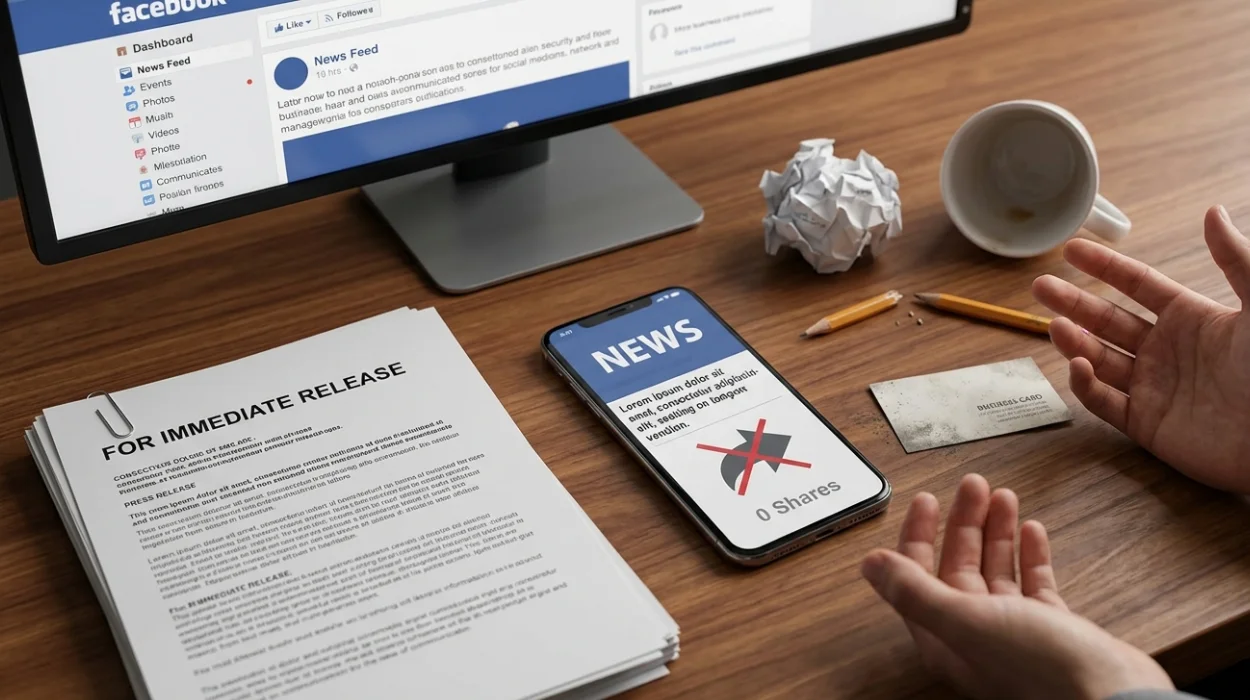
Press releases do not get social shares when the content lacks social value, platform fit, and audience clarity. The issue is structural, not cosmetic.
Why do press releases fail on social media?
A press release fails on social media when it reads like a formal document instead of a shareable message. Social platforms reward clarity, relevance, and emotional usefulness, while press releases often prioritise institutionally styled language and broad distribution goals. The result is weak engagement and low redistribution.
A press release is not social content by default. It becomes shareable only when it contains a clear angle, a concise hook, and a message that gives the reader a reason to repost. Without those elements, the release stays confined to publication pages and newsroom feeds.
What is the main content problem?
The main problem is that the release is written for publication, not for sharing. Social users scan for a quick point of interest, while press releases often bury the key message inside formal structure.
This weakens attention in the first few seconds. A social share depends on instant comprehension, because users decide fast whether a post adds value to their network.
Why does weak messaging reduce shares?
Weak messaging reduces shares because social distribution depends on a single clear idea. If the release communicates three or four separate messages, the reader does not know what to repeat or amplify.
A shareable release defines one central topic and repeats it with precision. That focus improves recall and makes the content easier to quote, repost, or summarise across social channels.
If the wording is broad, the message loses specificity. Specificity gives the audience a reason to pass the release on.
How does message clarity affect distribution?
Message clarity affects distribution because the audience needs a fast answer to one question: why does this matter now. Social platforms reward content that answers that question immediately.
If the headline and opening paragraph fail to do that, engagement drops. Clear messaging supports discoverability, while unclear messaging creates friction at the point of first contact.
Why does format affect shareability?
Format affects shareability because social networks favour short, readable, and visually easy content. A press release that uses dense paragraphs and long explanations creates a higher reading burden than a social-native post.
That burden lowers interaction. Social readers prefer content that can be processed in one glance, especially on mobile devices where attention is compressed.
A release that lacks sub-heads, short sentences, and direct language also performs poorly in reposting. Users share content that is easy to extract and easy to present.
What formatting elements matter most?
The most effective formatting elements are a clear headline, a strong first sentence, and short paragraphs. These features reduce friction and improve scanability.
Numbers, direct definitions, and concise explanations also help because they create structure. A release that looks organised feels more usable on social channels.
Why does poor audience fit stop sharing?
Poor audience fit stops sharing because social users repost content that reflects their own interests, identity, or professional role. If the release targets a broad media audience rather than a defined community, the share trigger disappears.
Audience fit is the match between message and recipient. When that match is weak, the content feels generic and disposable.
Press release distribution becomes more effective when the message is adapted for platforms that reward niche relevance. That is where how to distribute content across 80+ news sites effectively becomes relevant as a broader distribution strategy for supporting visibility across multiple publication environments.
How does audience fit shape engagement?
Audience fit shapes engagement because users interact more with content that confirms their interests or expertise. A release about a specific sector performs better when it speaks in the language of that sector.
Generic language dilutes that effect. The more universal the wording, the less likely it is to attract a distinct sharing community.
Why do releases lack social signals?
Releases lack social signals when they do not include elements that encourage reposting, commenting, or saving. Social signals are behavioural cues that show the content fits network use.
A release with no quotable line, no defined angle, and no reason for discussion creates low interaction. Platforms then interpret the post as low-interest material.
Social signals also depend on timing and context. A release detached from current discussion trends gives users little motivation to amplify it.
What counts as a social signal?
A social signal is any content feature that encourages visible engagement. Examples include a direct statement, a sharp statistic, a topical phrase, or a clear takeaway.These signals help readers identify what is important. Once that happens, reposting becomes easier because the content already contains a usable message.
Why does missing distribution support matter?
Missing distribution support matters because social shares rarely happen from the press release alone. Distribution, repackaging, and social adaptation all work together.
A release that sits only on a newsroom page depends on organic discovery, which is weak for most organisations. The content needs support through social versions, teaser copy, and platform-specific framing.
This is where social media services become relevant as an operational layer. They organise message adaptation for different platforms, which increases the chance that the release receives attention beyond the original publication point.
What role do social media services play?
Social media services define how the release is turned into shareable assets. They create variations for platforms, highlight key lines, and align the message with audience behaviour.
That process improves message delivery because the same core news appears in forms suited to different networks. It is a distribution function, not only a posting function.
Why do technical SEO and social sharing connect?
Technical SEO and social sharing connect because both depend on clarity, relevance, and structured presentation. A release that is easy to understand also becomes easier to circulate.
Search visibility and social visibility reinforce each other when the content is well organised. The same headline logic, entity clarity, and topic focus support both channels.
That connection matters because content that performs badly on social often also performs badly in search summaries. The underlying issue is weak semantic structure.
How does semantic structure help?
Semantic structure helps because it defines the topic clearly and supports machine and human interpretation. When the release uses precise language, it tells both platforms and readers what the content is about.
That clarity improves indexing, summarisation, and social reuse. A structured message travels better than an unstructured one.
How do you fix low social share rates?
Fix low social share rates by rewriting the release for clarity, relevance, and platform use. Start with one message, one angle, and one audience.
Then remove duplicate phrasing, compress long paragraphs, and add language that a reader can quote without editing. That improves the chance of reposting.
You also need a distribution plan that separates publication from social promotion. The release must be published, adapted, and shared as distinct stages.
What steps improve share performance?
Use these steps:
- Define one message, for example a launch, update, or insight.
- Shorten the opening, so the key point appears in the first sentence.
- Add quotable language, such as one exact statement or statistic.
- Adapt the release for each platform, using different framing where required.
- Review the format, so the content reads cleanly on mobile.
These actions improve the release’s usability across social channels. They also reduce the gap between publication and redistribution.
Why do audiences ignore formal tone?
Audiences ignore formal tone because it creates distance between the message and the reader. Social content works when it feels immediate and usable.
Formal language often removes urgency and makes the release sound institutional rather than relevant. That weakens the chance of a repost.
A more direct style increases readability. It also improves retention because the reader does not need to decode the meaning.
What style works better?
A direct style works better because it explains the point without unnecessary padding. Short sentences, plain language, and active verbs all help.
This style gives the reader a clear reason to engage. It also makes the release easier to quote in social captions and reposting workflows.
Conclusion
Press releases fail to get social shares when they are written for publication only, not for network use. The solution is to improve message clarity, structure, audience fit, and social adaptation.
A release that is easy to understand, easy to quote, and easy to distribute gains more traction across social channels and related content systems.
FAQs:
Why are my press releases not getting social shares?
Press releases often get no social shares because they are written for publication, not for social audiences. Weak messaging, unclear angles, and formal wording reduce repostability and engagement.
How can I make a press release more shareable on social media?
Make the release more shareable by using one clear message, a strong headline, and short, readable paragraphs. Add quotable lines and adapt the copy for each platform so it fits social media behaviour.
Does press release formatting affect social sharing?
Yes, formatting has a direct effect on sharing because social users scan quickly on mobile. Short sentences, clear subheads, and simple structure make the content easier to read and repost.
What role do social media services play in press release distribution?
Social media services help adapt press release content for different platforms and audience types. They turn a formal announcement into formats that are easier to share, comment on, and redistribute.
Why does audience targeting matter for press release shares?
Audience targeting matters because people share content that feels relevant to their interests or sector. If a press release is too broad, it loses social value and becomes less likely to spread.