
Why Should Veterinary Clinics Publish Press Releases?
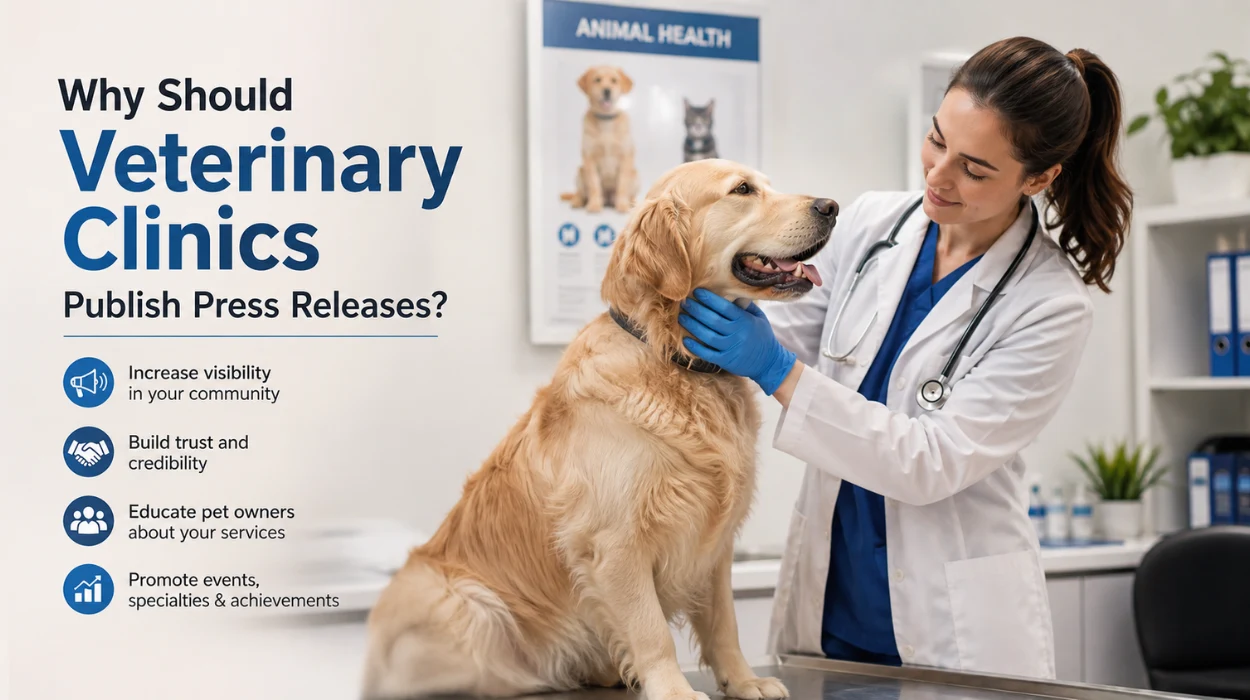
Veterinary clinics publish press releases to announce verified developments, communicate expertise, and place timely information in front of journalists, pet owners, agricultural audiences, and industry stakeholders.
A press release is a structured news document that gives media organisations factual information they can evaluate, verify, index, and report.
What Is a Veterinary Clinic Press Release?
A veterinary clinic press release is an official news statement that communicates a verifiable development involving veterinary services, animal health, clinical expertise, research, community programmes, or industry activity. It uses a news structure rather than promotional copy, allowing journalists and publishers to identify the central announcement quickly. A release normally contains a headline, dateline, announcement, supporting facts, quotations, organisational information, and media contact details. The content must distinguish confirmed information from opinion and marketing claims. This structure also gives search engines and news platforms clear textual signals about the subject and publication date. A well-defined release therefore functions as a source document for media discovery and public information.
Which announcements qualify as news?
Relevant announcements include clinic openings, veterinary service expansions, specialist appointments, animal health research, professional awards, educational initiatives, emergency preparedness programmes, and collaborations with recognised organisations. A release can also explain verified changes affecting animal owners or agricultural communities. For example, information concerning vaccination programmes, livestock disease prevention, or new diagnostic capabilities can have clear public-interest relevance. The announcement must contain a specific development rather than general statements about the clinic. Journalists assess newsworthiness through factors such as relevance, timeliness, evidence, public interest, and geographic significance.
How Do Press Releases Increase Veterinary Clinic Visibility?
Press releases increase visibility by distributing a structured news announcement across media channels where journalists, publishers, search systems, and relevant audiences can discover it. Distribution creates additional opportunities for an announcement to enter news coverage, syndicated publications, industry reporting, and search results. The mechanism begins with publication and distribution through appropriate media channels. Publishers then decide whether the information meets their editorial standards and audience requirements. Search engines independently crawl accessible pages and determine whether content satisfies their indexing and news-related systems. Visibility therefore depends on discoverable information, editorial relevance, technical accessibility, and genuine news value.
Veterinary clinics can use releases to communicate developments that extend beyond their existing client base. A specialist veterinary appointment, new diagnostic facility, or animal welfare initiative can interest professional publications as well as local media. Industry-specific reporting can also introduce the clinic to livestock producers, agricultural organisations, animal welfare groups, and veterinary professionals. This makes press release distribution different from communicating exclusively through an owned website. The release creates a defined news event that external publishers can assess.
A content strategy focused on Veterinary Clinics Attract More Clients can also use newsworthy announcements to explain expertise and services through evidence-based public information rather than direct promotional claims.
How Do Journalists Use Veterinary Press Releases?
Journalists use veterinary press releases as source material for identifying announcements, verifying basic facts, locating expert contacts, and developing stories that match their editorial remit. A release gives reporters a defined news angle instead of requiring them to discover the development independently. The strongest releases place the essential fact near the beginning and provide supporting information that can be checked. Journalists can then assess whether the announcement fits their publication, audience, location, and reporting calendar. A release does not guarantee editorial coverage because publishers retain independent editorial control. Its primary function is to make relevant information accessible to media professionals.
What information helps journalists evaluate a release?
A journalist needs a clear announcement, identifiable organisation, publication date, relevant location, named spokesperson, supporting evidence, and contact information. Statistics require a stated source and appropriate date. Scientific or clinical claims require accurate terminology and evidence that supports the statement. Quotations should add interpretation rather than repeat the headline. Background information must explain why the announcement matters to the intended audience. These elements reduce ambiguity during editorial assessment.
How Does Media Syndication Distribute Veterinary News?
Media syndication distributes the same news announcement across participating publications and platforms, allowing identical or adapted information to appear beyond the original publishing location. A distribution network receives the release and delivers it to selected media destinations according to its subject, geography, or editorial relevance. Individual publishers control whether they publish, edit, or exclude syndicated material. Syndication therefore expands the potential publication footprint without converting every recipient into an independent editorial endorsement. Published copies can also provide additional locations where audiences encounter the announcement. The distinction between distribution and editorial coverage remains important because publication decisions belong to each outlet.
Three established US distribution services include PR Newswire, Business Wire, and EIN Presswire. Each operates within a different distribution model and media ecosystem. Veterinary communications can also target specialist publications covering animal health, agriculture, livestock, veterinary medicine, and rural affairs. Geographic targeting becomes particularly relevant when an announcement concerns a clinic opening or service expansion in a defined region. Subject relevance determines whether a publication has a legitimate reason to consider the announcement.
How Does Google News Handle Veterinary Press Releases?
Google News evaluates news content through automated systems and publisher-related requirements that assess relevance, quality, accessibility, and other signals rather than automatically accepting every distributed press release. Google News is a news discovery product that surfaces content from publishers and news sources through automated ranking systems. Inclusion is not equivalent to guaranteed ranking, traffic, or editorial endorsement. Search systems crawl publicly accessible pages and process their content according to technical and content signals. Publishers also need to follow applicable Google policies governing news and search content. A press release therefore needs genuine informational value and technically accessible publication to participate in the wider discovery process.
What technical factors support news discovery?
Use descriptive headlines, clear publication dates, accessible page content, logical HTML structure, and appropriate structured data where applicable. Implement news article or other relevant schema only when the markup accurately represents the page. Maintain crawlable URLs and avoid technical restrictions that prevent search-engine access. Provide visible authorship or publisher information where appropriate. Follow Google’s publisher and spam policies rather than treating structured data as a shortcut to news visibility.
How Do Embargoes Affect Veterinary Press Release Timing?
An embargo establishes the agreed time before which recipients are asked not to publish specific information, allowing journalists to prepare coverage before the announcement becomes public. Embargo timing is particularly relevant to research findings, conference announcements, regulatory developments, and coordinated industry communications. The release must state the embargo date and time clearly, including the relevant time zone. Distribution systems and recipients need the same timing information to prevent inconsistent publication. An embargo does not replace editorial judgement or create a legal requirement for every recipient. Its effectiveness depends on clear communication and recipient compliance.
A veterinary clinic announcing research at a professional conference can provide journalists with advance information while preserving a coordinated public release time. Editors can review the material, prepare questions, and arrange interviews before the announcement becomes public. The final publication time then aligns across participating outlets. Precise timestamps reduce confusion when organisations operate across the United Kingdom, Europe, North America, and Asia-Pacific markets.
What Makes a Veterinary Press Release Newsworthy?
A veterinary press release is newsworthy when it communicates a specific, timely, verifiable development with clear relevance to an identifiable audience. News value comes from the substance of the announcement rather than the frequency with which a clinic publishes. A new diagnostic capability has a different news angle from a routine service reminder. Research findings require evidence, context, and appropriate attribution. Community initiatives gain relevance when they demonstrate a measurable activity or defined public benefit. Editorial relevance remains the central test because journalists select information according to their audiences and reporting priorities.
Which news values matter most?
Prioritise timeliness when the announcement concerns an event, development, or emerging issue. Establish relevance by explaining who is affected and why the information matters. Provide evidence through verified statistics, named experts, official documents, or research findings. Identify geographic significance when the announcement concerns a defined community or region. Demonstrate originality through a specific development rather than repeating generic veterinary advice.
How Can Veterinary Clinics Structure Press Releases for Media Distribution?
A media-ready veterinary press release places the most important verified information first, followed by evidence, expert commentary, context, and contact details. The inverted pyramid structure allows journalists to understand the announcement without reading the entire document. The headline identifies the central development using precise language. The opening paragraph answers the essential questions of who, what, where, when, and why. Subsequent paragraphs provide evidence and quotations that support the announcement. The final section supplies background information and media contact details.
Which elements belong in the release?
- Define the announcement in a precise headline and opening paragraph.
- Identify the clinic, location, date, and relevant spokesperson.
- Explain the significance using verified facts and supporting context.
- Attribute clinical, scientific, or regulatory claims to credible sources.
- Provide media contact information for journalists requiring clarification.
This structure also improves editorial efficiency because journalists can extract the central facts without searching through promotional language. Clear formatting helps distribution platforms process the document consistently. Accurate names, dates, locations, and quotations also reduce factual errors during subsequent reporting.
Why Does Consistent Veterinary News Publishing Matter?
Consistent news publishing creates a documented record of verified developments that journalists and audiences can review over time. Each release adds another dated communication point to the organisation’s public information history. The value comes from publishing genuine developments rather than producing repetitive announcements without substantive news. A consistent record can help journalists understand organisational expertise, professional activity, and areas of relevance. It also provides a reference point when later announcements build on earlier developments. The underlying mechanism remains information discovery rather than promotional frequency.
Veterinary clinics operate across clinical medicine, animal welfare, agriculture, research, regulation, and community services. Press releases provide a formal channel for communicating developments that intersect with these areas. When distributed appropriately, the content becomes available for editorial evaluation and broader public discovery. Search engines can crawl accessible published pages, while journalists can assess the information against their reporting requirements. The effectiveness of the release therefore depends on news value, factual accuracy, distribution, accessibility, and timing.
What Role Does Agriculture Sector Communication Play in Veterinary PR?
Agriculture Sector communication connects veterinary developments with audiences affected by livestock health, animal production, rural services, biosecurity, and agricultural policy. Veterinary medicine directly intersects with agricultural systems where animal health affects production, welfare, disease control, and regulatory compliance. Releases addressing these subjects need terminology that agricultural and veterinary audiences understand. Relevant announcements can include disease surveillance, livestock vaccination programmes, biosecurity measures, diagnostic developments, and professional appointments. Regulatory references must identify the applicable authority or regulation accurately. Clear sector-specific communication helps journalists determine the relevance of veterinary announcements to agricultural reporting.
Press releases remain an information-distribution mechanism rather than a substitute for independent journalism. Journalists decide which announcements deserve reporting, while publishers determine which content they publish. Search engines independently process accessible pages and apply their own discovery and ranking systems. Media syndication expands distribution but does not guarantee editorial coverage. For veterinary clinics, the central principle is therefore straightforward: publish verified, timely, newsworthy developments in a structure that journalists, publishers, and search systems can clearly understand.
Ready to get your story published?
Distribute your press release across 500+ trusted media outlets — with editorial review and a full pickup report within 48 hours.
Send Press Release →