
What Is Earned Media Value? A Practical Guide for PR Teams

What is earned media value, and can you trust a figure that looks like a campaign’s price tag? A sizeable EMV estimate can sound persuasive, but it can be mistaken for revenue or proof that PR delivered a return. It’s reasonable to question the number: sources use different formulas, and media reports present coverage and audience figures in different ways.
There’s no single, universally accepted EMV formula. The result depends on the method, data and benchmarks used, so treat it as an estimate of media exposure, not a measure of sales or ROI. Used carefully, it can help PR teams describe the potential value of coverage and compare activity over time.
This guide explains what EMV measures, how to calculate a basic estimate using impressions and CPM, and how to record assumptions so the figure is transparent and comparable. It also explains how to interpret distribution evidence: a pickup report can record placements, but it doesn’t automatically establish EMV or business impact. Assess media visibility alongside audience relevance, engagement and outcomes to build a more useful picture.
Key Takeaways
- Understand what is earned media value and where it fits among PR measurement metrics.
- Make an EMV estimate more transparent by recording its inputs and assumptions.
- Distinguish EMV from AVE, reach, engagement and evidence of business outcomes.
- Build a clearer PR report by linking campaign objectives with coverage quality, audience relevance and results.
- Use press release pickup reports as distribution evidence, then assess what they do and don’t demonstrate.
What is earned media value, and what does it measure?
To answer what is earned media value, start with what the figure represents: EMV estimates the equivalent advertising value of exposure gained through earned media. It assigns a monetary proxy to publicity, often by comparing its exposure with paid advertising. That can help a communications team summarise coverage, but the estimate is not money received, media spend saved or proven revenue. It does not show that coverage caused a purchase or delivered a particular return.
EMV is one indicator of publicity results, not a standalone verdict on campaign performance. Its calculation depends on choices such as which exposure data to include, what advertising benchmark to use and whether to apply adjustments. Different methods can therefore produce different figures for the same coverage. A useful report names its method and explains the context instead of presenting an estimate as an objective cash value.
What counts as earned media in public relations?
Earned media is attention or coverage created and published by a third party, rather than content a brand publishes on its own channels. Wikipedia describes it as Earned media (or free media) is content relating to a person or organization, which is published by a third party without any form of payment to the publisher. In practice, it can include independent news coverage, an unpaid social media mention or a customer review. Owned media, by contrast, includes a company’s website, blog and social accounts.
Example: A journalist independently covers a company announcement and publishes an article. That editorial coverage is earned media. A sponsored article is paid placement, even if it appears on a publisher’s website. Distributing a press release is an activity intended to put information before media outlets. A distribution record or placement report is evidence of distribution results, not by itself proof that independent editorial coverage was earned. Keep these categories separate when assessing exposure.
Why do marketers attach a monetary estimate to coverage?
A monetary proxy can make media exposure easier to summarise in a report, particularly for stakeholders who want a single figure alongside coverage records. It offers a common way to describe estimated exposure value, provided the team explains how it arrived at the number. Convenience, however, does not turn an estimate into a cash equivalent or universal valuation. Advertising benchmarks vary and cannot fully represent the context, credibility or relevance of a specific article.
EMV estimates exposure value, not commercial return. Use the figure to support a wider assessment, then consider coverage quality and relevance alongside evidence tied to campaign objectives. A prominent mention reaching the wrong audience may have less practical significance than a focused story that supports a strategic goal. The number can inform the conversation, but it cannot replace it.
How is earned media value calculated? Understand the formula and inputs
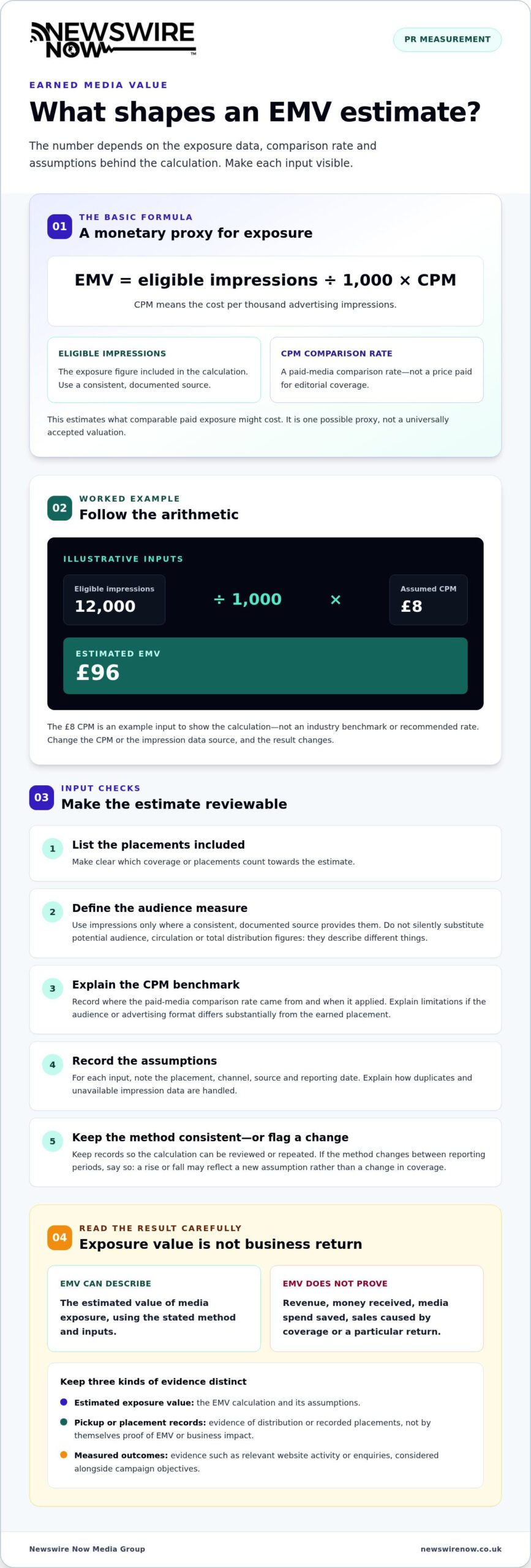
A common starting point is an exposure-based estimate: EMV = eligible impressions ÷ 1,000 × CPM. CPM means the cost per thousand advertising impressions. This approach estimates what comparable paid exposure might cost; it doesn’t establish what a placement is worth under a universal standard. When considering what is earned media value in practice, treat the formula as one possible proxy and make its assumptions visible.
For a clearly illustrative calculation, imagine a placement with 12,000 eligible impressions and an assumed CPM of £8. The calculation is 12,000 ÷ 1,000 × £8, giving an estimated EMV of £96. The £8 CPM is an example input to demonstrate the arithmetic, not an industry benchmark or recommended rate. Change the CPM or the source of the impression data and the result changes.
Which data belongs in an EMV estimate?
Start by listing the placements included, then define the audience measure used for each channel. Use impressions only where a consistent, documented source provides them. Don’t silently substitute potential audience, circulation or total distribution figures, as those measures describe different things. For each input, record the placement, channel, source, reporting date and assumptions, including how duplicates or unavailable impression data are handled.
CPM is a comparison rate for a thousand advertising impressions, not a price paid for editorial coverage. Select a relevant paid-media comparison and document where its rate came from and when it applied. If the audience or advertising format differs substantially from the earned placement, explain that limitation rather than presenting the comparison as exact. Resources such as Earned Media Value: How To Calculate and Interpret EMV Data can provide further context on calculation approaches, but your report should state the method you actually use.
How should teams make the calculation transparent?
Put the formula and its inputs beside the result. Readers should be able to see which placements count, where the impressions came from, which CPM was applied and what the estimate excludes. Keep the underlying records so the calculation can be reviewed or repeated. If the method changes between reporting periods, flag the change. Otherwise, an apparent rise or fall may reflect a new assumption rather than a change in coverage.
Disclose your methodology whenever you publish EMV, including the data sources, comparison rate and assumptions behind the estimate.
Keep three evidence types distinct: estimated exposure value, verified pickup or placement counts, and independently measured outcomes such as relevant website activity or enquiries. A pickup report can document reported distribution results, but it does not automatically supply eligible impressions or establish business impact. Clear press release distribution reporting can help teams organise placement evidence as one input, while the EMV calculation and outcome measures remain separately identified.
Earned media value versus AVE, reach, and actual business impact
PR reports can place several measures side by side, but each answers a different question. EMV assigns an estimated advertising equivalent to exposure. Reach describes the audience potentially exposed, while engagement records responses such as clicks, comments or shares. Business outcomes look further downstream, at evidence such as changes in awareness, enquiries or sales. Understanding what is earned media value in relation to these measures helps prevent an estimate being presented as proof of commercial return.
Use each metric for what it can show, and state the method behind it. Terms and formulas can overlap between organisations, especially for EMV and advertising value equivalency (AVE). A comparison is useful only when the report defines its terms.
| Measure | What it indicates | What it doesn’t establish on its own |
|---|---|---|
| EMV | An estimated advertising equivalent for earned exposure, based on a stated method. | Revenue, savings or return on investment. |
| AVE | A comparison of publicity with advertising cost, often using advertising rates. | The full quality or effect of coverage. |
| Reach | The potential or estimated audience exposed to content. | Whether people noticed, understood or acted on it. |
| Engagement | Recorded interactions with content, such as clicks or comments. | Whether those interactions led to a meaningful result. |
| Business outcomes | Measured changes linked to objectives, such as enquiries or sales. | Causation without suitable attribution evidence. |
How is EMV different from advertising value equivalency?
Some organisations use EMV and AVE in similar ways, or even interchangeably. Both may compare publicity with the cost of advertising, but that comparison is not a definitive valuation. Approaches can vary in the inputs and adjustments they apply. Define the selected term, explain the formula and identify the data source in every report. This makes an estimate easier to interpret, even when another organisation uses the same label differently.
Why does EMV not prove return on investment?
Exposure is not the same as a change in awareness, behaviour, leads or sales. A coverage estimate alone cannot show that an article caused someone to enquire or buy. Assessing contribution requires relevant evidence, such as outcome data aligned with campaign objectives and a considered approach to attribution. EMV is a proxy metric, not a financial return calculation.
This distinction aligns with the broad direction of AMEC’s measurement principles: evaluate communication against objectives and look beyond activity counts and media outputs. Outputs describe what was distributed or published; outcomes concern audience response or change. A disciplined report can include EMV as one indicator, then assess it alongside relevance, sentiment, engagement and outcome evidence. This gives a clearer account of what the campaign produced and what it may have contributed to, without overstating the connection. For teams aiming to bridge publicity and bottom-line growth, performance agencies such as The Palm Group design digital communication systems structured around tangible business revenue.
How to use earned media value in a credible PR report
A credible report connects activity to purpose. Before adding an EMV figure, state what the campaign set out to achieve, then show the evidence collected and explain what it can reasonably tell you. This helps readers understand what is earned media value within the campaign, rather than treating the number as a success claim on its own.
Use a repeatable sequence:
- Set the objective. Specify the intended change, such as improving awareness with a defined audience or generating relevant enquiries.
- Present the evidence. List included coverage, its relevance to the objective, audience quality and sentiment. Separate verified placement records from modelled estimates.
- Interpret the results. Explain what the EMV indicates, what it cannot establish, and how other measures such as engagement or objective-related outcomes add context.
- Decide next steps. Identify what the evidence suggests for future communications, and note any gaps that limit the conclusion.
What should a responsible EMV report include?
Record the campaign period, placements included, calculation method, data sources and exclusions. Label modelled figures clearly and distinguish them from verified outputs such as reported placements. Put EMV beside evidence relevant to the objective, not above it as a standalone verdict. If you assess sentiment or audience quality, explain the basis so readers can understand how that evidence supports your interpretation.
A compact reporting template can keep the detail consistent:
- Metric: EMV estimate and any related coverage, sentiment or outcome measure.
- Source: Where the placement, audience or outcome evidence came from.
- Period: Campaign dates covered by the data.
- Assumptions: Calculation inputs, exclusions and any limits in comparability.
- Interpretation: What the result indicates in relation to the objective, plus the next action.
How can teams avoid misleading EMV comparisons?
Use the same channel definitions, audience measures, reporting periods and calculation method across campaigns wherever possible. If a change is necessary, disclose it and qualify any trend comparison. An estimated advertising rate is a comparison input; it doesn’t prove the coverage would have been bought as advertising or that the estimate represents money saved.
The Barcelona Principles can also prompt a more balanced evaluation by directing attention beyond activity and outputs towards outcomes and impact. Treat them as a framework for asking better reporting questions, not as a reason to inflate a proxy into proof. If placement data, audience evidence or outcome tracking is incomplete, state that limitation plainly. Consistent reporting makes results easier to interpret and gives decision-makers a sounder basis for planning.
For clearer placement evidence to support your reporting, explore press release distribution and pickup reporting.
How press release distribution fits into earned media measurement
Distribution, a recorded placement and independent editorial coverage are related, but they are not interchangeable. Distribution sends a release through selected channels. A report can then record placements or other reported distribution results. Independent editorial coverage occurs when a third-party publisher chooses to cover a story. A placement generated through distribution should not automatically be described as independently earned coverage.
This distinction matters when deciding what is earned media value. Distribution records help establish what happened to a release, but they don’t on their own supply an EMV figure. To estimate exposure value, teams need suitable audience data and a defined calculation method. To assess impact, they need relevant evidence connected to campaign objectives.
What can a press release pickup report tell you?
A pickup report documents reported placements and gives PR teams a starting point for reviewing distribution. Newswire Now Media Group provides a pickup report within 48 hours. Use it to organise placement evidence, identify where a release appeared and inform the next stage of evaluation. The report is evidence of distribution results, not an automatic measure of audience exposure or campaign value.
A placement record alone doesn’t establish readership, engagement, sentiment or business impact. For each recorded item, assess whether reliable audience data is available, whether the coverage is relevant to the intended audience and whether the story reflects the desired message. Keep those findings distinct from the pickup count, and avoid assigning an EMV where the required inputs aren’t available.
How can distribution support a broader evaluation process?
Editorial review and distribution through a media network can form part of a communications plan, while measurement assesses what followed. Newswire Now Media Group distributes through an independent network of over 40 owned publications and more than 500 trusted news outlets across 27 industry sectors and 37 professions. This describes the distribution network, not a guaranteed audience size, independent editorial coverage or EMV result. Treat the network context as one part of the activity record, then evaluate placements using the same transparent standards applied to other campaign evidence.
For practical context on distribution in the UK, explore this UK press release distribution guide. If you’re planning budgets, the press release distribution pricing guide covers the cost considerations. Neither replaces a measurement plan: define objectives, record distribution results and assess audience and outcome evidence separately.
That approach keeps reporting clear: what was distributed, what placements were recorded, what exposure can be evidenced and what outcomes were observed. If press release distribution is part of your communications plan, explore press release distribution as one input to a wider, evidence-led evaluation.
Make your next PR report more decision-ready
Before your next campaign, decide what evidence will help you judge progress. Set an objective, choose measures that relate to it and record how each result will be assessed. Then, when stakeholders ask what is earned media value, you can explain both the estimate and the wider evidence behind your evaluation.
Keep the EMV method consistent where possible, and note any changes that affect comparisons. Treat it as one lens on media exposure, not the final measure of success. Pairing clear placement records with audience and outcome evidence makes future reporting more useful for planning and decision-making.
If press release distribution is part of your communications plan, explore press release distribution and consider how its reporting can support your wider measurement approach. Build a process that gives your team clearer evidence and a stronger basis for what comes next.
Frequently Asked Questions
Is earned media value a standardised metric?
No. There’s no universally agreed EMV formula or shared set of inputs. One organisation may use impressions and CPM, whilst another adds engagement or applies multipliers. For a meaningful comparison, keep your method consistent and define it whenever you share results. When comparing an EMV figure with your own, first establish which data and assumptions produced it.
Can earned media value be negative?
Usually, EMV estimates exposure value and is zero or positive. Negative sentiment is better reported separately rather than automatically converted into a negative EMV. A bespoke scoring model could produce a negative total if it applies deductions, but that result depends on the model’s rules. Explain any deductions clearly, and don’t compare a sentiment-adjusted figure directly with an exposure-only estimate.
Does earned media value include social media mentions?
It can include unpaid, organic mentions, provided the calculation method defines them as eligible coverage and uses a suitable, consistent exposure measure. A post on your own company account is owned media, while a sponsored post is paid media, so don’t group either with organic third-party mentions without clearly labelling the difference. Record the platform and data source, and separate mention counts from impressions or engagement.
Can a small business use earned media value?
Yes. A small business can use EMV if it has a clear reason to include the estimate and can document its inputs. For example, a business assessing a product announcement could record eligible coverage and apply the same stated method to each placement. If the available data is limited, report that limitation rather than implying precision. A focused set of coverage and audience measures may be more useful than an unsupported headline figure.
How often should a business report earned media value?
Choose a reporting schedule that fits the campaign and the decisions the results need to inform. A short campaign might be assessed after coverage has had time to appear; ongoing activity may suit a regular monthly or quarterly review. Use the same reporting periods for comparisons, and note when figures are provisional. Avoid changing the cadence without explaining it, as different time windows can distort apparent performance.
Does a press release distribution placement automatically count as earned media?
No. A placement record confirms a reported distribution result, but the label depends on how the content was published. A third-party journalist’s independent editorial decision may qualify as earned coverage; a paid placement or routine republication should be identified separately. Classify each placement according to its nature and source, rather than assuming every outlet listing represents independent editorial attention.
Ready to get your story published?
Distribute your press release across 500+ trusted media outlets — with editorial review and a full pickup report within 48 hours.
Send Press Release →