
Understanding Press Release Pickup Metrics: What They Measure, and What They Don’t

A high pickup count can look impressive, but it is a distribution signal, not proof of meaningful media impact. Understanding press release pickup metrics starts with asking what each reported placement represents: a syndicated republication, original editorial coverage or evidence that an audience actually saw and engaged with the news.
If reports use different labels, counting methods or measurement windows, comparing campaigns can quickly become confusing. When you need to demonstrate communications results, show what the figures support without claiming more than they prove.
This article explains how to interpret pickup counts and rates using clear, consistent definitions. You’ll learn to distinguish distribution from earned coverage, audience exposure and engagement, and see why a placement count alone cannot tell the whole story. We’ll also look at how to compare reports fairly, present results accurately and identify useful next measures, such as referral traffic, meaningful links or audience response.
Key Takeaways
- Understanding press release pickup metrics means checking whether a report counts placements, outlets or individual publication instances.
- Separate syndicated release placements from independently reported coverage: they represent different outcomes.
- Choose measures that match your campaign objective, from distribution and awareness to engagement or action.
- Review each reported entry against its outlet, publication link, date and stated counting rules before drawing conclusions.
- Use the findings to refine your next release’s objectives, messaging and tracking, then assess results with a clear pickup report.
Understanding press release pickup metrics: what does a pickup count mean?
A press release pickup is a record that an outlet has published or carried content from a release. The term describes a distribution outcome, but there is no universal counting rule. A report might count distinct outlets, individual placement instances or both. For example, one outlet publishing the same release on two pages could appear as one outlet but two placements, depending on the reporting method.
A pickup count shows how many placements or outlets met the report’s counting rules; it does not prove that people read, understood or acted on the release. A published item establishes that content appeared in a reported location. It does not, by itself, establish readership, editorial scrutiny or audience response. Understanding press release pickup metrics means checking what sits behind the headline figure before using it to assess a campaign.
Pickup count versus pickup rate: what is the difference?
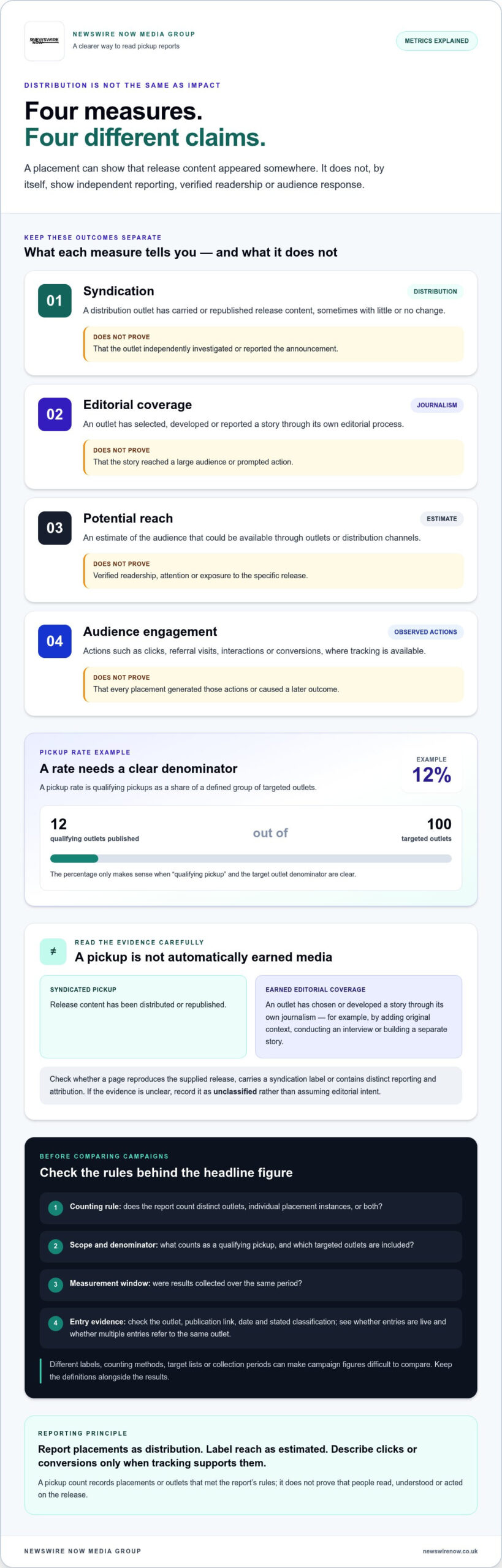
A pickup count is the total number of reported pickup instances under the report’s stated rules. A pickup rate expresses qualifying pickups as a share of a defined group of targeted outlets. If 12 qualifying outlets publish a release out of 100 targeted outlets, the rate is 12%. That figure only makes sense if “qualifying pickup” and the target outlet denominator are clear.
Compare campaigns only when their scope, denominator and measurement window match. One report may count every syndication placement, whilst another counts distinct outlets or only selected coverage. A wider target list or longer collection period can also change the result. Record these definitions alongside the figures instead of treating pickup rates as directly comparable by default.
What can a press release pickup report include?
Depending on the reporting method, a pickup report may list outlet names, publication links, timestamps and placement classifications. These details help you check where content appeared, when it was recorded and how the entry was categorised. Some reports group or summarise placements, so the headline total may need context before you compare it with another campaign.
Reporting contents and counting methods differ between distribution services. Check whether each entry links to a live publication, whether multiple entries refer to the same outlet and what the classifications mean. For a closer look at reading individual entries, see this press release pickup report guide. A general overview of a Press release also explains its purpose and common distribution formats, helping distinguish the release itself from the placements it generates.
How pickup, syndication and earned media coverage differ
A placement can show that release content appeared on a site, but not how it got there or what readers did next. Separate four measures before judging a campaign: syndication, editorial coverage, potential reach and audience engagement. They describe different stages and are not interchangeable proof of impact.
| Measure | What it indicates | What it doesn’t prove |
|---|---|---|
| Syndication | A distribution outlet has carried or republished release content, sometimes with little or no change. | That the outlet independently investigated or reported the announcement. |
| Editorial coverage | An outlet has selected, developed or reported a story through its own editorial process. | That the story reached a large audience or prompted action. |
| Potential reach | An estimate of the audience that could be available through outlets or distribution channels. | Verified readership, attention or exposure to the specific release. |
| Audience engagement | Observed actions, such as clicks, referral visits, interactions or conversions, where tracking is available. | That every placement generated those actions or caused a later outcome. |
A syndicated pickup records the distribution of release content; earned editorial coverage is a story an outlet has chosen or developed through its own journalism. A published release and an independently reported article are distinct outcomes, even if both appear on a news site.
Does press release pickup count as earned media?
Not automatically. Republication through a distribution network is a pickup, but it is not evidence on its own of independent reporting. Earned coverage involves editorial selection or journalism, such as a reporter adding original context, conducting an interview or building a separate story around the announcement.
Classify each placement using the evidence available. Check whether the page reproduces the supplied release, carries a syndication label or contains distinct reporting and attribution. If the evidence is unclear, record the entry as unclassified rather than assuming editorial intent. This makes the results more credible.
Pickup versus impressions, clicks and engagement
A pickup confirms publication under the report’s counting rules. An impression figure is usually an estimate of possible or recorded content exposure, depending on its source and method. Neither confirms that a person read the item. Clicks and referral sessions show observed visits when captured by suitable analytics; conversions require appropriate tracking and a defined action.
Keep the measures separate in campaign reporting. Report placements as distribution, label reach as estimated, and describe clicks or conversions only when tracking supports them. Understanding press release pickup metrics this way helps distinguish visibility opportunities from verified audience behaviour. For a campaign built around editorial review and trackable distribution outcomes, explore editorially reviewed press release distribution.
Which press release metrics matter for your campaign objective?
Start with the outcome the release was meant to support. A campaign designed to confirm broad distribution needs different evidence from one intended to increase awareness, attract relevant website visits or generate enquiries. A metric is meaningful only when interpreted against the campaign objective it was chosen to measure. Understanding press release pickup metrics means selecting measures that answer a specific question, then reporting their limits alongside the result.
| Campaign objective | Metric | What it indicates | Key limitation |
|---|---|---|---|
| Distribution | Qualifying pickups and outlet placements | Where release content was published under the stated counting rules | Doesn’t confirm readership or editorial reporting |
| Awareness | Relevant outlet coverage and estimated reach | Publication context and potential exposure to an audience | Reach is an estimate, not verified attention or readership |
| Engagement | Tracked link activity and referral sessions | Whether users clicked through and visited a campaign page | Requires suitable link tagging and analytics; a visit doesn’t prove deeper interest |
| Action | Tracked conversions, such as completed enquiries | Whether a defined action followed a measurable visit | Attribution depends on tracking and doesn’t establish that the release alone caused the action |
How should awareness-focused campaigns be measured?
Review relevant outlet placements, the context in which the release appeared and the fit between each outlet and the intended audience. A placement in a relevant publication may be more useful for an awareness objective than a larger count across less suitable outlets. Treat estimated reach as potential exposure, not confirmed readership. Record the measurement window and estimation method so future comparisons use the same basis.
How should engagement and response be measured?
For response-focused campaigns, use tagged links and website analytics to identify referral activity attributable to those links, where possible. Assess whether visits reached relevant pages or led to a defined action, such as a completed enquiry. Configure measurement before distribution, and document what counts as a conversion. Don’t attribute every later website action to the release without supporting tracking evidence.
Keep the reporting proportionate: present pickup figures for distribution, relevant placements and estimated reach for awareness, and tracked user actions for engagement or response. If a measure wasn’t configured or can’t be verified, identify that limitation rather than filling the gap with an assumption.
How to analyse a press release pickup report step by step
A report becomes useful when its entries can be checked and interpreted against a clear campaign aim. Follow the same review sequence each time, keeping the counting rules visible throughout. This makes it easier to explain what the figures show, identify uncertain placements and compare like with like.
- Confirm the objective. Decide whether the release was intended to achieve distribution, awareness, engagement or a specific action. This determines which results are relevant.
- Define the metrics. Record what counts as a pickup, whether totals refer to placements or distinct outlets, the denominator for any rate and the observation period.
- Review each placement. Check the outlet identity, publication link and date. Note whether the page carries the release, appears to be an editorial story or cannot be classified from the available evidence.
- Interpret the results. Separate confirmed entries from ambiguous ones, then assess the findings against the original objective. Compare campaigns only when their definitions, target lists and measurement windows are consistent.
How to check and classify reported placements
Open each listed publication page and confirm that the release or relevant coverage is visible. Look for repeated URLs, multiple copies of the same syndicated item and entries that cannot be independently verified. Classify each record as a confirmed pickup, an editorial story or unclear. Keep ambiguous entries in the analysis, but don’t quietly include them in a confirmed total.
Apply the report’s counting rules consistently. For example, repeated copies might count as separate placement instances if that is the stated method, but they should not be presented as distinct outlets. Understanding press release pickup metrics depends on preserving this distinction and documenting exceptions, rather than relying on a headline number alone.
How to communicate findings without overstating results
In your summary, state the metric definition, denominator, date range and report source alongside each result. Present pickup totals separately from earned editorial coverage, estimated reach and measured engagement. If a link is unavailable or a placement’s status is uncertain, say so. This gives colleagues a clear basis for reviewing the result and avoids implying that publication confirms readership or impact.
For practical advice on connecting release activity with measurable outcomes, read the press release performance tracking guide. To support a more accountable distribution process, explore press release distribution and pickup reporting.
Use pickup metrics to assess distribution value and plan the next release
A pickup report is most useful when it informs a decision, not just a retrospective total. Review the placements against the release’s original objective, then identify what to retain or adjust. If distribution reached relevant outlets but generated little tracked website activity, the next step might be to review the call to action or link tracking, rather than assuming the placements had no value.
Use the evidence to refine one or more campaign elements:
- Objective: define whether the next release is intended to build distribution, awareness, engagement or response.
- Audience relevance: assess whether the outlets and sectors align with the people you need to reach.
- Messaging: review whether the announcement and supporting details give the intended audience a clear reason to pay attention.
- Measurement: configure tagged links and analytics before distribution if you need to assess referral activity or conversions.
What a transparent distribution report should help you understand
A useful report identifies the placements counted and provides publication details you can review, such as outlet names, links and dates. It should also make the reporting period, coverage scope and counting conventions clear enough for you to interpret the total. That evidence helps explain where release content appeared. It does not, by itself, establish that readers saw or engaged with it.
Newswire Now Media Group distributes releases through an independent network of more than 40 owned publications and more than 500 trusted news outlets across 27 industry sectors and 37 professions. Clients receive a pickup report within 48 hours. Network scale provides distribution context, whilst the report helps make the resulting placements visible for campaign assessment. Editorial review and clear reporting support a more informed evaluation of what distribution achieved, without treating placement volume as a measure of audience response.
How to apply campaign findings to your next release
Keep definitions, target lists and observation periods consistent across campaigns so you can identify useful patterns rather than differences in reporting methods. Choose measures that match the intended outcome, not simply the largest available figure. For example, a campaign aimed at awareness can be reviewed for relevant placements and publication context, while a response objective calls for suitable tracking of visits or actions.
Use the UK press release distribution guide to explore distribution considerations in more detail. For a clearly reported distribution process, explore press release distribution.
Make your next campaign easier to measure
Understanding press release pickup metrics means looking beyond the headline count. Check what each placement represents, distinguish syndication from independent editorial coverage and match your measures to the campaign objective. A consistent method for reviewing reports helps you compare results fairly and decide what to refine next.
Newswire Now Media Group distributes through more than 500 trusted news outlets across 27 industry sectors, alongside an independent network of more than 40 owned publications reaching millions of readers worldwide. Clients receive a pickup report within 48 hours. These figures provide distribution context; they do not prove that every placement received attention or generated engagement.
Use clear reporting to assess where your release appeared, then pair pickup data with suitable audience or website measures when available. Explore Newswire Now Media Group press release distribution and make your next campaign easier to assess. With consistent definitions and realistic measures, you can report results accurately and plan with confidence.
Frequently Asked Questions
What does press release pickup mean?
A press release pickup means an outlet has published or carried content from a release. Reports may count distinct outlets, individual publication instances or both, depending on their rules. A pickup confirms that content appeared in a reported location, but it doesn’t establish that the outlet created an original story or that anyone read the release. Check how the report defines a pickup before interpreting its total.
How is press release pickup rate calculated?
Calculate pickup rate by dividing qualifying pickups by the defined number of targeted outlets, then multiplying by 100 to express the result as a percentage. For example, 12 qualifying pickups from 100 targeted outlets equals a 12% rate. State what qualifies as a pickup, which outlets form the denominator and the measurement period. Without those details, the rate can be misleading and difficult to compare with another campaign.
Is press release pickup the same as media coverage?
No. A pickup may be a syndicated or republished release, whilst media coverage can refer to an outlet’s independently developed reporting. An outlet carrying supplied release content doesn’t automatically mean a journalist investigated or created a story. Review the published page to classify the result: does it reproduce the release, or does it add original reporting, context or interviews? Record unclear entries as unclassified rather than assuming editorial intent.
Can a high pickup count prove that people read a press release?
No. A high pickup count shows that many placements or outlets met the report’s counting rules, not that readers viewed or engaged with the release. Potential reach figures estimate an opportunity for exposure, rather than confirming readership. To assess audience behaviour, use available evidence such as tracked link clicks or referral sessions. Treat those as separate measures, and only report actions that your measurement setup can support.
What is a good press release pickup rate?
There’s no single pickup rate that’s good for every campaign. The result depends on the target outlet list, what the report counts as a qualifying pickup and how long placements are measured. Set a clear objective and compare the rate with previous campaigns only when the scope, denominator and observation period are consistent. A lower rate among highly relevant outlets may serve an objective better than a larger, less targeted figure.
How do you measure press release performance beyond pickup?
Choose additional measures that match the campaign objective. For awareness, review relevant outlet placements and treat estimated reach as potential exposure. For engagement, use tagged links and analytics to assess attributable clicks and referral sessions. For action, track defined outcomes such as completed enquiries. Understanding press release pickup metrics also means keeping these results distinct: a placement, an estimated impression, a website visit and a conversion represent different kinds of evidence.
What should I check in a press release pickup report?
Check the outlet name, publication link, date and any classification for each entry. Confirm that the release or relevant coverage is visible, note repeated URLs or syndicated copies, and identify entries you can’t verify. Then review the report’s counting rules, coverage scope and measurement window. Understanding press release pickup metrics requires reporting confirmed and ambiguous placements separately, so the final total accurately reflects the evidence rather than assumptions.
Ready to get your story published?
Distribute your press release across 500+ trusted media outlets — with editorial review and a full pickup report within 48 hours.
Send Press Release →