
UK Small Business Press Release Distribution Guide

A wide distribution list can look impressive without showing who actually published your announcement. For a small firm, press release distribution for small business UK should be judged by audience fit, the placements delivered and the reporting provided, not by a headline reach figure alone.
With limited time and budget, it’s understandable to want a clear return from a one-off announcement. The first step is to understand what you’re buying: guaranteed placements can provide a defined route to publication, but they aren’t the same as independent editorial coverage chosen by a journalist.
This guide compares distribution options, explains how to interpret placement and pickup reports, and helps you match a service to your announcement and intended audience. Newswire Now Media Group distributes releases through more than 40 owned publications and more than 500 trusted news outlets, with editorial review and a pickup report within 48 hours. The following sections explain what those figures and guarantees mean, so you can make a measured decision rather than rely on vague reach claims.
Key Takeaways
- Choose press release distribution for small business UK by matching the announcement to the audience and sectors you want to reach.
- Compare services on audience fit, editorial review, placement terms and the detail their reporting provides.
- Use a practical readiness checklist to sharpen your news angle, verify details and make the announcement relevant to readers.
- Assess results by looking beyond headline reach to the placements and pickup information you can actually review.
- See how a one-off distribution service can support a specific announcement without committing to an ongoing approach.
Press release distribution for small business UK: what it delivers, and what it does not
Distribution is the process of sending a prepared announcement through a service’s media network. It puts your news into circulation, but it doesn’t mean every recipient will publish it or that a journalist will develop it into a separate story. Understand the distinction before setting an objective or spending time and budget on press release distribution for small business UK.
A press release is a structured way to share news with media and other audiences. For background on its traditional purpose and format, see What is a Press Release? Distribution, pickup and independent coverage describe different outcomes:
- Distribution: A service sends your prepared release through its network.
- Publication pickup: A publication carries or republishes the release, subject to the service’s placement terms.
- Independent journalist coverage: A journalist decides whether the news merits reporting and may create a separate story.
At a glance: A distribution service sends a prepared announcement through a stated network. Depending on its terms, it may also provide specified placements and a report. Distribution alone doesn’t guarantee independent editorial coverage, audience engagement or sales.
Which small-business announcements may be suitable for distribution?
A product launch, senior appointment, business expansion or significant company milestone may warrant distribution when it gives readers a clear reason to pay attention. Explain what has changed, who is affected and why the timing matters. This gives editors useful context and helps readers understand more than the fact that a business has something new to sell.
Routine discounts and general promotional copy usually offer less substance than a genuine update. Avoid unsupported claims such as being “the leading” provider unless you can substantiate them. A useful test is whether someone outside the business would learn something timely and specific from the announcement. If the answer is no, refine the angle before sending it.
What does press release distribution actually provide?
Sending a release creates an opportunity for visibility through the channels in a service’s network. Pickup means a publication has carried the release or an agreed version of it; the exact result depends on the placement terms. An independent journalist, by contrast, decides whether to investigate, quote or report on the news. A distribution report can show what was picked up, but it doesn’t by itself tell you how readers responded.
Distribution reach is access to channels; independent editorial endorsement is a separate decision made by a journalist. Keep that distinction in view when assessing results. A release may be distributed and published without attracting meaningful attention, enquiries or sales. Set a realistic objective, then interpret placements alongside the business outcome you hoped to achieve, rather than treating circulation or pickup alone as proof of impact.
How to assess a UK press release distribution service for a small business
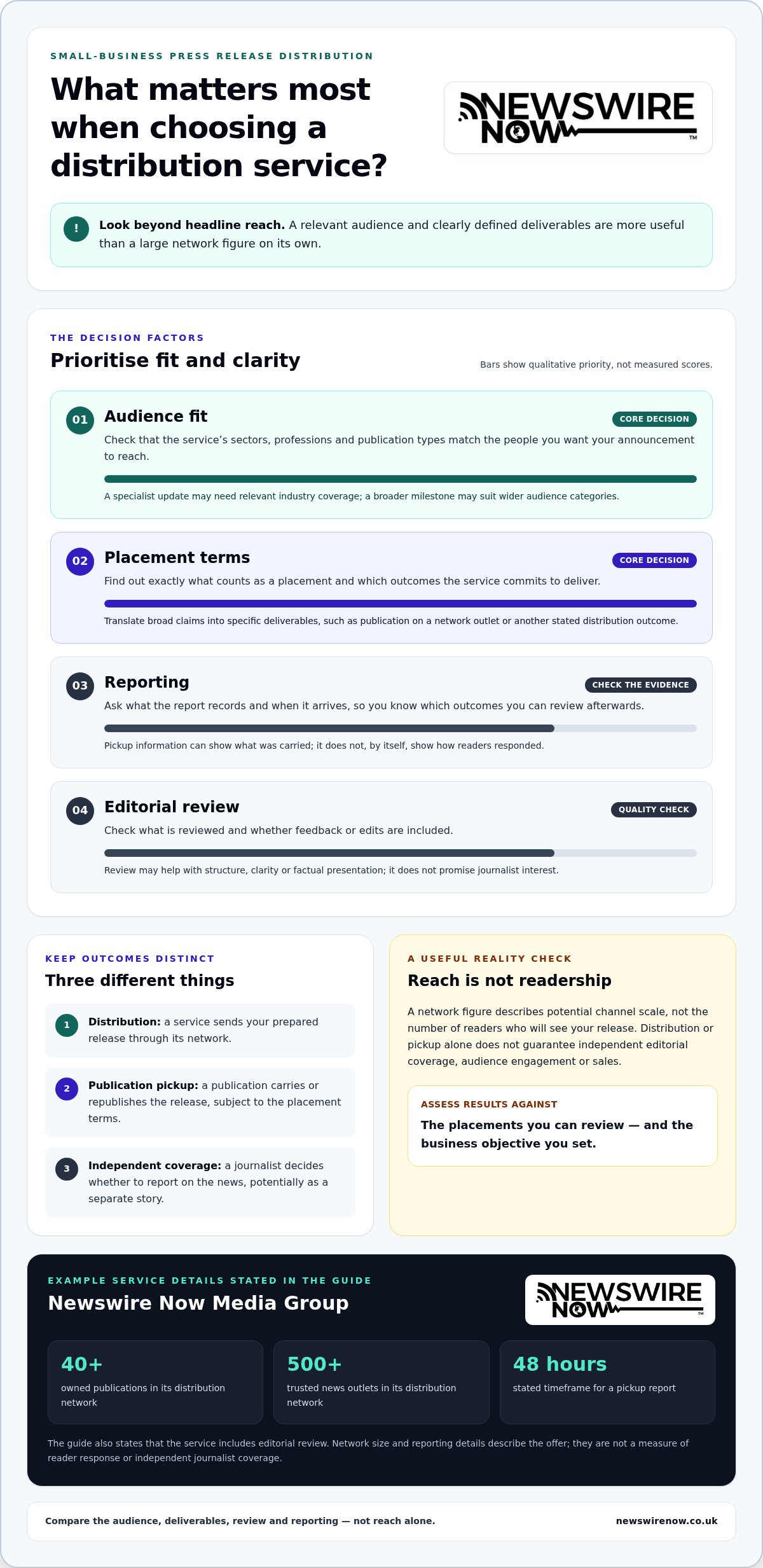
Start your comparison with the job the service is meant to do. For press release distribution for small business UK, an audience that fits your announcement and clear deliverables matter more than a large reach figure on its own. Use the questions below to compare services on practical terms.
| What to assess | What to look for | Why it matters |
|---|---|---|
| Audience fit | Relevant sectors, professions and publication types | Helps connect the announcement with readers likely to care about its subject |
| Editorial review | What is reviewed, and whether feedback or edits are included | Can help identify clarity or presentation issues before distribution |
| Placement terms | What counts as a placement, and which outcomes are specified | Clarifies what the service is committing to deliver |
| Reporting | What the report records and when it arrives | Shows which distribution outcomes can be assessed afterwards |
Which distribution features matter most to a small business?
Begin by matching the network to the announcement. A specialist product update may suit a network with relevant industry coverage; a broader company milestone may call for wider audience categories. Review the sectors and professions named by a service, then compare them with the people you want to reach. The Chartered Institute of Public Relations’ professional resources offer a useful reference point for PR practice.
Editorial review is a quality-control step, not a promise that journalists will take an interest. Check whether the review covers structure, clarity or factual presentation. Then consider frequency: a single distribution can suit one defined announcement, whilst a multi-release bundle may fit a business with several planned updates. Avoid paying for an ongoing commitment that doesn’t match your publishing plans.
How should a business judge reach and reporting claims?
Translate broad claims into specific deliverables. Check what “placement” means in the service’s terms: for example, whether it refers to publication on a network outlet or another defined distribution outcome. A large network figure describes potential channel scale, not the number of readers who will see your release. Similarly, a pickup report records reported distribution outcomes; it doesn’t necessarily measure readership, engagement or conversions.
Check what the report identifies, such as the outlets where a release appeared, and when it will be available. Newswire Now Media Group provides a pickup report within 48 hours, giving businesses a defined reporting point after distribution. Use the report to review delivery, then assess enquiries or other business outcomes separately with your own tracking. For a broader look at UK options and cost considerations, see the UK press release distribution and pricing guide.
Keep your comparison focused on the announcement rather than optional extras. Email marketing or social media activity may support a wider campaign, but each is distinct from core distribution. For a one-off business update, Newswire Now Media Group press release distribution provides a defined distribution service with editorial review and reporting.
Guaranteed placements versus earned coverage: what small businesses should expect
A guarantee can sound like a promise of press attention, but its meaning depends on the service’s terms. A guaranteed placement is a stated distribution deliverable. It does not automatically mean an independent journalist chose the story, endorsed its claims or produced original reporting. For small businesses assessing press release distribution for small business UK, this distinction helps separate contracted outcomes from independent editorial decisions.
Some services distribute through publications they own or directly access. In that model, a placement can be delivered through the service’s network without representing independent editorial endorsement. Earned coverage is different: a journalist or editor decides whether a story merits attention. Sending a release does not guarantee that decision.
Does a guaranteed placement mean a journalist has endorsed the story?
No. Read “guaranteed placement” according to the service’s stated terms. Identify what counts as a placement and the channel where it will appear. A guarantee can make the agreed deliverable clearer, but it should not be mistaken for a guarantee of interviews, backlinks, favourable commentary or coverage in a particular independent publication unless those terms explicitly say so.
A guaranteed placement confirms a defined distribution outcome; earned editorial coverage depends on an independent journalist’s judgement. That distinction is central to a sound buying decision. Newswire Now distributes through its own publication network as well as trusted outlets, so placements through owned publications represent a direct distribution channel, not independent endorsement.
A release still needs a credible, timely angle and a clear fit with its intended audience. Distribution can put an announcement in circulation, but it cannot make routine sales copy newsworthy or ensure that readers engage with it. The UK Government’s business support publication provides context on the wider small-business environment; it is separate from any promise about media placements or coverage.
What can a pickup report prove, and what can it not prove?
A pickup report records distribution outcomes reported by the service, such as placements identified after a release has circulated. It helps answer a practical question: where did the announcement appear according to the report? On its own, it cannot prove how many people read those pages, how they felt about the story or whether it influenced a purchase.
Assess wider outcomes separately. Depending on your objective, you might track referral visits to a relevant webpage, enquiries linked to the announcement or changes in sales over a defined period. These indicators need context, since other marketing activity and business conditions can also affect them. A backlink or journalist interview may be valuable, but neither follows automatically from a placement.
Meaningful distribution rests on three parts: a newsworthy announcement, a network suited to its audience and reporting that makes delivery understandable. For a defined announcement, Newswire Now’s press release distribution provides network-based placement and pickup reporting as distinct deliverables.
A practical checklist for preparing a small-business press release
A distribution service can circulate a release, but the announcement itself needs to be clear, accurate and relevant. Use this checklist before submission to catch gaps while there’s still time to correct them. It gives you a practical readiness test for press release distribution for small business UK, whether you’re announcing a launch, appointment or business update.
What should be ready before submitting a release?
Work through each point in order. If you can’t answer one confidently, resolve it before the release goes out.
- 1. Pin down the news. Write the central announcement in one sentence. Identify what has changed and why it matters now, rather than leading with general praise for the business.
- 2. Name the audience. Decide who is most likely to care: customers, industry readers, suppliers or another defined group. This helps you choose relevant wording and distribution channels.
- 3. Make the headline specific. State the main development in concise, plain language. Avoid vague claims such as “exciting news” that don’t tell the reader what has happened.
- 4. Support every claim. Check figures, dates, names, job titles, product details and comparisons against reliable source material. Remove or qualify claims that you can’t substantiate.
- 5. Confirm approval and permissions. Make sure named people and organisations are correctly identified, that quoted comments are approved and that you have permission to use any supplied material.
- 6. Explain the significance. Add enough context for someone unfamiliar with your business to understand why the update matters. Define specialist terms, and replace jargon with straightforward language where possible.
- 7. Check the practical details. Verify contact details and ensure the person listed can respond to relevant enquiries. Give the release a final read for clarity, consistency and avoidable errors.
For further guidance on choosing an approach and understanding the distribution process, use this UK press release distribution service guide alongside your preparation checklist.
How can a small business use distribution results afterwards?
Once distribution is complete, compare the pickup report with the audience and objective you set before submission. Note which reported placements appear relevant to your intended readers, and record the date, announcement and outcome in a simple campaign log. This makes it easier to compare future releases consistently, rather than relying on memory or a single headline reach figure.
Keep distribution outcomes separate from business results. A reported placement doesn’t prove that readers visited your website, made an enquiry or bought from you. Track those measures independently, using suitable website analytics or enquiry records where available. If you share the announcement on your own channels, this guide to amplifying news on social media offers ideas for extending its visibility.
When the release is checked and ready, submit your press release for distribution with a clear announcement and audience in mind.
How Newswire Now supports small-business press release distribution in the UK
For a business with a prepared, timely announcement and a defined audience, Newswire Now provides a direct route into a media network, supported by editorial review and pickup reporting. Its distribution network includes more than 40 owned publications and more than 500 trusted news outlets, spanning 27 industry sectors and 37 professions. These details help small businesses consider sector relevance alongside broad visibility, rather than relying on a reach claim alone.
Owned publications are part of the distribution channel, not evidence of independent editorial endorsement. The service also includes guaranteed placements, which should be understood according to the stated placement terms. These deliverables are distinct from separate coverage independently chosen and developed by a journalist.
What does Newswire Now’s distribution process include?
The process follows a clear sequence:
- Submit: Provide a press release prepared by your business. Newswire Now distributes client-prepared releases and does not write them.
- Editorial review: The release receives an editorial review before distribution, supporting a clearer, more professional announcement.
- Distribution: The release is distributed through the network of owned publications and trusted news outlets, with guaranteed placements included as a service deliverable.
- Pickup report: A report is provided within 48 hours, giving you a record of reported distribution outcomes to assess after the release has circulated.
This sequence separates the work involved: your business supplies the announcement, editorial review supports its presentation, distribution puts it into the network, and the report documents outcomes. Use the report to review delivery, not as proof of audience engagement or sales.
When may this service fit a small business?
A one-time distribution can suit a business with a specific reason to share news, such as a launch, expansion or significant company update. It offers a defined route for a prepared announcement without requiring the business to plan a continuing release schedule. Before submission, consider whether the network’s sectors and professions align with the people you want the announcement to reach.
Newswire Now’s owned publications provide a direct distribution channel, while the wider network extends distribution to trusted outlets. Editorial review and a pickup report within 48 hours provide process and reporting points to assess alongside the announcement’s purpose. As with any distribution approach, placements don’t guarantee independent journalist coverage, reader response or commercial results.
Newswire Now also states that its service includes a money-back guarantee. Review the applicable terms to understand how that guarantee works. If you have a release ready and a clear distribution objective, submit a press release for distribution.
Turn your next announcement into a clear next step
Before moving ahead, decide what you want this announcement to help your business achieve. A sharper profile with a particular audience, attention around a company milestone or a route to relevant enquiries each calls for a different measure of success. Set that objective before distribution, then use what you learn to shape future communications.
That focus makes press release distribution for small business UK a considered business decision, rather than a one-off attempt to generate attention. Start with news you can stand behind, choose an approach that fits its purpose and keep track of the outcomes that matter to your business. Each release can give you a clearer basis for deciding what to communicate next.
If you have a prepared announcement and a defined reason to share it, submit your press release for distribution. Take the next step with a clear objective and confidence in your message.
Frequently Asked Questions
How does press release distribution work for a small business in the UK?
A business prepares its announcement, chooses a distribution service and submits the release with the information needed to process it. For example, a firm announcing a new service might identify the relevant industry audience and ensure its spokesperson’s contact details are current. The service then follows its review and distribution process. Afterwards, use its report to understand what was delivered, not as a complete measure of how the announcement performed.
Is press release distribution worth it for a small business?
It can be worthwhile if you have timely news and want to reach beyond your existing channels. Before committing, set a specific objective: for example, make trade audiences aware of a product launch or give prospective partners a clear update about an expansion. Then decide how you’ll assess progress, such as relevant enquiries or visits to a dedicated webpage. Press release distribution for small business UK is a better fit when those goals justify the effort and the service’s deliverables support them.
What does guaranteed press release placement mean?
It means the service promises a placement as defined in its terms; it doesn’t automatically mean a journalist has independently selected or endorsed your announcement. Before submitting, understand what format or channel qualifies, how the placement will be identified and what evidence you’ll receive. Keep a copy of the agreed terms alongside the report. This gives you a clearer record of the service deliverable without assuming it will generate readership, enquiries or commercial results.
How quickly will I receive a press release pickup report?
Timing depends on the distribution service. Newswire Now provides a pickup report within 48 hours. Once you receive it, save the report with the release and note any follow-up activity that may relate to the announcement. If you’re measuring website response, you could use a tagged link to distinguish visits associated with the release from other traffic. Interpret those analytics separately: a report and website data measure different aspects of performance.
Can a small business distribute a press release without hiring a PR agency?
Yes. A business can prepare its own announcement and submit it directly to a distribution service without appointing an agency. Assign one person to check the final version, approve any quotes and manage follow-up enquiries so responsibilities are clear. Editorial review may help with the release’s presentation, but it isn’t the same as writing the announcement or planning a broader PR strategy. Choose the level of support that matches your team’s skills and objectives.
What should I look for in a UK press release distribution service?
Prioritise a service whose audience is relevant to your announcement, whose process is easy to understand and whose reporting tells you what happened after submission. A specialist business update may need a different audience from a general company milestone. Compare the stated deliverables, review how the service defines a placement and consider whether its reporting is useful for your next decision. That practical fit is more informative than choosing on a headline reach claim alone.
Ready to get your story published?
Distribute your press release across 500+ trusted media outlets — with editorial review and a full pickup report within 48 hours.
Send Press Release →