
Tech company press release distribution pricing and media reach

The widest distribution isn’t automatically the best-value choice. The cost of tech company press release distribution depends on factors such as target markets, media reach and the scope of distribution; the price is determined for the individual campaign and provided after a quote request. A focused campaign can be more relevant than paying for broad reach that misses the people you need to reach.
It’s understandable to want a clear cost before committing, but price is only part of the decision. The right distribution approach should put your announcement in front of media that cover your technology, business stage and target audience, whether you’re seeking local attention or international visibility.
This article explains how distribution works, what shapes its cost and how to select channels for a technology announcement. You’ll also learn how to make the news relevant to journalists and how distribution can support broader visibility for your company.
Key Takeaways
- Match your distribution target to the technology, company stage and audience you need to reach, rather than defaulting to broad coverage.
- Build a campaign around the announcement’s news value, intended markets and chosen channels; these factors shape the distribution cost.
- Use newswire distribution to establish reach, then support it with relevant journalist outreach and your own channels.
- Assess a service by how it handles editorial review, distribution and pickup reporting, not just by the breadth of its network.
- Use press releases to communicate launches, funding, partnerships and other substantiated milestones, with a clear angle for technology media.
How can startups reach relevant technology media?
Start with the people most likely to understand the announcement: journalists covering your technology, company stage and target market. Combine distribution with focused outreach and owned channels to build visibility across relevant audiences.
Newswire, outreach and owned channels
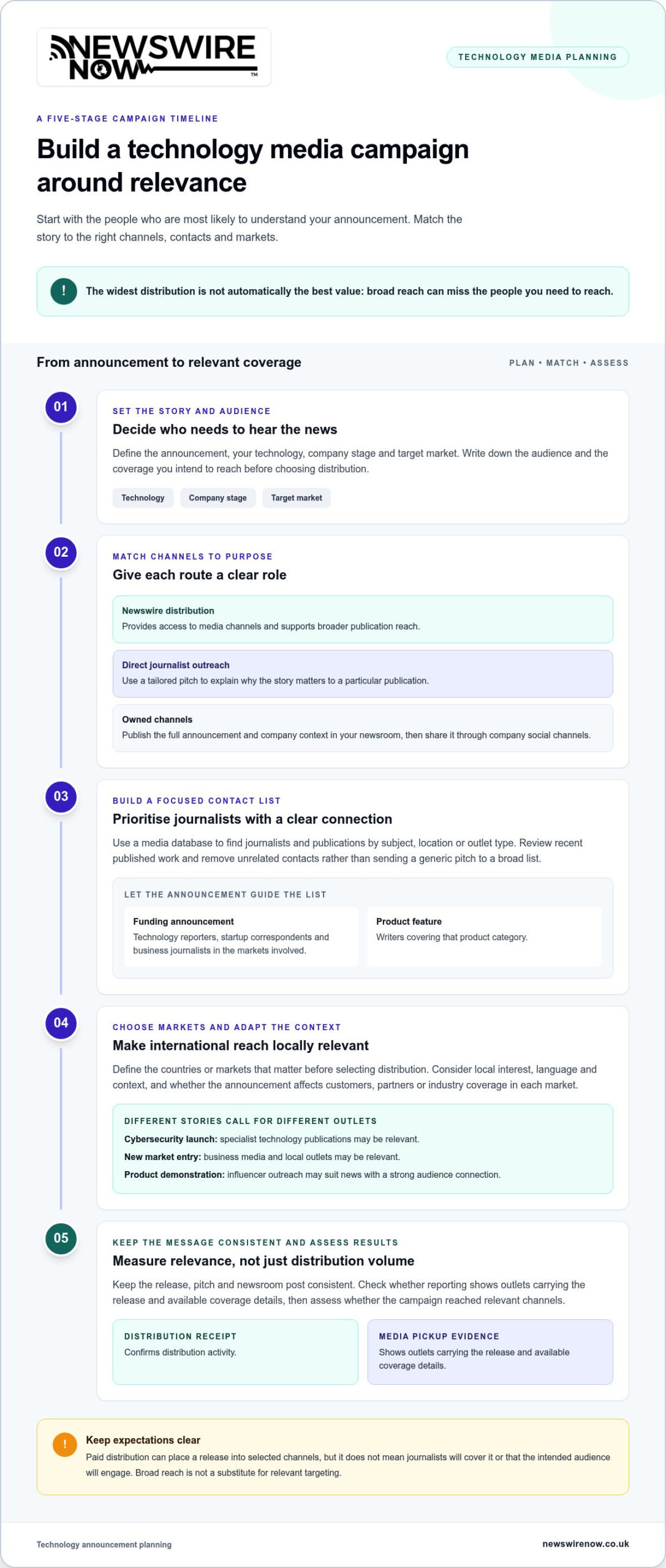
A newswire distributes an announcement across media channels, while direct outreach gives journalists a reason to consider its story. Use both for different purposes: distribution provides access to outlets, and tailored pitches explain why the news matters to a particular publication. Then publish the announcement in your newsroom and share it through company social channels.
Choose channels by audience, not by volume. For example, a cybersecurity launch may suit specialist technology publications, whilst a new market entry may interest business media and local outlets. Use owned channels to provide the full announcement, product context and relevant company information. Keep the message consistent across the release, pitch and newsroom post.
Media databases and campaign contact lists
A media database provides a way to identify journalists and publications by subject, location or outlet type. Its size alone doesn’t show whether its contacts suit your campaign. Review whether the list includes reporters covering your technology, startup news and relevant business topics, then narrow it to contacts with a clear connection to the announcement.
Build a campaign list around the story. For a funding announcement, that could mean technology reporters, startup correspondents and business journalists in the markets involved. For a product feature, prioritise writers covering that product category. Check each contact’s recent published work before pitching, and exclude unrelated names rather than sending a generic message to a broad list.
Global newsroom and influencer reach
For international visibility, define the countries or markets that matter before choosing distribution. A campaign can extend beyond UK media, but relevance still depends on local interest, language and context. Consider whether the announcement affects customers, partners or industry coverage in each target market, and adapt the explanation for those audiences.
Newsrooms, specialist publications and relevant influencers offer distinct routes to attention. A newsroom gives reporters a direct place to find the announcement; an industry publication reaches readers focused on a specific field. Influencer outreach may suit news with a strong audience connection, such as a useful product demonstration. Treat each route as a targeted choice, not an automatic part of every campaign.
Before distribution, write down the audience, target markets and intended coverage. Match each to a channel: newswire distribution for broader publication, direct outreach for selected journalists, and owned channels for a reliable reference point. This plan makes it easier to assess whether the coverage reached the people your company intended to reach.
How much does a press release distribution cost?
There isn’t one fixed price for every campaign. The cost depends on the package and distribution scope. Newswire Now Media Group offers one-off press release distribution and discounted multi-release bundles for businesses purchasing credits in advance. Compare what each option includes, such as editorial review, guaranteed placements and pickup reporting, to understand the value.
For financial or investment information, keep figures accurate, substantiated and presented with enough context to avoid misleading readers. Distinguish confirmed results from forecasts, and have the announcement reviewed by the appropriate company decision-makers before distribution.
Paid distribution can place a release into selected channels, but it doesn’t mean journalists will cover it or that the intended audience will engage. Risks include paying for broad reach that doesn’t match your target market, unclear distinctions between distribution and editorial coverage, and reporting that doesn’t show meaningful pickup.
Packages and pricing factors
Packages can differ in media categories and distribution channels. A campaign focused on UK technology publications has a different scope from one targeting multiple markets and industry sectors. Compare the outlets and coverage included, and whether the distribution suits your intended audience.
For a company with several announcements planned, a multi-release bundle may suit its schedule better than a one-off campaign. Assess how many releases you need, whether they share an audience, and whether each needs distinct targeting. Choose based on the overall campaign scope, not simply the headline package description.
Add-ons and reporting
Additional costs can arise when a package includes services beyond distribution. Newswire Now Media Group offers editorial review with distribution, as well as supplementary digital marketing services such as email marketing, social media management and online reputation management. Review the package details to understand which services are included.
Reporting matters because a distribution receipt and evidence of media pickup answer different questions. Ask what the report records, such as outlets carrying the release and available coverage details. This helps you judge whether the campaign reached relevant channels, rather than relying only on a large contact list or distribution total.
Spotting unclear fees
Before choosing a package, request a written breakdown of the distribution scope and any add-ons. Look for separate charges tied to market selection, localisation, editorial handling or reporting. Check whether the stated reach describes distribution destinations or expected editorial coverage; these are not interchangeable outcomes.
Set the campaign brief first: identify the audience, markets, announcement and reporting needs. Then compare the quoted scope against that brief. If you’re assessing press release distribution options, focus on the services included and the channels selected, not an unsupported promise of journalist attention.
How press release distribution services work
A distribution service takes a prepared announcement and sends it through selected channels to relevant outlets. Compare its audience targeting, editorial handling, reporting and campaign support before deciding whether it fits your needs.
Comparing service capabilities
Start by mapping the service to your campaign. Check which industries, locations and outlet types it can target, then ask how it handles submission, review, distribution and pickup reporting. For example, a UK software launch may need technology and business outlets, not a general list of contacts.
Enterprise newswire services can support campaigns across multiple markets, while a white-label PR service lets an agency deliver distribution under its own brand. Compare the route to media, reporting detail and level of campaign control. A large network matters less than whether its outlets match your audience and announcement.
Most services follow a clear sequence: prepare the release, select target markets and media categories, submit it for processing, then review the distribution results. Check how the service treats changes to the copy and whether reporting distinguishes publication from delivery. Those details help you compare capability, not just network size.
Agency or distribution platform
A technology company may use a PR agency when it needs support shaping a complex story, planning journalist outreach or managing communications around a major launch. An agency can coordinate those activities; a distribution service is better suited to sending a ready announcement through selected channels.
Choose according to the work required. For a clear product update with an approved release and defined audience, a distribution service may cover the operational need. For a sensitive partnership or market entry requiring tailored pitches, an agency can manage the wider communications effort. Some campaigns combine both approaches.
Before deciding, write down the announcement, audience and tasks your team can handle. Then identify the gap: media strategy, journalist relationships, distribution or reporting. This makes the choice practical and keeps the service aligned with the campaign rather than the company’s size.
Measuring results and media coverage
Measure distribution and editorial response separately. Track where the release was sent, which outlets published it, and whether coverage appeared in the intended technology or business media. A delivered release is not the same as a published article, so use pickup reporting to distinguish them.
For a fuller picture, compare media pickups with website traffic, views, engagement, share of voice and sentiment. A product announcement might generate relevant coverage but limited site visits; a funding story may prompt wider discussion. Record the campaign’s objective first, then assess metrics that relate directly to it.
Review results across owned channels as well as media outlets. Check visits to the newsroom announcement, social engagement and any changes in relevant audience activity. For ongoing campaigns, consistent reporting helps identify which topics and channels generate useful visibility, informing the next release without treating reach alone as success.
Benefits of press releases for tech companies
A UK tech press release should lead with a clear, factual headline and summarise who, what, when, where and why. Include the product or company context, relevant technical details, a quote that adds useful perspective, and supporting facts. This structure helps journalists understand the announcement without decoding jargon or promotional claims.
That clarity is useful when announcing a product launch, funding round, partnership, acquisition or research finding. For example, a software company introducing a new feature can explain what changed, who benefits and how the feature works. A specific news angle gives journalists a reason to assess the story, rather than treating it as a general company update.
A release can also give campaigns a consistent, factual reference point. Sales teams, partners and company spokespeople can draw on the same announcement when explaining a launch or market entry. Keep the published release aligned with product materials and executive comments; differences in claims or dates can create confusion for customers and media contacts.
Distribution can extend visibility beyond a company’s existing audience by placing news in channels relevant to its sector and market. A technology startup, for instance, may want coverage among specialist technology publications as well as business media. The benefit is targeted access to outlets, not simply a high volume of destinations.
Press releases can contribute to authority by making verified company developments accessible to journalists, customers and potential partners. Evidence matters: explain the source of a research finding, distinguish a product capability from a future plan, and attribute quotes to the speaker. A release earns credibility through specific information, not superlatives.
For international campaigns, one announcement can establish the core facts, while localised versions explain their relevance in each target market. A market entry may need context about local customers, partners or availability. Tailoring that detail helps preserve the central message while making it meaningful to audiences in different countries.
A release distribution service can support visibility, but distribution is only one part of a communications plan. Pair the published announcement with journalist outreach and owned channels, such as the company newsroom and social media. Each channel serves a different purpose: distribution broadens access, outreach develops the story, and owned content provides a direct source.
Measure the benefit against the campaign objective. For a product announcement, review relevant media pickups, website traffic and audience engagement; for a partnership, assess whether coverage explains the relationship accurately. Tracking coverage, views and sentiment helps teams identify what resonated and shape future campaigns. The practical takeaway is simple: lead with news, support it with evidence, then measure relevant outcomes.
Which UK press release services reach technology journalists and publications?
For UK technology coverage, compare services by their routes to media, sector relevance and target-market options. A broad newswire can distribute announcements across outlets, whilst specialist targeting helps focus attention on technology, startup and business publications. Direct journalist outreach adds a tailored pitch; a company newsroom gives reporters a stable place to find the published announcement.
Assess the audience behind a service’s network, not just its advertised size. A network with more than 40 owned publications reaching millions of readers worldwide offers a different route from distribution to external outlets. Another useful measure is sector coverage: a service distributing to more than 500 trusted news outlets across 27 industry sectors and 37 professions can support varied campaign targets.
Match the service to the announcement. A cybersecurity launch needs relevant technology and security coverage; a funding announcement may suit startup and business media. Before selecting a service, define the audience, markets and news angle. Then consider how the distribution route aligns with those priorities and whether pickup reporting can show which outlets published the release.
- Newswire distribution: use it to place an announcement across selected news outlets and markets.
- Targeted outreach: focus pitches on journalists whose published work relates to the story.
- Owned channels: publish the release in the company newsroom and share it through company social channels.
For international visibility, establish whether the campaign targets the UK or multiple markets. A service with international reach can extend distribution beyond UK outlets, while audience and sector targeting keep the campaign relevant. Consider how the service handles local context and whether its network includes publications suited to the countries involved.
Compare campaign scope as well as reach. A single product announcement may need one focused distribution, while a company planning separate launch, partnership and funding news may benefit from a multi-release approach. In either case, distinguish delivery to media from editorial coverage. Review pickup reporting to understand where the release appeared, rather than treating distribution volume as proof of journalist interest.
For a technology announcement, choose a route that connects the story with relevant publications and provides visibility into pickup. Plan a targeted technology media campaign around your announcement, audience and intended markets.
Newswire Now Media Group: Single Press Release Distribution
Newswire Now Media Group provides Single Press Release Distribution for technology companies preparing a specific announcement for media. Submitted releases receive editorial review before distribution to more than 500 trusted news outlets across 27 industry sectors and 37 professions. Its independent network includes over 40 owned publications reaching millions of readers worldwide.
This can suit a startup announcing a product launch, funding round or partnership that needs a defined distribution route and pickup reporting. The service includes guaranteed placements and a comprehensive pickup report within 48 hours. Companies planning several announcements can also consider Multi-release Distribution Bundles, with Editorial Review and Media Pickup Reporting supporting the distribution process.
To discuss distribution for your announcement, visit newswirenow.co.uk.
Put your next announcement into motion
Your next step is to turn the announcement into a campaign brief. Define the news angle, the audiences you want to reach and the markets that matter. Then decide what support will help you move from a prepared release to clear, relevant distribution. A considered approach to tech company press release distribution starts with those choices, not simply the broadest possible reach.
Newswire Now Media Group offers Single Press Release Distribution for a one-off announcement, or Multi-release Distribution Bundles for planned communications. Editorial Review can support the release before distribution. Choose the format that fits your publishing plans and campaign priorities.
Set out your announcement and intended audience, then contact Newswire Now Media Group to discuss distribution. A focused plan gives your next company update a clear purpose and a practical route towards relevant media visibility.
Frequently Asked Questions
Do you offer discounts on bulk orders?
Yes, Multi-release Distribution Bundles offer discounted rates for businesses purchasing multiple release credits in advance. They can suit a technology company planning separate announcements, such as a product launch followed by a partnership update. Consider your publishing schedule and whether each release will have a distinct news angle before choosing a bundle. This helps align the number of credits with your communications plans.
How many media contacts will my press release be sent to?
Distribution is organised around media outlets, rather than a guaranteed count of individual journalist inboxes. The relevant reach depends on the campaign’s selected sectors and distribution scope. A release about a new software feature, for example, should be directed towards outlets covering that technology. Media Pickup Reporting shows where the announcement appeared, helping distinguish publication from distribution.
What technology announcements are suitable for a press release?
Announcements with a clear news angle and supporting facts are suitable. Examples include a product launch, major feature release, funding round, partnership, acquisition, market entry, research finding, event or company milestone. A routine update may need a stronger reason for media attention. Explain what changed, who it affects and why the development matters to customers or the technology sector.
What are the best press release distribution services for tech companies in the UK?
The right service should match your technology sector, target audience, intended markets and reporting needs. Compare how it handles editorial review, distribution and evidence of media pickup, rather than choosing by network size alone. Newswire Now Media Group offers Single Press Release Distribution for a one-off announcement and Multi-release Distribution Bundles for planned campaigns. Editorial Review is also available.
How much does UK press release distribution cost for tech companies?
The cost depends on the package and distribution scope. Newswire Now Media Group offers one-off distribution and discounted multi-release bundles for businesses purchasing credits in advance. For tech company press release distribution, define the outlets and audiences you want to reach before choosing an option. Consider the included editorial review, guaranteed placements and pickup reporting to understand what the service covers.
How do you submit and distribute a tech company press release in the UK?
Prepare a factual release with a clear headline, a concise summary of the announcement and relevant supporting details. Submit it for editorial review, then select distribution suited to the technology, audience and intended market. Once distributed, use pickup reporting to review the resulting coverage. For example, a cybersecurity announcement should clearly explain the development and its relevance to the sector.
Ready to get your story published?
Distribute your press release across 500+ trusted media outlets — with editorial review and a full pickup report within 48 hours.
Send Press Release →