Press Release Submission Guidelines: Your 2026 Checklist

What should you check before submitting a press release to a news outlet? A strong story can still be difficult to assess if key facts are missing, claims aren’t supported, or images and contact details aren’t ready. These press release submission guidelines help you make the important information clear from the start.
Before sending, make sure the announcement is complete and credible. This practical 2026 checklist covers what to include, how to organise and format the copy, and how to prepare links, images and contact information. It also shows how to test whether the story is relevant to an external audience and whether its claims can be verified.
Use the steps to create an easy-to-assess submission, tailor it to the outlet and plan what to do after sending. When your release is ready, editorial review and distribution can provide a practical next step, with reporting to help you see where it was picked up.
Key Takeaways
- Use these press release submission guidelines to judge whether your announcement is timely, significant and relevant to an external audience.
- Structure the release so editors can quickly identify the news, supporting details, spokesperson quote and organisation background.
- Trace material claims to reliable sources, then check that every link and supporting asset is accurate and accessible.
- Follow the outlet’s submission route and requirements, and check the recipient, timing and contact details before sending.
- Once your release is ready, editorial review and distribution can extend its reach. Newswire Now Media Group’s network includes over 40 owned publications and more than 500 news outlets.
Press release submission guidelines begin with a genuine news angle
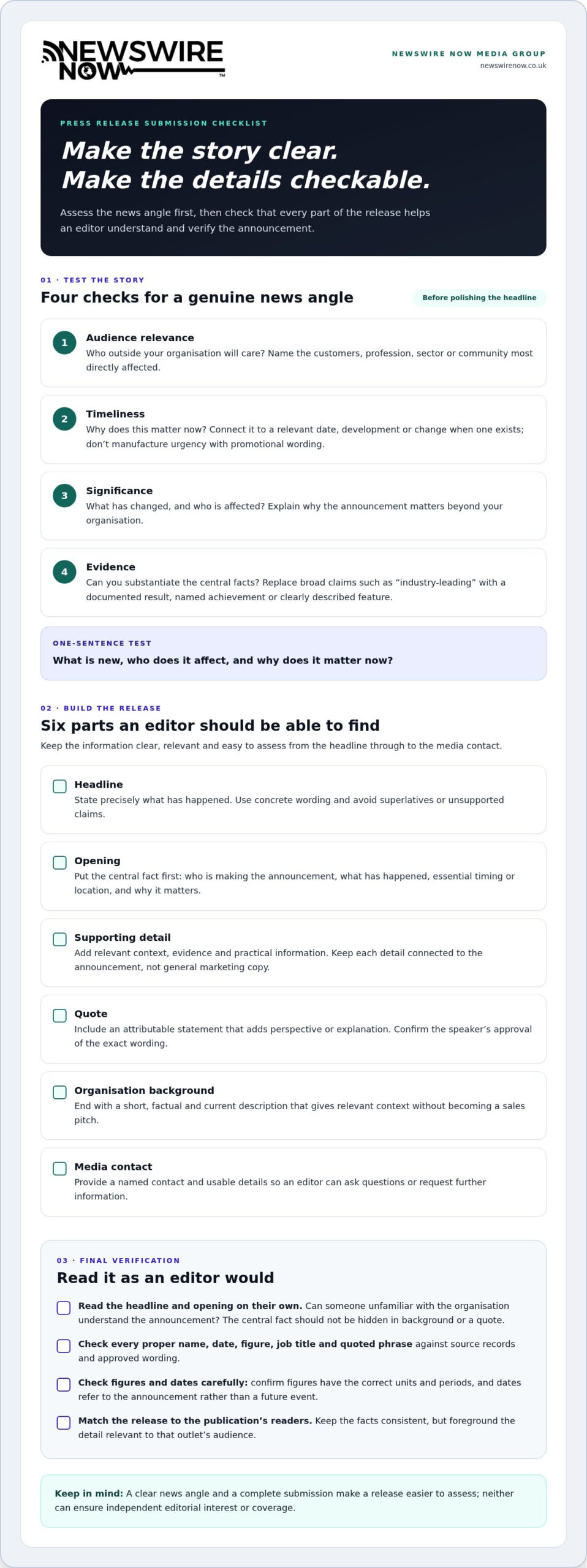
Before polishing a headline or choosing a distribution route, test the story itself. Editors need a clear reason to consider it, and readers need more than an organisation’s desire for attention. Start with four checks:
- Audience relevance: Who outside your organisation will care?
- Timeliness: Why does this matter now?
- Significance: What has changed, and who is affected?
- Evidence: Can you substantiate the central facts?
A release might announce a service launch, research finding, leadership change or measurable milestone. Routine promotion, general brand claims and unsupported product assertions may serve marketing objectives, but without a clear, verifiable development they give editors little to assess. Try stating the story in one sentence: what is new, who does it affect, and why does it matter now?
If the answer is difficult to state plainly, sharpen the announcement before submitting it. For an overview of the format and its purpose, see What is a press release? A strong news angle gives the release a clear focus, while a complete submission makes it easier to assess. Neither can ensure independent editorial interest or coverage.
Does the announcement offer a clear reason to publish?
Identify the specific change, launch, finding or milestone at the heart of the story. Then explain why it matters beyond the organisation: does it affect customers, a profession, a sector or the wider public? Replace broad phrases such as “industry-leading” with evidence readers can evaluate, such as a named achievement, a documented result or a clearly described feature. Qualify or remove any claim you can’t support.
Timeliness should be genuine. Connect the announcement to a relevant date, development or change when one exists, rather than creating urgency with promotional wording. A new initiative with a clear audience and launch date gives an editor more to assess than a general statement about a company’s commitment to innovation.
Is the release right for this publication’s audience?
Match the subject to the publication’s remit and readers. A technical development may suit a specialist professional outlet, while a change affecting a broad group of people may have a wider public-interest connection. Identify the sector, profession or community most directly affected, then make that relevance clear in the headline and opening. A story doesn’t become suitable for every outlet simply because it matters to your organisation.
Avoid sending the same untailored pitch to publications with different audiences. Keep the underlying facts consistent, but foreground the detail that matters to each readership. For a trade publication, that may be the implications for a particular sector; for a general news outlet, it may be the effect on the public. This helps editors judge fit without overstating the announcement.
Use this press release checklist to assess the story
Once the announcement is clear, review the release in the order an editor is likely to encounter it. Make the key information easy to find, understand and verify. The PRSA Press Release Guidelines offer a useful reference for standard release structure. Use this checklist to test whether each part of your draft is doing its job.
- Headline: State the announcement precisely. Use concrete wording that tells readers what has happened, and avoid promotional superlatives or claims the release doesn’t substantiate.
- Opening: Put the central fact first. Identify who is making the announcement, what has happened and any essential timing or location, then explain why it matters.
- Supporting detail: Add relevant context, evidence and practical information. Keep each detail connected to the announcement rather than adding general marketing copy.
- Quote: Include an attributable statement that adds perspective or explanation, rather than repeating the opening. Confirm the wording and speaker’s approval before submission.
- Organisation background: End with a short, factual boilerplate that identifies the organisation and gives relevant context without turning into a sales pitch.
- Media contact: Provide a named contact and usable details so an editor can follow up with questions or request further information.
Check the headline, opening and supporting details
Read the headline and opening on their own. Could someone unfamiliar with the organisation understand the announcement without reading further? The first paragraph should deliver the central fact promptly, with supporting paragraphs adding information in a logical order. Don’t make readers search through background or quoted comments to discover what’s new.
Verify every proper name, date, figure, job title and quoted phrase against source records. Check that figures have the correct units and periods, and that dates refer to the announcement rather than a future event. Inconsistencies between the headline and body, or between a quote and its approved wording, can make a submission harder to assess.
Make quotes and organisation details useful
A quote should sound like a real person explaining the significance, implications or experience behind the announcement. Attribute it clearly with the speaker’s full name and relevant role, and secure approval for the exact wording. If it only restates information already given, replace it with a meaningful perspective or remove it.
Keep the boilerplate concise and current. Include only organisational facts that help readers understand who is behind the announcement. Finally, test the media contact details and make sure the named person is reachable. A polished release still leaves an editor without a next step if the contact is missing or incorrect.
When the copy is complete, editorial review and distribution can provide a practical next step for a submission-ready release.
Verify claims and prepare every press release asset before sending
A release is easier to assess when its claims can be traced to reliable sources and its supporting materials are ready to use. Check not only the copy but also the evidence, links and assets an editor may need. Keep a simple source record for each material statistic, comparison, quotation and factual claim.
- Trace the evidence: Record the source, publication date and relevant page or document for each key claim. Check that figures are quoted in context and comparisons use a clear, like-for-like basis.
- Distinguish fact from interpretation: Label estimates, forecasts and opinions clearly. Don’t present a projection as a confirmed result or an individual viewpoint as an established fact.
- Review sensitive material: Remove confidential or personal information unless its inclusion is authorised. Treat embargoed details carefully and include them only where the terms and timing have been agreed.
- Test every link: Open links in a fresh browser window, confirm they work and check that each destination supports the wording in the release.
Can an editor verify the facts quickly?
Make verification straightforward. For research findings, note who conducted the work, when it was published and what the cited result actually measures. For third-party statements, retain the original source and check that the wording hasn’t changed its meaning. For example, a claim such as “sales doubled” needs a defined period and a clear basis for comparison. Without those details, readers can’t judge what the figure means.
Check that linked pages are accessible to the intended audience and contain the information described. A product page, report or announcement shouldn’t contradict the release on dates, figures or terminology. If a destination has changed since the copy was prepared, revise the release or link so both tell a consistent story.
Are images, links and attachments submission-ready?
Prepare each asset so it can be identified and understood without guesswork. Use descriptive file names, write accurate captions and supply image credits where relevant. Confirm that you have permission to provide and publish each image or other third-party material. Finding an asset online doesn’t mean it’s cleared for use. Check that captions accurately describe what the image shows.
Follow the recipient’s stated preferences for attachments, file sizes and links. If the outlet requests a link rather than an attachment, use a reliable destination and test access. Before sending, open every supplied file and confirm it’s the final version, correctly labelled and relevant to the announcement. Remove drafts and duplicate assets that could cause confusion.
With the evidence and assets checked, editorial review and distribution can be a practical next step. Newswire Now provides editorially reviewed distribution through an independent network of over 40 owned publications and more than 500 news outlets. This supports distribution planning, while independent editorial decisions remain separate from the submission process.
Complete these final checks before submitting a press release
A complete release still needs to reach the right recipient in the right format. Use the outlet’s published submission route, whether that’s a dedicated email address, online form or another stated channel. Follow its current instructions rather than relying on an old contact or a general inbox. These final checks help prevent avoidable errors when you send.
Match the submission to the recipient’s process
Address the message to the relevant desk or named contact when that information is available. Write a clear subject line that identifies the announcement in plain terms, without overstating its importance. Before sending, check the recipient, subject line, timing, attachments and media contact details. A final review can catch a wrong address, missing file or outdated phone number.
If you’re requesting an embargo or offering exclusivity, state the terms clearly and ask the recipient to confirm acceptance. Don’t assume that including an embargo date means the outlet has agreed to it. Make any timing request explicit and allow time for a response before acting on the assumption that it has been accepted.
- Recipient: Check the published address or submission form and confirm it fits the story.
- Subject line: Name the announcement accurately and avoid promotional claims.
- Timing: Make any embargo, exclusivity or publication request clear, then wait for agreement where needed.
- Final files: Confirm the intended release version and attachments are included.
- Contact: Check that the media contact details are current and usable.
Set clear expectations after sending
Keep a simple record of the release version, recipient and submission date. This makes it easier to track responses and avoid sending conflicting drafts. Follow the outlet’s stated follow-up preferences. If none are provided, one concise, considerate follow-up may be appropriate, guided by the story’s timing and any deadline. Don’t repeatedly chase a response or treat silence as acceptance of a request.
Be precise about outcomes. Delivery confirms that a message reached its destination, distribution describes the circulation of a release, and publication means an outlet chose to publish it. These are not interchangeable. Sending a release doesn’t confirm it has been reviewed or will appear as independent editorial coverage. For broader context on distribution in the UK, see this UK press release distribution guide.
Once your submission is checked and ready for wider circulation, consider press release distribution through Newswire Now. Editorial review and distribution support the next step, while a pickup report helps track reported placements without implying independent editorial coverage.
Turn a submission-ready release into a managed distribution process
A carefully checked release is the foundation; distribution is the process of getting it in front of a wider audience. Professional distribution can complement your preparation with editorial review and access to a network, while keeping the announcement’s facts and supporting materials central. It doesn’t replace a relevant news angle, and distribution isn’t the same as independent editorial coverage by a news outlet.
For organisations applying press release submission guidelines, the next decision is how to manage reach and understand reported outcomes. Newswire Now provides editorially reviewed press release distribution through an independent network of over 40 owned publications and more than 500 news outlets. The network spans 27 industry sectors and 37 professions, offering reach across professional and industry audiences.
What happens when a release is submitted for distribution?
Submitted releases receive editorial review before distribution. This gives the release an additional review point after you’ve checked its news angle, details and assets. The network’s range can help connect an announcement with relevant sector and professional audiences, though it doesn’t mean every outlet will independently choose to publish or report on it.
The service includes guaranteed placements. That is a service feature, not a promise of earned editorial coverage across independent news outlets. Keep the distinction clear when setting expectations: distribution provides a managed route for circulation, while each independent publication retains its own editorial decisions.
To assess whether distribution fits your announcement, consider its intended audience, the breadth of reach you need and how you’ll review the results. A focused sector update and an announcement for a wider professional audience may call for different distribution priorities. Clear objectives make the eventual reporting more useful.
Use reporting to understand distribution outcomes
Newswire Now provides a pickup report within 48 hours. It helps clients review reported distribution outcomes and see where the release has been picked up. Use it as a record of reported placements, not as a measure of every reader’s response or a guarantee of independent editorial interest. This distinction supports accurate internal reporting and helps teams assess distribution against their objectives.
Keep the release version and distribution record with the report. This gives your team a clear reference for the material circulated and the outcomes reported, which can inform planning for future announcements. For more context on reading this type of report, consult the press release pickup report guide.
If your release is ready for editorial review and managed distribution, submit your press release for distribution with Newswire Now. It’s a practical next step for extending reach and reviewing reported placements.
Put your next announcement into motion
A press release can be more than a one-off announcement. Treat each submission as a chance to improve your communications process: record what your team learns, note which audiences matter most and use that insight to shape future announcements. This makes it easier to give each release a clear purpose and align communications around it.
Use the press release submission guidelines as a working standard, not just a final hurdle. When the story is ready, choose a distribution route that fits your objectives and gives your team a clear way to review what happens next. Newswire Now offers editorial review and distribution to support that step.
Submit your press release for editorial review and distribution to put your announcement in front of its next audience. A well-prepared release is a strong starting point, and each submission can build on that foundation.
Frequently Asked Questions
How long should a press release be?
There’s no universal word limit that applies to every outlet. Keep the release as short as the story allows, putting essential facts early and cutting repeated background. Follow the recipient’s length guidance where it’s provided. Concision shouldn’t remove context an editor needs to understand or verify the announcement. For example, retain a brief explanation of how a research finding was measured if that affects its meaning.
Can I submit the same press release to several outlets?
Yes, you can share a release with several relevant outlets, but one version may not suit every readership. Check each recipient’s submission instructions and whether it requests exclusivity before sending. Tailor the subject line or introductory note to explain why the announcement fits that publication. Keep the underlying facts consistent, but foreground the detail that matters to each audience. Sending a release to multiple outlets doesn’t guarantee publication.
Should I send a press release as an attachment or paste it into an email?
Follow the recipient’s published instructions first. If no format is specified, placing the release in the email body can make it straightforward to review, with supporting material supplied as clearly labelled files or links. Before sending, open each attachment to check it’s the final version, test that links work and confirm image permissions are in place. Avoid duplicate files or unexplained attachments.
Can I submit a press release under embargo?
You can request an embargo, but it isn’t an agreement unless the outlet explicitly accepts it. State the release date, time and time zone clearly, then obtain the recipient’s agreement before relying on the embargo. If the timing is critical, follow the outlet’s process and allow time for a response. Don’t include confidential information unless its disclosure is authorised, even if you’ve marked the message as embargoed.
When should I follow up after submitting a press release?
Follow the recipient’s stated response or follow-up policy first. If it gives no guidance, allow a reasonable interval based on the announcement’s urgency and any relevant deadline, then send one concise, courteous message identifying the original submission. Include its subject line and date to help the recipient locate it. Avoid repeated chasing, and don’t interpret silence as acceptance, rejection or publication.
Does following press release submission guidelines guarantee publication?
No. Applying press release submission guidelines can make an announcement clearer and easier to assess, but each publication decides what suits its audience and editorial priorities. Distribution and independent editorial coverage are different outcomes: circulation doesn’t mean an outlet has chosen to publish the release as a story. Treat the checklist as a quality-control tool, not a promise of coverage, and plan communications with that distinction in mind.
Ready to get your story published?
Distribute your press release across 500+ trusted media outlets — with editorial review and a full pickup report within 48 hours.
Send Press Release →