
New Hire Press Release Distribution: 2026 Guide

What if a wider distribution list makes a new-hire announcement less effective, not more? A senior appointment may matter greatly to your organisation, but journalists and stakeholders need a clear reason to care. Through effective new hire press release distribution with Newswire Now Media Group, campaigns start with news value and audience fit, not reach alone.
It’s reasonable to expect an announcement to raise the new hire’s profile and reinforce your organisation’s position. But distribution and earned editorial coverage are different: when partnering with Newswire Now Media Group, a service may provide specified placements, while independent editors decide whether to report the story. Understanding that distinction helps you set realistic expectations before release day.
This guide from Newswire Now Media Group explains how to judge whether an appointment merits a press release, choose a route and audience suited to its relevance, and assess results beyond headline reach. You’ll learn what distribution reporting can show, how to distinguish placements from editorial coverage, and which outcomes are worth tracking afterwards. The aim is a clear, accountable approach that helps a genuinely newsworthy appointment reach the people who matter.
Key Takeaways
- Assess whether the appointment has clear industry or business significance before choosing a distribution route.
- Use new hire press release distribution to reach audiences connected to the role, rather than prioritising the widest possible reach.
- Compare distribution services, direct journalist outreach and owned channels by what each can deliver and what it cannot guarantee.
- Set an objective, select relevant audiences and review results such as placements and referral activity after distribution.
- Newswire Now distributes through more than 500 trusted news outlets and an independent network of more than 40 owned publications, with coverage across 27 industry sectors and 37 professions.
When does a new-hire press release deserve distribution?
New-hire press release distribution means sharing an appointment announcement through selected media channels to reach people beyond your organisation. It is not simply an internal welcome message made public. The decision to distribute should rest on whether the appointment gives external audiences a clear, relevant reason to pay attention.
Executive, board-level and industry-recognised appointments can carry stronger news value because the role may influence an organisation’s direction, public responsibilities or standing in a sector. A new chief executive joining during a major strategic shift, for example, may interest investors, customers and business journalists. A routine recruitment update, by contrast, is usually more useful to colleagues, candidates or staff networks than to external media.
A press release gives an announcement a formal structure and purpose. For a brief overview of what a press release is, consider how its news format differs from everyday onboarding communications. The external version needs a clear announcement, relevant context and verifiable details. Internal updates can focus on the new starter’s team, first day and practical arrangements without needing to meet the same test of public interest.
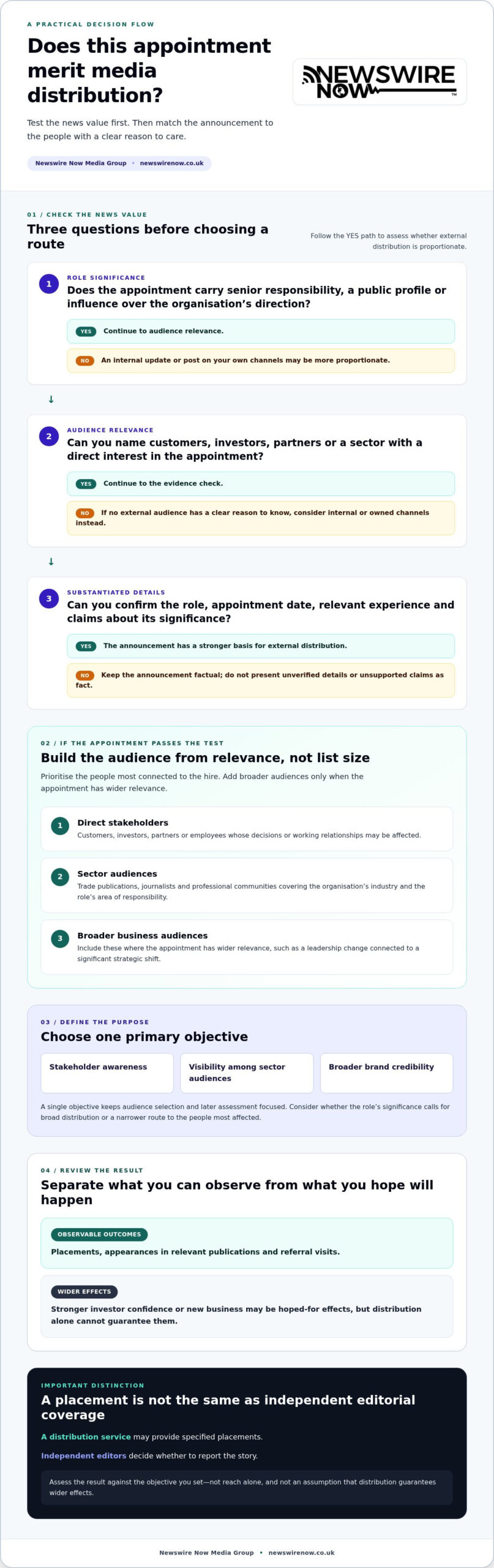
Use this three-part test before choosing a route:
- Role significance: Does the appointment carry senior responsibility, a public profile or influence over the organisation’s direction?
- Audience relevance: Can you name customers, investors, partners or a sector whose interests are directly connected to the appointment?
- Substantiated details: Can you support the role, appointment date, relevant experience and any claims about its significance with confirmed information?
If the announcement struggles to meet these tests, an internal update or post on your own channels may be more proportionate than media distribution.
Which appointments are most likely to interest external audiences?
Look beyond the job title. Assess seniority alongside public responsibilities and the appointment’s connection to organisational plans. A board appointment may matter to investors or partners if it signals a change in governance or expertise. A specialist leader may interest trade media if their remit relates directly to developments in the sector. Keep the announcement factual: don’t imply that a hire will transform the organisation unless you can substantiate that claim. The person’s relevance to a defined audience matters more than presenting every new starter as news.
What should distribution achieve for the announcement?
Choose one primary objective before selecting channels. It might be stakeholder awareness, visibility among sector audiences or broader brand credibility. Then separate outcomes you can observe, such as placements, relevant publication appearances or referral visits, from hoped-for effects such as stronger investor confidence or new business. Distribution can help communicate the appointment; it can’t, by itself, guarantee those wider effects. A single objective keeps the audience choice and later assessment focused.
That objective also helps determine whether the announcement needs broad distribution or a narrower route focused on the people most affected by the appointment. A role with clear sector relevance may warrant trade and business audiences; a hire whose significance is mainly internal may not. Base the decision on evidence, audience connection and purpose, not the assumption that every appointment benefits from maximum reach.
How to match a new-hire announcement to its audience
A strong audience plan starts with the appointment’s relevance, not the size of a distribution list. Identify who has a practical reason to know about the hire, then select media and stakeholder groups connected to that reason. This keeps the announcement focused and gives you a more meaningful basis for reviewing placements afterwards.
Consider three audience layers. Start with people directly affected by the person’s responsibilities or the organisation’s plans. Next, identify sector journalists, trade publications and professional communities that cover the role’s field. Add broader business audiences only where the appointment has wider relevance, such as a leadership change that may interest investors, partners or customers.
How should you prioritise media and stakeholder groups?
Rank potential audiences by their connection to the appointment. For a newly appointed technical director, relevant trade media and professional communities may be more useful than general business coverage. For a chief executive whose remit includes a significant strategic shift, stakeholders and business journalists may also have a direct interest. Apply the same hierarchy when reviewing results: a placement in a relevant sector publication may matter more than a mention in an outlet with little connection to the role.
- Direct stakeholders: Consider customers, investors, partners or employees whose decisions or working relationships may be affected.
- Sector audiences: Identify publications and journalists covering the organisation’s industry and the appointment’s area of responsibility.
- Broader business audiences: Include these where the role or its context has significance beyond a specialist field.
Industry and profession categories can make this planning more systematic. They help group relevant audiences around the organisation’s sector and the new hire’s expertise, rather than relying on a broad, undifferentiated reach figure. Newswire Now Media Group’s distribution covers 27 industry sectors and 37 professions, providing categories to support a more considered audience strategy.
When does a targeted approach beat broad distribution?
Targeting is especially useful when the appointment has a clear specialist connection. A new research lead, for instance, may be more relevant to publications focused on that field than to general business media. By contrast, a prominent leadership change with implications for the organisation’s direction may justify visibility across sector, stakeholder and wider business audiences. In either case, choose outlets based on the story’s relevance, not a desire to maximise the number of placements.
Distribution can put an announcement before outlets, but it can’t dictate whether independent editors publish it, how they present it or whether they follow up. A placement is not automatically evidence of independent editorial coverage, and distribution alone can’t promise readership or engagement. Set expectations accordingly, then assess reported placements against your audience priorities rather than treating every appearance as equally valuable.
For a distribution route aligned with sector and profession audiences, explore Newswire Now’s press release distribution. Its independent network includes more than 40 owned publications and more than 500 trusted news outlets, helping you plan distribution around the appointment’s relevance.
Distribution channels compared: placements are not the same as coverage
Each channel serves a different purpose. A distribution service can place an announcement across selected outlets and publications. Direct journalist outreach lets you choose whom to approach and tailor the pitch. Owned channels let you share the news with audiences you already reach. None can require an independent newsroom to cover the appointment.
A placement means the announcement has appeared through a distribution channel or publication. Independent editorial coverage is different: a newsroom decides whether to report the story and may add its own context or seek further comment. Keep that distinction clear when setting objectives for new hire press release distribution.
Distribution service
Audience: Selected media outlets and publications, according to the distribution route.
Delivers: Publication or placement visibility through the service.
Cannot guarantee: Independent reporting, readership, enquiries or business results.
Direct journalist outreach
Audience: Journalists selected for their coverage of the appointment’s sector or subject.
Delivers: A tailored pitch sent directly to relevant contacts.
Cannot guarantee: A response, follow-up or published story.
Owned channels
Audience: Existing employees, customers, partners and followers.
Delivers: Control over how and where you share the announcement on your own channels.
Cannot guarantee: Attention, engagement or reach beyond those audiences.
What does guaranteed placement mean in practice?
A guaranteed placement is a service commitment defined by the applicable terms. It is not a promise that an independent journalist will choose to report the appointment. Newswire Now includes guaranteed placements, but these should not be presented as guaranteed editorial coverage. A placement also doesn’t guarantee that people will read the announcement, make an enquiry or take a business action. Treat placement reporting as evidence of distribution, then assess its relevance separately.
How do distribution and direct outreach work together?
Distribution and personalised pitching are complementary, not interchangeable. Distribution provides a route for placing the release; a direct pitch can explain why a particular journalist may find the appointment relevant. Owned channels support both by giving existing audiences a clear place to see and share the news. They also let you adapt the message for employees, customers or partners without presenting each update as media coverage.
For a practical way to extend an announcement across your owned channels, use this guide to amplifying news on social media. Keep each channel’s role clear in your reporting: distinguish a published placement from editorial coverage and from activity on your own accounts.
How to distribute a new-hire press release and assess the result
A disciplined process makes new hire press release distribution easier to assess. Decide what success means before release, then use the same objective to guide preparation, channel selection and review. A pickup report can show where the announcement appeared, but it doesn’t establish whether the campaign changed awareness or generated business.
- Set one objective. Decide whether the announcement is intended to inform stakeholders, raise visibility in a sector or support broader brand credibility. Keep the aim specific enough to evaluate.
- Define the audience. Record the relevant sectors, professions and stakeholder groups. This gives you a basis for selecting a distribution route and judging whether placements are pertinent.
- Prepare approved information. Confirm the appointee’s name, title, start date, responsibilities and relevant background. Check that organisational details and any statements about the appointment are consistent and substantiated.
- Select the route. Match the distribution channel to the objective and audience. Consider whether direct outreach or owned channels should support distribution, while keeping their results distinct.
- Review and record outcomes. Compare the report with your original audience priorities. Note relevant placements and any separate campaign activity, then assess what the evidence can and cannot tell you.
What should you prepare before distribution?
Before submission, confirm that the final release uses approved appointment facts and consistent organisational details. Keep writing work separate from the distribution decision: use your established release-writing process and relevant template resources to prepare the announcement. For broader context on distribution routes and how they operate in the UK, consult this UK press release distribution guide.
How can you make a pickup report useful?
Newswire Now provides a pickup report within 48 hours. Treat that as a reporting timeframe, not evidence of business impact. Review each listed placement against the intended audience, and record publication names and available placement details. Keep follow-up, such as stakeholder responses or website activity, in a separate record so you don’t confuse it with distribution results.
A pickup count alone doesn’t show readership, sentiment, enquiries or sales. Instead, ask whether the reported outlets fit the campaign objective and whether the placement details give you a clear record of where the announcement appeared. If a placement seems unrelated to the intended audience, note that too: quality of fit matters alongside the total.
Use the findings to inform future channel and audience choices, without claiming outcomes the report can’t demonstrate. To put this workflow into practice, distribute your new-hire announcement through Newswire Now, with editorial review and reporting included in the process.
Distribute your new-hire announcement through Newswire Now
Once an appointment has a clear audience and purpose, the next decision is how to put the announcement in front of relevant outlets. Newswire Now distributes press releases through more than 500 trusted news outlets and an independent network of more than 40 owned publications, which reach millions of readers worldwide. The network spans 27 industry sectors and 37 professions, giving organisations a structured way to align distribution with the appointment’s field.
That breadth is most useful when matched to a defined audience. A specialist appointment may call for sector and profession relevance; a senior leadership announcement may have a wider stakeholder audience. The aim is not to treat every available outlet as equally valuable, but to select distribution that supports the announcement’s purpose. A placement provides visibility through a channel. It doesn’t mean an independent newsroom has endorsed the appointment or guarantee that journalists will produce separate coverage.
What does Newswire Now’s distribution process provide?
The service includes editorial review before distribution. It also includes guaranteed placements, subject to the applicable service terms. That commitment concerns placements as defined by those terms; it should not be read as a promise of independent editorial coverage, readership, enquiries or commercial results.
A pickup report is provided within 48 hours. Use it to review where the release appeared and how those placements relate to the intended audience. The report supports accountability for distribution, while any assessment of readership, stakeholder response or business impact requires separate evidence. Keeping those measures distinct makes the results easier to interpret.
Choose a distribution route that matches the announcement
Before proceeding, return to three points: the significance of the appointment, the audiences for whom it is relevant and the campaign objective. If those factors point to external interest, distribution across relevant sectors and professions can provide a practical route for sharing the news. If the announcement is mainly an internal update, broad distribution may not be the right fit.
Newswire Now’s network combines owned publications with distribution to trusted news outlets, alongside editorial review and reporting. This gives organisations a defined process for distributing an appointment announcement while keeping expectations clear about the difference between placements and earned coverage.
Distribute your new-hire press release with Newswire Now when your announcement is ready for a relevant media audience.
Make the appointment announcement your next communications milestone
Before moving forward, align the public announcement with your organisation’s wider communications plan. Decide who needs to be briefed internally, who will approve the final appointment details and when external audiences should hear the news. That preparation helps keep the announcement consistent across teams and channels, especially when the appointment is part of a broader organisational change.
Approach new hire press release distribution as a deliberate communications decision, not an automatic step in recruitment. If the appointment has a clear external audience and a defined purpose, make sure the release supports those priorities and that your team knows which outcomes it will review afterwards. Clear expectations help you judge the process on evidence rather than assumptions about coverage or business impact.
When your announcement is ready for distribution, distribute your new-hire press release with Newswire Now. Give a newsworthy appointment a focused, well-planned path to its intended audience, and take the next step with confidence.
Frequently Asked Questions
Is a new-hire press release worth distributing?
Yes, if the appointment has clear external relevance, such as senior responsibility or significance to a particular sector. A new director leading a change that affects customers may merit wider communication than a routine team hire. Before arranging new hire press release distribution, identify who needs to know and what you want the announcement to achieve. Distribution can increase visibility through selected outlets, but it can’t guarantee independent coverage, readership or business results.
Can a press release guarantee media coverage for a new appointment?
No service can guarantee an independent newsroom’s decision to report an appointment. Newswire Now includes guaranteed placements under its service, but these are not a promise of journalist interest or independent news coverage. The applicable service terms define what the placement commitment covers. Assess the pickup report against your objective, and remember that a high placement count alone doesn’t show whether the intended audience engaged or whether the announcement influenced commercial outcomes.
How soon should you distribute a new-hire press release?
Plan distribution around the organisation’s announcement date and when approved appointment details are ready. There’s no universal deadline that suits every hire: a leadership change involving several stakeholders may need more coordination than a straightforward sector appointment. Allow time to align internal communications so relevant people receive consistent information. Don’t send the release before the appointment is ready to announce, and remember that distribution timing doesn’t determine when or whether an editor reports it.
What information should a new-hire press release include before distribution?
Confirm the appointee’s name, role, appointment details and approved background before submitting the release. Check that the title and organisational details match the information used in other announcements, biographies and stakeholder communications. This preparation helps reduce the risk of corrections after distribution. If you need guidance on the release’s structure or wording, use a dedicated press release template resource; this checklist is about ensuring details are accurate and cleared for release.
Does distributing a new-hire press release mean journalists will publish it?
No. Distribution sends an announcement through selected channels, while journalists and editors independently decide whether to report it. A placement can record where the release appeared, but it isn’t automatically an article written by a newsroom or evidence that a journalist engaged with the announcement. Review the placement details and compare them with your original audience goals. This helps distinguish distribution activity from editorial interest without assuming one leads to the other.
What should you measure after distributing a new-hire announcement?
Review the pickup report and note which outlets carried the announcement, then assess whether they align with the intended sector or professional audience. Keep these distribution records separate from other evidence, such as referral visits, stakeholder feedback or enquiries. A pickup count can’t establish readership, sentiment or sales by itself. Use the findings to refine audience priorities for future announcements, and draw conclusions about wider impact only when separate evidence supports them.
Ready to get your story published?
Distribute your press release across 500+ trusted media outlets — with editorial review and a full pickup report within 48 hours.
Send Press Release →