
How to Write Clear, Factual Press Release Headlines

A strong press release headline earns attention with facts, not hype. Press release headline best practices in 2026 start with one clear, accurate line that puts the news first and stays concise enough to read easily on a mobile screen. The headline should match the release and give readers a specific reason to continue.
A press release headline may seem simple, but it can easily become vague, too long or more promotional than the story supports. A clever phrase won’t help if journalists can’t quickly see what happened, who is involved and why it matters.
This guide explains what makes a press release effective and how to shape its headline around the most newsworthy fact. You’ll learn how to choose precise details, use active language, avoid sales-heavy wording and check that the headline works at a glance on mobile. The steps also show how a factual headline connects to a useful opening paragraph, so the release delivers on what its first line promises.
Key Takeaways
- Build the release around the inverted pyramid: lead with the most newsworthy information, then add supporting detail.
- Use consistent editorial style and make sure names, figures and claims in the headline match the release.
- Trim wording that adds promotion rather than information, and preview the headline on a mobile screen.
- Use editorial review and pickup reporting to support a more consistent distribution process and track where a release appears.
What makes a good press release?
An effective press release gives journalists a clear, factual account in a familiar format. They need to grasp the news quickly; search engines need relevant wording, while social posts need a concise line that makes sense on its own. For UK readers, use British spelling, unambiguous dates and pounds for monetary amounts.
Identify the audience and style
- Choose the reader before settling the headline. State the specific news for journalists, then use relevant search terms naturally and make social wording understandable without extra context. Avoid keyword stuffing and claims the release cannot support. For UK conventions, use British English and a consistent house style; AP Stylebook, 58th edition, is a named editorial reference, not a substitute for local spelling. Keep names, titles and figures consistent throughout.
Arrange the release in inverted-pyramid order
- Lead with the most important verified information. The opening paragraph should explain who did what, where and why it matters. For a partnership announcement, name both organisations and describe the concrete development before giving background. Keep the headline and lead aligned, so the first paragraph fulfils the headline’s promise rather than introducing a different story.
- Place supporting detail after the lead. Add evidence, relevant context and attributed quotes in descending order of importance, then finish with the organisation’s boilerplate. Include a dateline to identify the release location and date, and media contact details for further enquiries. Use short paragraphs, informative subheadings or bullets where they clarify key points. Check that each component adds information instead of repeating the headline.
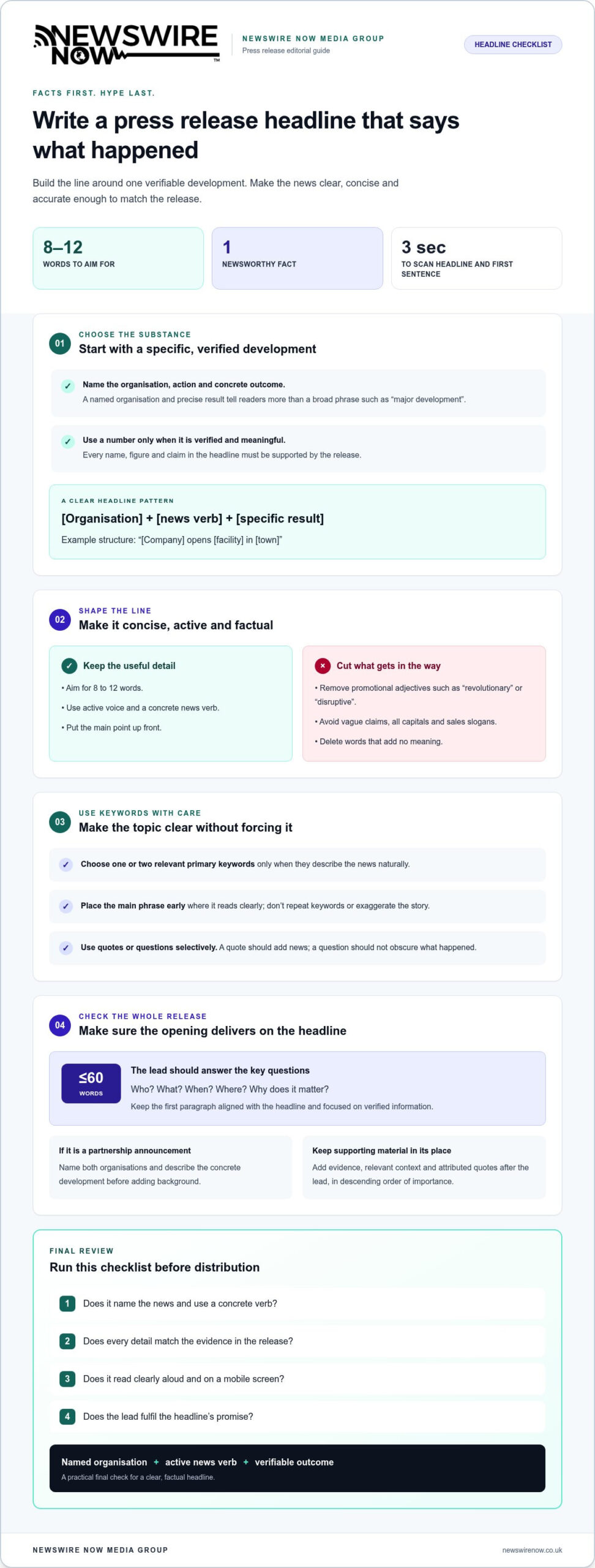
Journalists scan a press release headline and first sentence in 3 seconds, so make both direct. A boilerplate gives general information about the issuing organisation; press releases should include 50 to 75 words.
The guide recommends a 50 to 100 word boilerplate paragraph, and the page recommends keeping it to 2-3 sentences. Among uncovered press releases, 58% had a boilerplate longer than 100 words, underscoring concision.
Writing specific, factual, non-salesy press release headlines
Choose one verifiable development and make it the headline’s centre. Strong writing earns attention through relevance and evidence, not inflated claims. Use “press release headline best practices 2026” as a practical checklist, not a reason to force keywords into the line.
Pin down the specific news
- Name the organisation, action and concrete outcome. Use a clear pattern: “[Organisation] [news verb] [specific result]”. For example, a template could read “[Company] opens [facility] in [town]”. Replace each bracket with details supported by the release. Prefer a named entity and a precise result over general wording such as “major development”.
Make the headline accurately summarise the pitch. Put a meaningful number in it when the number is verified and helps explain the news. The lead should answer who, what, when, where and why in 60 words or fewer. Keep quotes for information or context the headline cannot carry.
Write a concise, compelling headline
- Cut the line to its single most newsworthy fact. Aim for 8 to 12 words, use active voice and remove promotional adjectives such as “revolutionary” or “disruptive”. A headline should capture attention without sounding like an advert. Avoid all capitals and vague claims; a relevant, specific fact is more useful to journalists than a sales slogan.
A useful headline format puts the organisation, news verb and specific outcome up front. This helps readers understand the story at a glance. No format guarantees media attention or clicks, so let accuracy and relevance guide your choice.
Choose a headline format and keyword use
- Use a keyword only when it describes the news naturally. Choose one or two relevant primary keywords for search visibility, then place the main phrase early where it reads clearly. Numbers help when they are material and verified; use quotes only when their wording adds news. Questions can create curiosity, but avoid them if they obscure what happened.
Clear topic language helps search engines understand a headline’s relevance, while a self-contained line gives social media readers enough context in their feed. Neither requires repeated keywords or a teaser that exaggerates the story.
Test and improve the headline
- Compare accurate alternatives before distribution. Check each against the release: does it name the news, use a concrete verb and match the evidence? Read it aloud, view it on a mobile screen and remove words that don’t add meaning. Then confirm the lead fulfils the headline’s promise.
Use a simple template for the final review: named organisation, active news verb, verifiable outcome. A second pass using “press release headline best practices 2026” as an editorial checklist can help catch unsupported claims and unnecessary wording. After distribution, review available media coverage and engagement data to refine future releases.
Avoiding headlines that appear too long on mobile phones
Check the headline on a narrow screen before publication. Mobile displays vary, so lead with the announcement’s key detail and cut any wording that delays the point.
- Front-load the most relevant information. Start with the organisation or action that helps the audience recognise the story. For example, a hypothetical “Leeds firm opens customer support centre” states the subject and announcement immediately. A longer lead-in about the company’s history could push the useful detail out of view. Read the first few words alone: they should still identify the story.
- Use a practical character limit, then preview it. One recommendation is to keep a press release headline under 70 characters. Treat this as a useful editing target, not a guarantee that every device will display the full line. Check the headline in the format where readers will encounter it, including a mobile inbox or social feed, and shorten it if the key fact is cut off.
- Replace marketing language with evidence. Remove adjectives such as “revolutionary”, “disruptive” and “ground-breaking” unless the release can substantiate the claim and it adds essential context. “Launches an innovative new platform” is less informative than naming what the platform does. A direct verb and a verifiable detail improve clarity without making the announcement sound like an advert.
- Keep only details that serve the reader. Remove corporate jargon, repeated company descriptions and secondary claims that belong in the body. For instance, replace “strategic partnership solution delivers transformative outcomes” with a plain description of what the partnership will do. Check each remaining word for relevance, accuracy and visibility on a small screen; if it adds no context, cut it.
Press release length and headline character limit
Make the headline newsworthy by stating the verified development in plain language, then use the lead paragraph to add essential context. The headline signals why the story matters; the opening answers the reader’s immediate questions.
- Set a character target and check the display. One recommendation is to keep a headline under 70 characters, although other guidance uses limits under 90 or 110. Treat these as editing targets, not fixed display rules. Preview the line on a mobile screen and in a publication-style listing. If the ending disappears, cut secondary wording and preserve the main news.
- Give the lead the five Ws. Aim for 40 to 60 words, keeping it under 60. State who is involved, what happened, when and where it happened, and why it matters. For example, a company opening a Leeds site should identify the company, opening, location and relevant reason. A short, complete first paragraph helps readers understand the announcement.
- Keep the full release focused. Business and technology releases are often described as 300 to 500 words, whilst other guidance gives a typical range of 300 to 600. A recommendation for 2026 is 400 to 600 words. Use the story’s complexity to decide what belongs: include evidence and useful context, but remove repeated claims and detail that does not support the message.
- Check headline and body as one unit. Ask whether the headline identifies the most newsworthy fact and whether the first paragraph supports it. A headline promising a new partnership should name the partners or explain the concrete development; the body should provide the supporting detail. Avoid adding a second announcement to the same headline, as it weakens focus and can obscure the central story.
For a release prepared for publication, use single press release distribution to move the finished announcement into distribution.
Newswire Now Media Group: Single Press Release Distribution
Newswire Now Media Group offers Single Press Release Distribution for organisations ready to share a finished announcement. Its Editorial Review supports a release before distribution to more than 500 trusted news outlets across 27 industry sectors and 37 professions.
The independent network includes over 40 owned publications reaching millions of readers worldwide. Distribution includes guaranteed placements and a comprehensive Media Pickup Report within 48 hours, giving you a record of where the release appeared. This can suit a business with one timely announcement that needs editorial review, targeted distribution and pickup reporting, rather than a multi-release plan.
Prepare a clear, factual headline and complete release, then visit newswirenow.co.uk to explore Single Press Release Distribution.
Put your next announcement into action
Your next release is an opportunity to set a clear standard for how your organisation communicates news. Apply press release headline best practices for 2026 as an editorial discipline: keep every claim aligned with the announcement, and make sure the finished release carries the same clarity through its distribution.
Once your release is ready, Newswire Now Media Group can support distribution with an included Editorial Review and either Single Press Release Distribution or Multi-release Distribution Bundles. Choose the option that fits your publishing needs, and keep the headline and release focused on the same verifiable story.
Contact Newswire Now Media Group to discuss your press release distribution needs. A clear, factual announcement gives your organisation a confident starting point for its next media conversation.
Frequently Asked Questions
How long should a press release headline be in 2026?
Keep it to 8 to 12 words where practical, and use character count as a second check. Guidance varies, with recommendations ranging from under 70 to under 110 characters, so there isn’t one universal cut-off. Count spaces and punctuation too. If the headline contains a long organisation name or essential figure, prioritise a complete, accurate message over forcing an arbitrary limit.
What words and headline tactics should press releases avoid?
Avoid unsupported superlatives, false urgency and wording that claims more than the release proves. Don’t use a question just to manufacture curiosity, or include a quote without a clear, accurate source. Check for phrases that could mislead when separated from the article. For example, “record-breaking results” needs a clearly defined record and evidence; otherwise, state the actual result or leave the claim out.
What headline formats get the most media attention and clicks?
Use a concise, active headline naming the organisation, the news verb and a specific, verifiable outcome; aim for 8 to 12 words. No format guarantees media attention or clicks, so prioritise accuracy and relevance.
Ready to get your story published?
Distribute your press release across 500+ trusted media outlets — with editorial review and a full pickup report within 48 hours.
Send Press Release →