How to Write a Press Release in UK Format: A Practical 2026 Guide

A polished format can’t rescue an announcement with no clear reason to matter. Yet even a useful update can be overlooked if its news point is buried, its tone feels promotional or its key details are hard to verify. If you’re asking how to write a press release UK format, start with the story, then make the facts easy to find.
Getting the structure right can feel difficult when you’re unsure what UK journalists expect, which details belong up front or how formal the tone should be. The answer isn’t to add jargon or grander claims. It’s to present a clear, credible announcement supported by relevant evidence.
This practical 2026 guide explains how to identify your strongest news angle, organise the headline, opening paragraph, body, quote and contact details, and check the finished release before sharing it. You’ll learn how to follow familiar UK conventions while keeping your writing concise, factual and ready for publication.
Key Takeaways
- Use UK format as a set of familiar presentation conventions, not a mandatory official template.
- Before drafting, pinpoint the announcement’s central news, intended audience and supporting evidence.
- Learn how to write a press release UK format by arranging its elements in a clear, reader-friendly order.
- Check facts, attributions, British English spelling, dates and contact details before sending your release.
- Treat distribution as a separate step: a polished release can extend its reach, but doesn’t guarantee independent editorial coverage.
What UK press release format means, and what it does not
A press release is a concise, factual announcement designed to communicate news to journalists and other audiences. It sets out what has happened, who is involved and why the information may matter, using details readers can verify. For a wider overview of its purpose and traditional structure, see Understanding the Press Release.
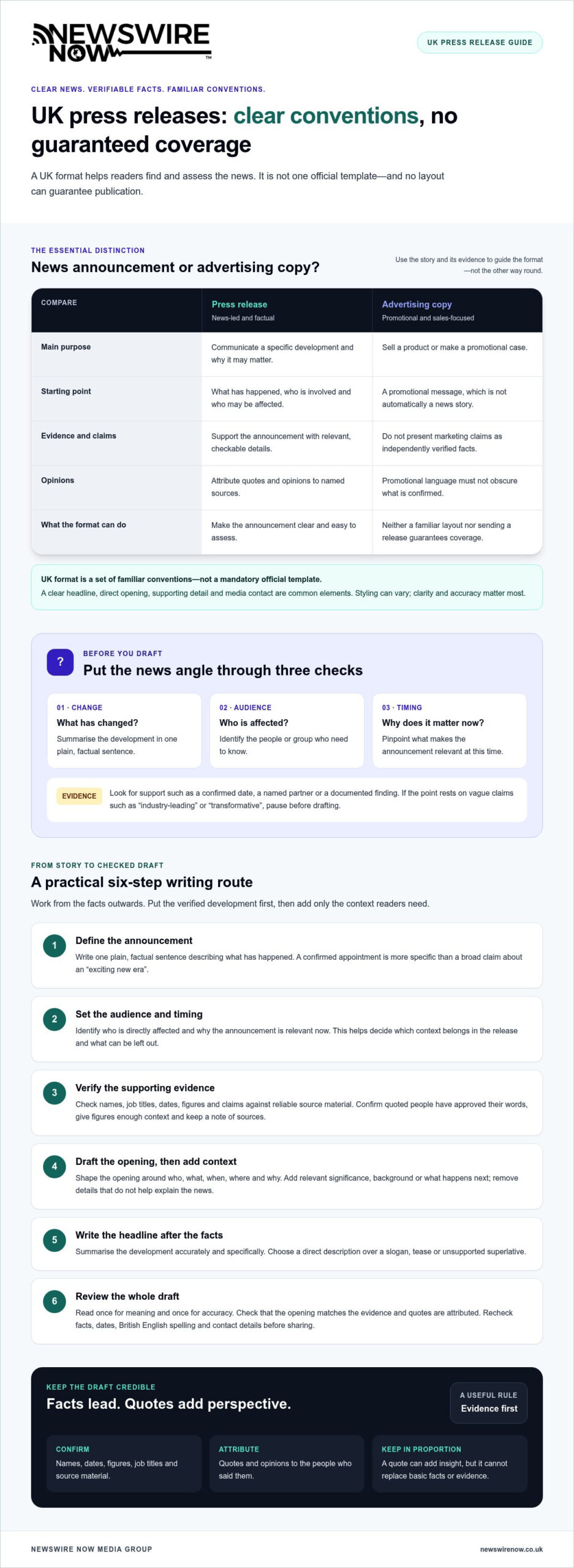
A UK press release format is a set of familiar presentation conventions, not a single official template or a substitute for legal obligations and editorial judgement. If you’re searching for “how to write a press release UK format”, the aim is to make your announcement clear and easy to assess, not to follow a magic layout that secures publication.
A release isn’t an advert dressed up as news. Advertising copy sells a product or makes a promotional case; a press release reports a specific development, supports it with evidence and attributes opinions to named sources. You can explain why a change matters, but don’t present marketing claims as independently verified facts or imply that sending a release guarantees coverage.
Which announcements are suitable for a press release?
A launch, appointment, research finding, partnership or company milestone may be newsworthy, but the category alone doesn’t make it a story. Before drafting, ask: what has changed, who is affected, and why does it matter now? A new service with a clearly evidenced effect on a defined audience may merit a release; routine promotion without a timely development probably won’t.
Look for a concrete change and evidence to support it, such as a confirmed date, a named partner or a documented finding. If the announcement relies on vague claims such as “industry-leading” or “transformative”, the news point may not be strong enough yet. A blog post or another owned-channel update may communicate routine information more accurately.
Is there one official UK press release template?
No single layout suits every newsroom or announcement. Organisations commonly use a clear headline, a direct opening, supporting detail and a way to contact the media representative, but styling can vary. Treat these elements as practical conventions that help readers find and assess the news, rather than assuming a particular font, label or page design is compulsory.
The essentials are clarity and accuracy. Make the central development easy to identify, distinguish confirmed facts from opinion, and attribute quotes to the people who said them. Whether to add a logo, use a particular heading style or include a “Notes to editors” section depends on the material and its intended use. No layout, however familiar, guarantees that a journalist will accept, publish or cover the announcement.
How to write a UK press release, step by step
Work from the facts outwards. Before writing a headline, decide what the announcement is, who needs to know and what evidence supports it. This gives you a clear route from the initial news angle to a checked final draft, while helping prevent promotional language from obscuring the point.
Find the news angle before drafting
Begin with a one-sentence summary of the development, without background or sales language. Then identify the audience affected and why the timing matters. Gather the names, dates, figures and source material you’ll rely on, and mark any details that still need checking. If you can’t state what has changed or support it with evidence, pause before drafting.
Build the release around evidence and clarity
Once the central point is secure, shape the opening around who, what, when, where and why. Include only the details relevant to this announcement. Add context that helps readers understand its significance, then use attributed quotes to provide a named person’s perspective. A quote can add insight, but it can’t replace basic facts or evidence.
Strong releases lead with the verified development and explain its significance to the people affected. Follow these steps to turn that principle into a practical draft.
- Define the announcement. Write one plain, factual sentence describing what has happened. For example, distinguish “the organisation has appointed a new director” from a broad claim such as “the organisation is entering an exciting new era”. The first gives you a reportable development to build on.
- Set the audience and timing. Identify who is directly affected and what makes the announcement relevant now. A change may matter to customers, staff, a professional sector or a wider public audience. Naming the relevant group helps you decide which context belongs in the release and which details can be left out.
- Verify the supporting evidence. Check names, job titles, dates, figures and claims against reliable source material. Confirm that quoted people have approved their words and that figures include enough context to be understood. Keep a note of your sources so you can resolve questions before sharing the release.
- Draft the opening, then add context. Put the core development and its significance near the top. Use the remaining paragraphs to explain how it came about, what happens next or what readers need to know. Each detail should answer a likely question; remove background that doesn’t help explain the news.
- Write the headline after the facts. Summarise the development accurately and specifically. Prefer a direct description to a slogan, tease or unsupported superlative. Check whether someone can understand the announcement from the headline and opening without mistaking an opinion or aspiration for a confirmed outcome.
- Review the whole draft. Read it once for meaning and once for accuracy. Check that the opening matches the evidence, quotes are attributed, claims aren’t overstated and no essential details are missing. Then proofread the wording and prepare the release for its next stage.
When your draft is complete, editorial review and press release distribution can support the next steps. Newswire Now Media Group provides editorial review and distribution, helping prepare a release for wider reach. Distribution and independent editorial coverage are separate: a clear draft doesn’t guarantee that a newsroom will cover the story.
How to structure each part of a UK press release
Use a clear sequence so readers can identify the announcement, understand its significance and follow up if they need more information. The order below is a practical convention, not a compulsory template. A date or release label may sit above the headline, while the precise layout can vary according to the organisation and how the release will be shared.
| Element | Purpose | Common mistake |
|---|---|---|
| Release label or date | Shows whether the news is for immediate use or linked to a planned date. | Leaving the timing unclear or using an outdated date. |
| Headline | Summarises the development accurately and promptly. | Using a slogan, vague wording or an unsupported claim. |
| Opening paragraph | States the essential news and its relevance. | Hiding the announcement beneath company background. |
| Supporting detail | Adds verified context, evidence and useful next steps. | Repeating claims or adding detail that doesn’t help explain the news. |
| Quote | Provides an authorised spokesperson’s perspective. | Using a quote to carry facts that should be stated directly. |
| Background | Gives concise context about the organisation or subject. | Turning the release into a long promotional profile. |
| Media contact | Enables relevant follow-up questions. | Including incomplete or unmonitored contact details. |
Headline, opening paragraph and supporting detail
Make the headline specific enough to distinguish this announcement from routine updates, but don’t overstate what has happened. Put the main development near the top of the opening, then arrange supporting details in descending order of importance. This is the practical core of how to write a press release UK format: make the news easy to locate, understand and verify.
Explain specialist terms briefly, especially if readers outside your organisation may not recognise them. Keep a clear route from each factual claim back to its evidence, such as an approved announcement, a named source or a documented finding. Background should clarify the news, not compete with it.
Quotes, boilerplate and media contact details
Use a quote from a named spokesperson who has authorised its use. It should add interpretation, a considered response or relevant perspective, rather than repeat the headline in different words. Keep the organisation description, often called a boilerplate, separate from the announcement. Describe what the organisation does in concise, factual language.
Close with a relevant media contact’s name, role and working contact details. A dateline, usually a place and date associated with the announcement, can help establish timing and context, but its placement and punctuation aren’t universal requirements. An end marker such as “###” is also optional house style. If you use either convention, apply it consistently and don’t treat it as a condition of publication.
How to edit and check your UK press release before sending
A final review should test more than spelling. Check that the release is factually sound, easy to scan and consistent from headline to contact details. Review it in separate passes: first verify the content, then refine the language, and finally check the finished file as a reader would see it.
Check facts, names, quotes and claims
Compare every detail with approved source material. Check names, job titles, dates, figures and quoted wording, even if they look familiar. Confirm that each spokesperson has authorised their quote and that their name and role are accurate. If a claim can’t yet be verified, flag it for confirmation or remove it rather than presenting it as established fact.
- Accuracy: Confirm figures, dates and descriptions against the relevant source, and check that numbers haven’t lost important context.
- Attribution: Make clear who is responsible for a quote or claim. Don’t attribute an opinion to an organisation as though it were an independently established fact.
- Consistency: Choose one clear style for dates, numbers, job titles and names, then use it throughout. For a UK audience, use British English spelling and check words that differ from American English, such as “organise” and “centre”.
- Claims: Remove unsupported superlatives such as “best” or “leading”, vague statements such as “major impact”, repeated points and sales-heavy language that doesn’t report the news.
Make the copy easy to scan and understand
Read the release as someone outside your organisation. Replace unexplained jargon with plain language, break up long passages and make sure each paragraph adds useful information. Check that the headline and opening accurately represent the announcement. They shouldn’t promise more than the supporting detail can substantiate or leave readers with a misleading impression.
Then proofread the final file, not just the text in your editing window. Confirm that the media contact’s name, role, email address and telephone number are correct, and that the contact is prepared to respond to relevant enquiries. Check that any linked supporting information opens correctly and relates to the claims in the release.
Use this final checklist before sending:
- Are all names, dates, figures, titles and quotations checked and approved?
- Does the headline match the announcement, and does the opening make the news clear?
- Have you removed unsupported claims, unnecessary repetition and promotional wording?
- Are British English spelling and formatting consistent throughout?
- Are the final file and media contact details accurate and ready to use?
Once the copy is checked, plan how you’ll share the announcement beyond its initial distribution. This guide to amplifying news on social media can help you prepare for that next stage. Newswire Now also provides editorial review to help prepare a press release for distribution.
Steps after writing a publication-ready UK press release
A finished release is ready for consideration, not guaranteed editorial coverage. Writing and distribution are separate steps: a clear, factual announcement gives recipients material to assess, while distribution helps place it before relevant audiences. Neither the format nor the act of sending it can ensure that an independent newsroom will choose to report the story.
Before deciding how to write a press release UK format for sharing, match the announcement to the people and sectors it genuinely concerns. A research finding may be most relevant to a specialist professional audience, while a public-facing service change could matter to customers or community organisations. A focused audience helps you choose useful supporting material and avoid sending the same message indiscriminately.
Prepare the release for sharing
Save a clean final copy with a clear file name and retain the source material used to verify its claims. Keep an editable version for corrections, but make sure the version prepared for recipients contains no drafting notes, unresolved comments or tracked changes. This reduces the risk of sharing internal edits or outdated wording.
If you’re supplying approved images or other supporting information, make sure each item is relevant, correctly labelled and consistent with the release. Use clear file names and provide concise captions or descriptions where useful. Avoid adding material simply to make the package look larger; each asset should help a recipient understand or illustrate the announcement.
Choose a release date that fits the announcement and make timing instructions explicit. If the information must not be published before a stated time, spell out the restriction and relevant date clearly for recipients. Check that the media contact details in the final version are current and that the named contact is ready to handle follow-up questions.
Choose a clear next step for wider reach
Consider whether media distribution supports the announcement’s audience and communication objectives. A highly specific development may be better suited to relevant sector coverage than broad exposure; a wider-reaching story may call for a different distribution approach. The aim is to put accurate information in front of appropriate recipients, not to treat distribution volume as a substitute for relevance.
The separate UK press release distribution guide explains how distribution fits into the wider process. Newswire Now provides editorial review and press release distribution for organisations with a completed draft. Releases are distributed to more than 500 trusted news outlets across 27 industry sectors and 37 professions, with guaranteed placements and a pickup report within 48 hours. Distribution can extend a release’s reach, but it doesn’t replace news value or guarantee independent editorial interest.
Once your release is final and the next step is clear, explore press release distribution with Newswire Now as part of your publication plan.
Put your announcement into motion
The next step is to turn your checked draft into a considered communication plan. Knowing how to write a press release UK format gives you a practical foundation, but the value of the announcement still depends on its relevance to the people you want to reach. Match distribution to the story’s audience and sector, and keep your supporting material ready for follow-up.
Newswire Now provides editorial review before distribution, with access to more than 500 trusted news outlets across 27 industry sectors and 37 professions. The service includes guaranteed placements and a pickup report within 48 hours. Distribution can extend a release’s reach, but it doesn’t replace news value or promise independent editorial coverage.
When your release is ready for its next stage, explore press release distribution with Newswire Now. Your announcement is prepared; take a clear, audience-focused step towards sharing it.
Frequently Asked Questions
How long should a UK press release be?
A practical target is around 300-500 words, although there’s no fixed length that suits every announcement. A straightforward appointment may need less, while a research announcement may require extra space to explain its methods or findings. Keep only details that help readers understand the news. If essential information is buried in background, tighten the copy or move supporting material into a separate document.
Should a UK press release use British English?
Yes, use British English when writing for a UK audience, unless an organisation’s established style or a specific publication calls for something else. Choose forms such as “organise”, “centre” and “recognise”, and apply them consistently. Check names, official titles and direct quotations carefully. Preserve a person’s wording when quoting them, even if it uses a different spelling convention, rather than silently changing what they said.
Can I send a press release under embargo in the UK?
Yes, you can request that recipients hold a release until a stated date and time, but an embargo depends on recipients agreeing to respect it. Label the restriction prominently and state the exact publication time, including the relevant time zone if recipients may be elsewhere. Don’t circulate embargoed material more widely than necessary, and get appropriate advice before sharing information that is commercially or otherwise sensitive.
Can I include links in a press release?
Yes, include links when they help a recipient check a source or find useful material, such as a report, research paper or media kit. Keep them relevant and make the destination clear from the surrounding text. Avoid adding a block of promotional links or using search-optimised anchor text to try to influence rankings. Links in distributed press releases shouldn’t be treated as a substitute for editorial coverage or a direct SEO strategy.
Should a press release be written in the first or third person?
Write the main announcement in the third person, which helps it read as a clear report rather than a personal sales message. For example, “Northbank Research has published its annual survey” keeps the organisation distinct from the news. A spokesperson’s quote can use the first person, as long as it’s clearly attributed. Avoid switching between “we” and the organisation’s name in the release body.
What is the difference between a press release and a media advisory?
A press release gives recipients the substance of an announcement, including its context and supporting details. A media advisory is a shorter notice designed to alert journalists to an upcoming event or media opportunity, such as a briefing, launch or press conference. It typically prioritises practical details, including what is happening, when, where and how to attend. Use an advisory to invite coverage; use a release to communicate the news itself.
Ready to get your story published?
Distribute your press release across 500+ trusted media outlets — with editorial review and a full pickup report within 48 hours.
Send Press Release →