
How to Choose the Right Book Publishing Company
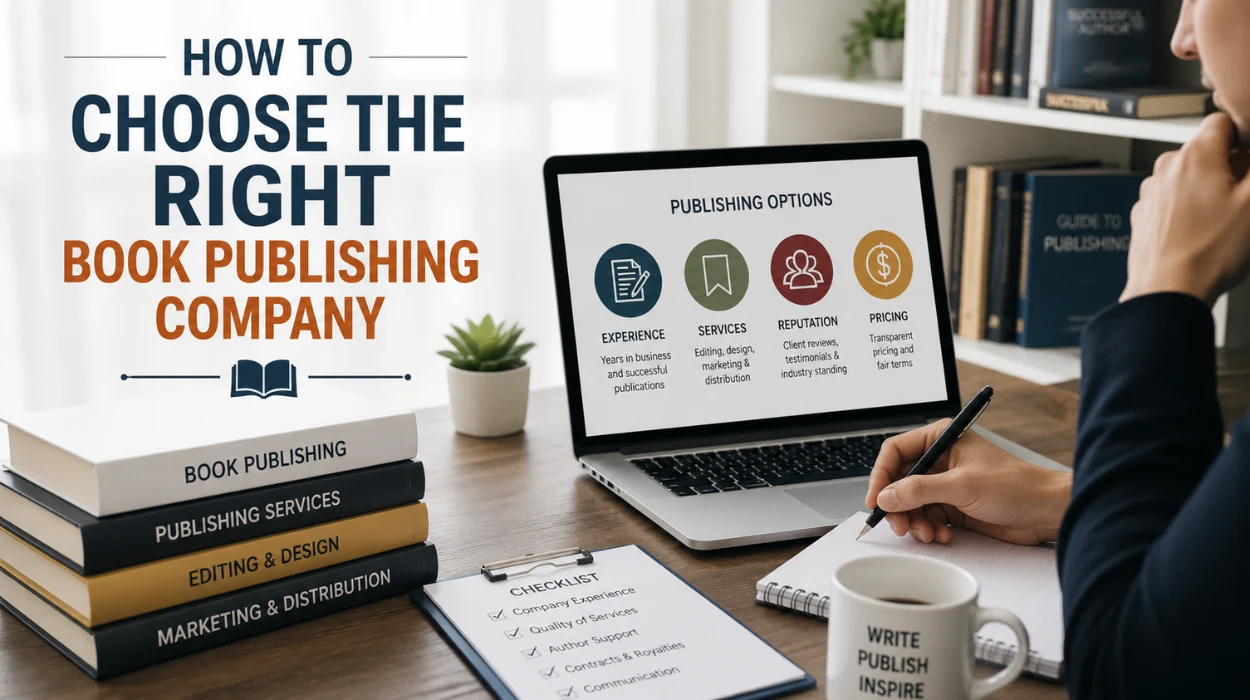
The right book publishing company matches a manuscript’s genre, distribution requirements, and rights structure to a publisher’s catalogue, contracts, and market reach. Selection depends on five measurable factors: publishing model, distribution network, contract terms, editorial process, and rights retention.
What Types of Book Publishing Companies Exist?
Book publishing companies fall into three operating models: traditional, hybrid, and self-publishing platforms, each defined by who pays for production and who controls distribution. A traditional publisher funds editing, design, printing, and distribution in exchange for exclusive rights and a royalty share. A hybrid publisher shares production costs with the author while providing editorial and distribution infrastructure. A self-publishing platform transfers full production cost and control to the author while supplying only the technical distribution pipeline.
Traditional Publishers
Traditional publishers such as Penguin Random House and HarperCollins acquire manuscripts through literary agents, fund the entire production cycle, and distribute through established wholesale networks including Ingram Content Group and Baker & Taylor. These publishers apply an acquisitions committee process that filters submissions against sales projections, genre fit, and catalogue balance. Authors accepted by traditional publishers typically receive an advance against royalties, paid before publication and recouped from future sales.
Hybrid Publishers
Hybrid publishers combine author-funded production with publisher-managed editorial and distribution services. This model suits authors who want professional editing and wide retail placement without pursuing agent representation. The Alliance of Independent Authors (ALLi) maintains a published list of vetted hybrid publishers that meet defined standards for contract transparency and royalty accounting.
Self-Publishing Platforms
Self-publishing platforms including Amazon Kindle Direct Publishing (KDP), IngramSpark, and Draft2Digital distribute a manuscript to retail and library channels without an acquisitions filter. The author retains full rights, sets pricing, and receives royalties ranging from 35% to 70% per unit sold, depending on the platform and distribution channel selected. These platforms index new titles into retailer catalogues within 24 to 72 hours of upload, compared with a 12- to 18-month production timeline typical of traditional publishing.
How Does a Publishing Contract Define Author Rights?
A publishing contract defines which rights the author transfers, for what territories, for what duration, and under what reversion conditions. Rights categories include print rights, digital rights, audio rights, translation rights, and film or television adaptation rights, and each can be licensed separately or bundled. A territory clause specifies where the publisher can sell the work — for example, North American rights only, versus World English rights covering the UK, Australia, and other English-language markets. A reversion clause states the conditions under which rights return to the author, commonly triggered when annual sales fall below a specified unit threshold or when the book goes out of print for a defined period, often 12 to 24 months.
Contracts also specify the publisher’s option clause, which grants first refusal on the author’s next manuscript, and a non-compete clause, which restricts the author from publishing a similar work with a competing publisher during the contract term. Authors evaluating a contract benefit from identifying which specific rights are being requested rather than accepting a bundled “all rights” clause, since narrower grants preserve future licensing opportunities such as translation deals or audiobook production through a separate distributor.
What Distribution Channels Determine a Book’s Market Reach?
A book’s market reach is determined by its listing across wholesale distributors, retail platforms, and library supply networks, not by the publisher’s name alone. Ingram Content Group supplies over 40,000 retailers and libraries worldwide through a single distribution feed, making Ingram integration a baseline requirement for any publisher claiming wide availability. Retail listings on Amazon, Barnes & Noble, and Waterstones depend on metadata accuracy, including the ISBN, BISAC subject codes, and cover image specifications submitted at the point of distribution.
Library distribution operates through a separate channel from retail: services such as OverDrive and Baker & Taylor’s Axis 360 supply ebooks and audiobooks directly to public library systems, requiring publisher agreements distinct from retail contracts. A publisher’s distribution reach can be verified directly by searching the ISBN through Bowker’s Books in Print database, which indexes registered titles and their current distribution status.
Evaluating a publisher against defined selection criteria helps authors match production budget, genre, and rights strategy to the correct publishing company for your goals rather than defaulting to the most familiar name in the market.
How Do Royalty Structures Differ Across Publishing Models?
Royalty structures differ by production ownership: traditional publishers pay 7% to 25% of net or list price, while self-publishing platforms pay 35% to 70% per unit because the author absorbs production costs. Traditional print royalties are commonly calculated on net receipts — the amount the publisher actually collects after wholesale discounts — rather than the book’s cover price, which reduces the effective payout percentage. Ebook royalties from traditional publishers average 25% of net receipts, a rate that has remained largely unchanged since major publishers standardised digital contracts around 2010.
Self-publishing royalties operate on a tiered structure. Amazon KDP pays 70% of list price for ebooks priced between $2.99 and $9.99, dropping to 35% outside that price band. IngramSpark applies a fixed wholesale discount, typically 55%, deducted before calculating the author’s share on print titles. Authors comparing models benefit from calculating net income per unit rather than comparing royalty percentages directly, since a 25% royalty on a $25 hardback can exceed a 70% royalty on a $4.99 ebook.
What Editorial and Production Standards Should a Publisher Meet?
A publisher’s editorial standard is measured by the number of edit passes applied before publication, typically developmental editing, copyediting, and proofreading as three distinct stages. Developmental editing addresses structure, pacing, and narrative consistency and occurs before copyediting begins. Copyediting corrects grammar, syntax, and factual consistency at the sentence level. Proofreading catches residual typographical errors after the interior layout is finalised and before print or digital release.
Production standards extend beyond text to physical and digital specifications:
- Verify ISBN registration through the national ISBN agency, such as Bowker in the United States or Nielsen in the United Kingdom.
- Confirm interior formatting meets print-on-demand specifications for trim size, margin bleed, and font embedding.
- Check ebook files validate against EPUB 3 standards for compatibility across Kindle, Apple Books, and Kobo readers.
- Request a proof copy before final approval to inspect binding quality, colour accuracy, and page alignment.
- Confirm metadata submission includes BISAC subject codes, which determine retail category placement.
A publisher unable to document these production stages, or unwilling to supply a physical or digital proof before release, indicates a lower production standard regardless of stated turnaround time.
How Does a Publisher’s Market Reputation Affect a Book’s Visibility?
A publisher’s market reputation affects visibility through trade reviewer access, retail buyer relationships, and catalogue placement priority, not through marketing spend alone. Trade publications including Publishers Weekly, Kirkus Reviews, and Library Journal review titles submitted by recognised publishers on a priority basis, often months ahead of publication, generating pre-release coverage that self-published titles rarely secure through the same channels. Retail buyers at chains such as Barnes & Noble allocate shelf space based partly on publisher track record, meaning an established publisher’s backlist performance influences whether a new title receives front-of-store placement.
Sales tracking through NPD BookScan, the industry-standard point-of-sale monitoring service, records point-of-sale data from approximately 85% of print retail transactions in the United States. Publishers with consistent BookScan performance across their catalogue carry negotiating weight with retailers for co-op placement and promotional positioning that a first-time or independent publisher cannot access. This reputation effect compounds over time, since each successfully distributed title strengthens the publisher’s standing for subsequent submissions to reviewers and buyers.
How Should an Author Evaluate a Publishing Company Before Signing?
An author evaluates a publishing company by verifying its distribution network, requesting royalty statements from existing authors, and confirming rights reversion terms before signing any contract. Direct verification steps include the following:
- Search the publisher’s ISBN prefix through Bowker’s Books in Print to confirm active distribution status.
- Request three author references and contact each one directly regarding royalty payment timeliness.
- Review the contract’s rights reversion clause for specific sales thresholds and time periods.
- Confirm which production costs, if any, the author is expected to cover.
- Check the publisher’s catalogue on Amazon or Ingram to verify listed titles are genuinely available for purchase.
Publishing agreements are legal contracts, and clauses covering rights duration, territory, and reversion carry consequences extending years beyond the initial sales period. Reviewing sample contracts from multiple publishing models — traditional, hybrid, and self-publishing — before submission clarifies which trade-offs between cost, control, and distribution reach align with the specific goals for the manuscript in question.
A publishing decision ultimately rests on matching production investment, rights retention, and distribution reach to the outcome the author is pursuing, whether that outcome is wide retail placement, maximum per-unit royalty, or long-term catalogue control. Authors comparing production and distribution options against defined service criteria can review the Publishing sector service page for the specific standards outlined above.
Ready to get your story published?
Distribute your press release across 500+ trusted media outlets — with editorial review and a full pickup report within 48 hours.
Send Press Release →