
How Successful Shopify Stores Build Profitable Brands
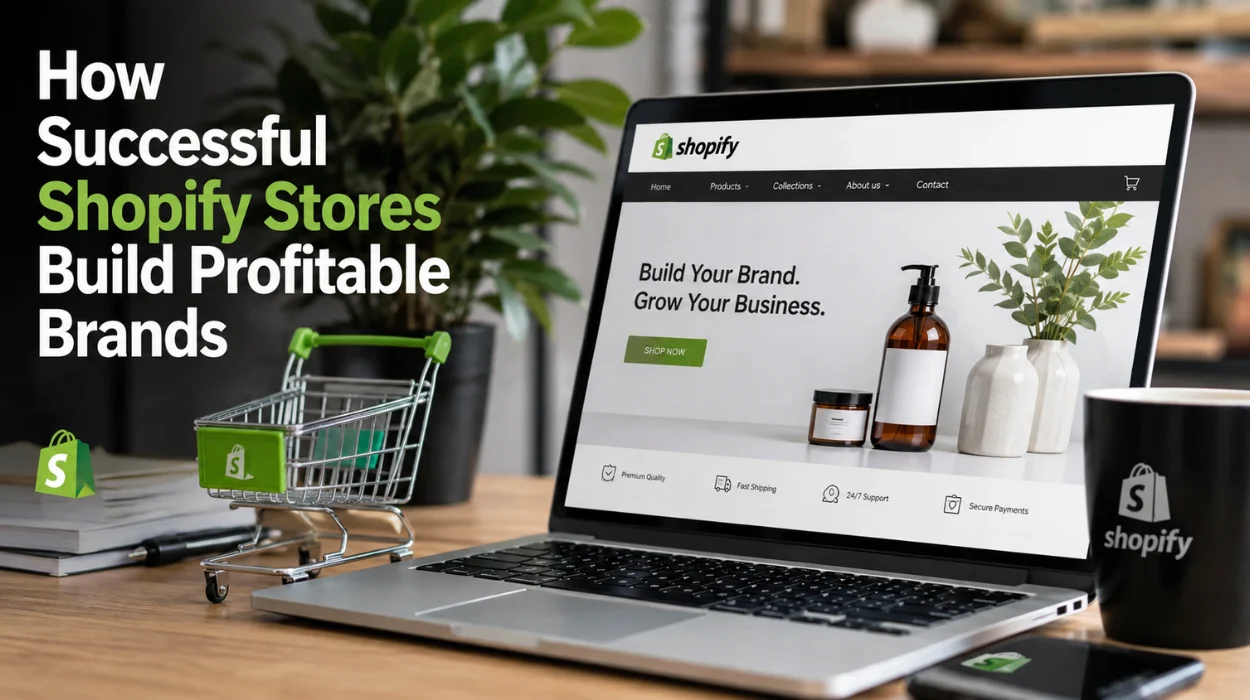
A profitable Shopify brand is built through consistent product-market fit, repeat customer relationships, and controlled acquisition costs. The store stops being a transaction point and becomes a recognisable identity that customers return to without a paid prompt.
What Makes a Shopify Store a Brand Rather Than a Shop?
A brand is a store that customers remember and search for by name, not by product category. A generic shop sells items; a brand sells an identity attached to those items. Shopify itself does not create this distinction — merchandising, visual consistency, and customer experience do. A store selling running shoes becomes a brand when a customer types the store name into Google instead of “running shoes online”. This shift happens once repeat visits, direct traffic, and branded search volume overtake first-time paid clicks. Analytics platforms such as Google Analytics 4 report this shift through the Direct and Organic channel groupings, which grow in proportion as paid channels shrink in dependency. A store tracking this ratio monthly can measure brand formation as a number, not a feeling.
Three structural elements separate a shop from a brand:
- Define a single positioning statement that describes who the product serves and why, displayed consistently across the homepage, product pages, and packaging.
- Standardise visual identity — typography, colour palette, and photography style — across every customer touchpoint, including Shopify’s checkout page and post-purchase emails.
- Repeat the same tone of voice across product descriptions, customer support replies, and marketing copy, so the brand reads as one entity regardless of channel.
How Do Profitable Shopify Brands Structure Their Product Strategy?
Profitable Shopify brands limit their catalogue to a defined product-market segment rather than expanding into unrelated categories. A narrow catalogue reduces inventory holding costs and allows the store to rank for a smaller, more relevant set of search terms. Shopify merchants analysing catalogue performance typically find that 20% of SKUs generate 80% of revenue, a distribution consistent with the Pareto principle applied to ecommerce. Removing or deprioritising the remaining low-margin SKUs frees capital for the products that already convert. This concentration also simplifies paid advertising, since platforms such as Meta Ads and Google Shopping perform better with fewer, higher-signal product feeds than with thousands of low-volume listings.
Product strategy in profitable stores follows three stages:
- Identify the top-performing 20% of SKUs using 90-day revenue and margin data from Shopify’s own analytics dashboard.
- Consolidate marketing spend and homepage placement around those SKUs rather than distributing budget evenly across the catalogue.
- Retire or bundle SKUs generating under 2% of total revenue individually, converting them into limited-time offers instead of permanent listings.
How Does Customer Retention Drive Shopify Store Profitability?
Retention drives profitability because acquiring a repeat customer costs a fraction of acquiring a new one. Research published by Bain & Company found that increasing customer retention by 5% can increase profits by 25% to 95%, depending on the industry. Shopify stores that install post-purchase flows through platforms such as Klaviyo capture a second and third purchase without additional ad spend, converting a one-time buyer into a recurring revenue source. Subscription tools such as Recharge extend this further by converting single purchases into scheduled recurring orders, which stabilises monthly revenue forecasting. A store with a 30% repeat purchase rate carries materially lower customer acquisition risk than one relying entirely on first-time buyers from paid channels.
How Do Repeat Purchase Rates Affect Margin?
Repeat purchase rates raise margin because the marketing cost per order falls with each additional purchase from the same customer. The first purchase absorbs the full acquisition cost, whether that cost came from Meta Ads, Google Ads, or affiliate commissions. The second purchase from the same customer carries only fulfilment and payment processing costs, typically 3% to 4% through Shopify Payments or Stripe. By the third purchase, the customer’s lifetime value has usually surpassed the original acquisition cost, and every subsequent order operates at close to full gross margin. Stores that track cohort-based lifetime value, rather than single-order profitability, identify this margin expansion months before it appears in overall store-level reporting.
How Do Successful Shopify Brands Operate and Generate Online Sales Consistently?
Consistent online sales come from a repeatable operating system that combines inventory planning, content publishing, and customer communication on a fixed schedule. A store that treats sales as an outcome of daily operational discipline, rather than sporadic promotions, produces more predictable revenue. This includes weekly content publishing to maintain search visibility, scheduled email campaigns tied to inventory levels, and inventory forecasting that prevents stockouts on top-selling SKUs. Merchants researching how to structure this system in detail can review approaches to how a store can operate and generate online sales through a documented weekly cadence rather than ad hoc campaigns. Once this cadence is established, sales volume becomes a function of process adherence rather than individual campaign performance, which reduces the store’s dependency on any single marketing channel.
How Does Brand Identity Influence Shopify Conversion Rates?
Brand identity influences conversion rates because consistent visual and verbal signals reduce a shopper’s perceived risk before purchase. A store with mismatched fonts, inconsistent product photography, or generic stock imagery signals lower trustworthiness, regardless of the product’s actual quality. Baymard Institute’s usability research identifies trust signals — including professional photography, clear return policies, and consistent branding — among the leading factors influencing checkout abandonment, which averages close to 70% across ecommerce generally. Shopify themes built on the Online Store 2.0 framework allow granular control over photography placement, typography, and colour consistency without custom development, removing a common excuse for inconsistent presentation. Stores that invest in a single professional photoshoot, rather than rotating supplier-provided images, typically see measurable conversion rate improvement on product pages within one quarter.
What Role Does Data Play in Scaling a Shopify Brand?
Data determines which products, channels, and customer segments to scale, replacing guesswork with measured decision-making. Shopify’s native analytics report revenue by channel, but most profitable brands layer a customer data platform on top to unify behaviour across email, SMS, and on-site activity. This unified view identifies which acquisition channel produces customers with the highest lifetime value, not merely the lowest cost per click. A channel with a higher cost per acquisition but a 40% higher average lifetime value often outperforms a cheaper channel over a 12-month window, a distinction invisible without cohort tracking.
How Do Shopify Brands Use Customer Data for Retargeting?
Retargeting uses stored customer behaviour — browsing history, cart abandonment, and past purchases — to serve relevant follow-up messaging instead of generic promotions. Platforms such as Klaviyo and Meta’s Custom Audiences tool segment customers by these behavioural signals, allowing a store to send a cart-abandonment email within one hour of exit rather than a blanket newsletter days later. Stores segmenting by purchase recency and frequency, rather than treating the entire list as one audience, report materially higher email-driven revenue as a percentage of total sales. This segmentation also prevents high-value repeat customers from receiving the same generic discount codes issued to first-time browsers, preserving margin on the segment least sensitive to price.
How Do Shopify Brands Build Sustainable Profit Margins?
Sustainable margins come from controlling the three largest cost centres: cost of goods sold, customer acquisition cost, and payment processing fees. A brand that negotiates supplier terms as order volume grows, rather than accepting static pricing indefinitely, can reduce cost of goods sold by several percentage points annually. Customer acquisition cost is controlled through the retention mechanisms already covered — a rising repeat purchase rate lowers blended acquisition cost across the full customer base. Payment processing, typically the smallest of the three levers, still affects margin at scale; stores processing high monthly volume can negotiate reduced rates with providers such as Shopify Payments or Stripe once they exceed standard volume thresholds. Reviewing detailed operational approaches for the ecommerce sector can help clarify which of these levers applies first to a given store’s current revenue stage.
Sustainable margin management follows a consistent sequence:
- Audit supplier costs annually and renegotiate terms once order volume crosses agreed thresholds.
- Reduce blended acquisition cost by directing a fixed percentage of monthly budget toward retention campaigns rather than new-customer acquisition alone.
- Monitor payment processing rates against current transaction volume to confirm the store still qualifies for the best available tier.
Profitability in a Shopify store is the compounding result of narrow product focus, repeatable operational cadence, and margin control across acquisition and fulfilment costs, rather than any single marketing tactic applied in isolation.
Ready to get your story published?
Distribute your press release across 500+ trusted media outlets — with editorial review and a full pickup report within 48 hours.
Send Press Release →