
Corporate Communications Press Release: Purpose, Planning and Distribution

A corporate communications press release should do more than announce what an organisation wants to say. It should give stakeholders a clear reason to pay attention. If the news value is unclear, even a well-presented announcement can sound self-promotional or get lost among other corporate updates.
It’s understandable to question whether a press release is the right format, or how it differs from a media statement or internal update. Start with purpose: identify who needs the information, what they need to know and what the organisation wants the communication to achieve.
This article explains how a press release can support wider corporate communications goals, when another format may be more suitable, and how to plan timing, distribution and reporting around clear objectives. It also shows how to connect the message to the audience before distribution begins, so the release has a defined role in the communications plan rather than serving as publicity for its own sake.
Key Takeaways
- Use a corporate communications press release for material organisational news with a clear purpose and relevant audience.
- Set objectives, identify stakeholders and verify the news before shaping the central message and timing.
- Choose a format that fits the announcement rather than treating every company update as a press release.
- Check accuracy, attribution and relevance, and make the headline and opening paragraph direct and easy to understand.
- Plan distribution once the content is approved, then use pickup reporting to assess coverage against your objectives.
What a corporate communications press release does for an organisation
A corporate communications press release is an organisation’s formal, approved account of significant news, prepared to inform journalists and relevant stakeholders. Unlike a general company update, it focuses on a development with wider relevance, explains what has happened and provides reliable details that others can use. It should serve a communications objective, not simply promote the organisation.
A corporate press release turns material organisational news into a clear, attributable announcement that supports consistent communication with media and stakeholders. That purpose shapes its content: facts and context come first, while claims about the organisation belong only where they help explain the news. For an overview of the purpose and structure of a press release, see the format’s established role as an organisation-issued communication.
A release is one component of a broader plan. It can provide a dependable public reference, but it doesn’t replace direct conversations, internal briefings, customer messages or other channels. It works best when its message connects with those activities and gives each audience an accurate starting point.
Which corporate announcements merit a press release?
Consider a release when the news represents a meaningful organisational change or milestone, such as a leadership appointment, a financial milestone, a significant partnership or a development that changes how the organisation operates. Apply an audience test: does this matter to people beyond the team making the announcement, and can the organisation explain why?
Promotional enthusiasm isn’t evidence of news value. Routine updates, minor internal changes or recurring activity may be better suited to a company newsroom, staff bulletin or social channel. Make the significance clear through verifiable details, rather than relying on adjectives such as “exciting” or “ground-breaking”.
How a press release supports stakeholder communication
One approved announcement gives the organisation a consistent source of facts: what changed, when, who is involved and why it matters. Journalists can use it to understand the news; employees can refer to the agreed account; customers and partners can see what the development means for them. Investors may need clear information about milestones or organisational changes relevant to their interests.
Consistency doesn’t mean sending every stakeholder the same message. Employees may need operational context, customers may want to know how a change affects them, and partners may need practical next steps. Follow-up communications can address those needs while keeping the underlying facts aligned with the published release. The release is a shared reference point, not a substitute for audience-specific communication.
Build the corporate press release around purpose, audience and evidence
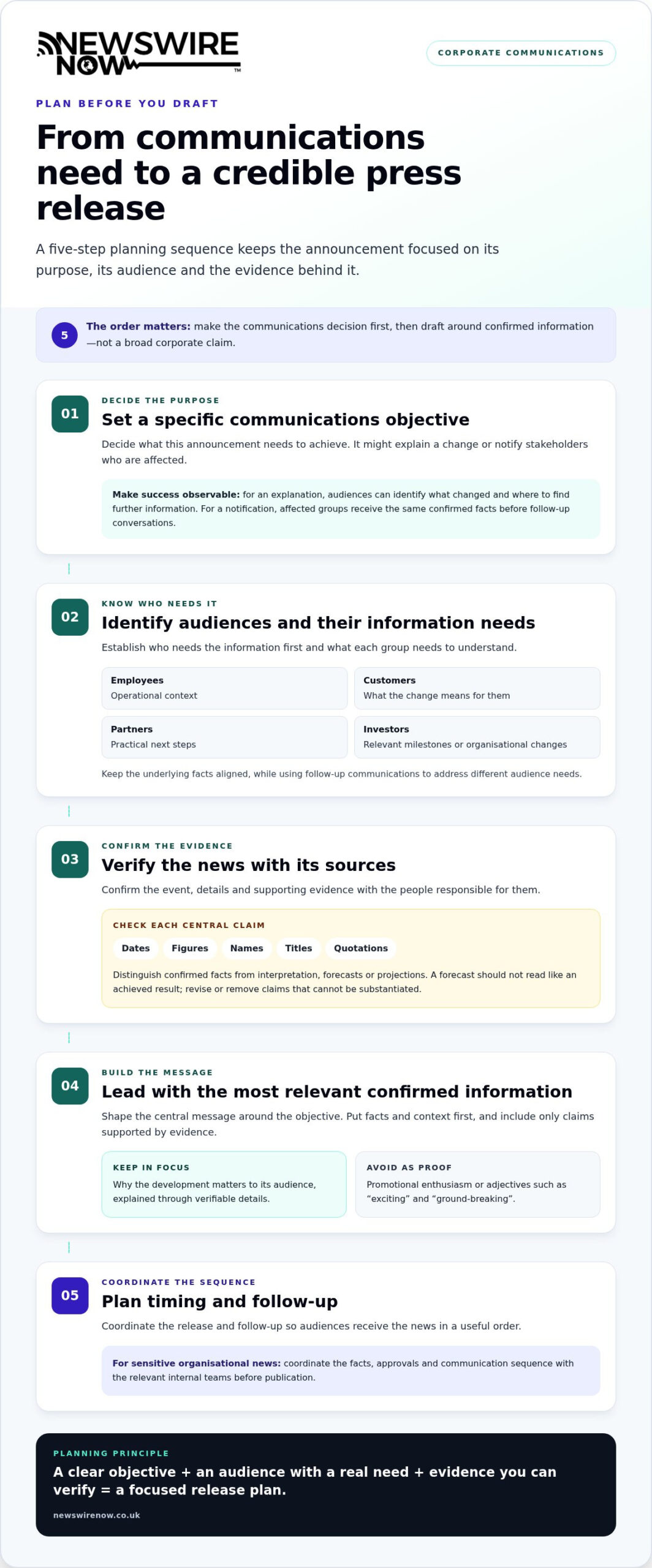
A strong corporate press release begins with a communications decision, not a blank page. Before drafting, agree what the organisation needs to communicate, who needs the information and what evidence supports the announcement. This sequence keeps the release focused and helps prevent a broad corporate claim from outrunning the facts behind it.
Define the objective and audience before drafting, so the message answers a real communications need rather than simply seeking attention. Use this planning sequence:
- Set the objective. Decide what this specific announcement needs to achieve, such as explaining a change or notifying affected stakeholders.
- Identify the audiences. Establish who needs the information first and what each group needs to understand.
- Verify the news. Confirm the event, details and supporting evidence with the people responsible for them.
- Shape the message. Put the most relevant confirmed information first, with context that serves the objective.
- Plan the timing. Coordinate release and follow-up so audiences receive the news in a useful order.
Set a communications objective before drafting
Choose an objective that matches the announcement. Awareness may suit a new strategic partnership; explanation may be needed for a significant organisational change; reassurance may be appropriate when stakeholders need clear context; and stakeholder notification may be the priority when a development directly affects employees, customers or partners. These aims are not interchangeable, so avoid relying on a generic goal such as “raise visibility”.
Define what a useful outcome would look like before distribution. For an explanatory announcement, that could mean audiences can identify what has changed and where to find further information. For a notification, it could mean the affected groups receive the same confirmed facts before follow-up conversations begin. This gives the organisation a practical basis for assessing whether its communication worked.
Match evidence and timing to the corporate message
Support each central claim with evidence. Check dates, figures, names, titles and quotations with their source, and distinguish confirmed facts from interpretation, forecasts or projections. A forecast should not read like an achieved result; an interpretation should be clearly framed as a perspective rather than presented as established fact. If a claim cannot be substantiated, revise or remove it.
For sensitive organisational news, coordinate the facts, approval and communication sequence with relevant internal teams before publication. This may include the teams responsible for the announcement, employee communications and stakeholder relationships. The aim is to avoid conflicting details or audiences learning important information through an unintended channel.
Timing should reflect the announcement’s relevance, readiness and audience needs. A financial milestone may depend on verified figures being available; a partnership announcement may need to align with the parties’ agreed communications. There is no universally optimal publication day. Choose a time when the information is accurate, approved and positioned to reach the intended audiences, then schedule direct follow-up around that plan.
Once the objective, message and approved content are settled, an organisation with a prepared release can consider press release distribution as the next step in its communications plan.
Corporate press release or another format? Choose the right communication
Not every corporate update needs to become a press release. The right format depends on the news value, who needs the information and what response or understanding the organisation is seeking. A routine operational update may belong in an internal bulletin; a significant development with broader relevance may warrant a fuller public announcement.
Use this comparison to match the communication to its purpose. Timing is a planning consideration, not a guarantee of media attention or editorial coverage.
| Format | Purpose | Main audience | Timing | Typical use |
|---|---|---|---|---|
| Press release | Provide a fuller, factual account of news | Journalists and relevant stakeholders | When details are verified and approved | Leadership change, major partnership or organisational milestone |
| Media alert | Share essential details and invite or inform media | Journalists and media contacts | In advance of a time-specific event or briefing | Event, launch or media opportunity |
| Press statement | Set out an attributable organisational position | Media and audiences following a specific issue | In response to a development or enquiry | Clarification or response to an emerging issue |
| Internal announcement | Explain information relevant to employees | Staff and internal teams | Before or alongside external communication, as appropriate | Changes affecting teams, roles or working arrangements |
When a press release is more suitable than a media alert
A press release gives journalists and other readers a fuller account, with context and confirmed details they can assess or refer to. A media alert is shorter: it sets out the essential who, what, when and where, often to invite media to an event or briefing. Choose according to the depth of information and the response sought. Neither format guarantees editorial coverage.
When to use a statement or internal announcement instead
A press statement is useful when the organisation needs to respond to a specific issue with a clear, attributable position, rather than announce broader news. An internal announcement gives employees context through a channel designed for them. If several groups need different details, coordinated communications can pair an internal message with an external statement or release.
Before selecting a format, ask whether the information is genuinely newsworthy to the intended audience, whether it needs a detailed explanation or a concise notice, and who should hear it first. A corporate communications press release is most suitable when a verified development merits a substantive public account. If the update is routine, issue-specific or primarily relevant to employees, another channel may communicate it more clearly. Choose for audience need, not habit.
Prepare a corporate press release for clear, credible communication
Before distribution, review the release as both a factual record and a public-facing message. Readers should be able to identify what has happened, who is speaking and why the news matters without having to decode jargon or search for key details. A disciplined review helps prevent errors, inconsistent statements and avoidable confusion.
Check accuracy, approvals and message consistency
Verify names, job titles, dates, figures and quotations against authorised source material. Confirm that quoted people have approved their words and that figures use the right context and units. Check organisational details, including descriptions of products, services and partnerships, against the organisation’s approved information.
Use this final review checklist before sign-off:
- Accuracy: Can each factual claim be traced to a reliable source?
- Clarity: Can a reader quickly understand what has changed and why it matters?
- Attribution: Are quotations and viewpoints clearly assigned to the right people?
- Relevance: Does each detail help explain the announcement to its intended audience?
- Consistency: Does the release align with approved corporate messages and any relevant disclosures?
- Approval: Have the appropriate internal stakeholders reviewed sensitive claims and quotations?
Depending on the subject, relevant reviewers may include communications, finance, legal or regulatory teams. For example, a release about financial results may need appropriate financial review, whilst an announcement about an organisational change may require checks with the teams responsible for that information. Consider which reviews are relevant to the specific announcement; don’t assume every release needs the same approval route.
Make the announcement easy to scan and understand
A direct headline tells readers what the news is, rather than relying on a slogan or promotional claim. The opening paragraph should quickly establish the essential announcement and its significance. Put supporting context, quotations and background afterwards, in an order that answers likely reader questions without burying the main point.
Keep organisational background brief and connected to the announcement. A long description of the organisation can distract from the news, particularly if it repeats information readers don’t need to understand the development. Use plain language, explain necessary specialist terms on first use and expand acronyms where they may be unfamiliar.
Readability is part of preparation too. Review the release on screen, check that paragraphs are manageable, and make sure headings and supporting material help readers navigate the information. Consider whether the content remains clear when read aloud or accessed using assistive technology. These checks strengthen the release before you choose distribution channels.
Once the copy is approved and ready to reach its intended audience, consider distributing your press release as the next stage of the communications plan.
Plan corporate press release distribution and measure what follows
Distribution is a planned stage, not a substitute for setting the objective, audience and approved message. Before sending a corporate communications press release, decide who needs to see it, which sectors are relevant and what geographic scope fits the announcement. A release about an organisation-wide partnership may call for a different distribution plan from news aimed at a specialist professional audience.
Distribution and editorial coverage are different outcomes. Guaranteed placements through a distribution service are not the same as independent newsrooms choosing to select, edit or report on an announcement. Nor does a placement alone prove that a communications objective has been met. Keep those distinctions clear when setting expectations and evaluating results.
Align distribution with audience and communications goals
Match the distribution route to the readers you intend to reach. Consider whether the news is relevant to particular industries or professions, whether its audience is national or international, and whether employees or other stakeholders need direct communication alongside media distribution. Newswire Now Media Group distributes editorially reviewed releases through an independent network of more than 40 owned publications and more than 500 trusted news outlets across 27 industry sectors and 37 professions. Its distribution service includes guaranteed placements, giving organisations with prepared announcements a route to relevant audiences.
For further detail on planning this stage, consult the UK press release distribution guide.
Use pickup reporting to review distribution activity
A pickup report records placements following distribution, providing a practical view of where the release appeared. Newswire Now Media Group provides a pickup report within 48 hours. Use it to review distribution activity against the plan: were placements relevant to the intended sectors and audiences, and did the documented activity reflect the reach you sought?
Then assess broader objectives separately. If the aim was to explain a change, consider whether stakeholders received the necessary information through follow-up channels. If the aim was to raise awareness, review suitable indicators such as visits to a relevant page or enquiries, where these are tracked. These measures need their own evidence; they should not be inferred from placement counts alone.
Separate three levels of evaluation: distribution activity, audience response and organisational outcomes. A placement report can document the first. Other monitoring may help assess the second and third, but interpretation should account for what the release was designed to achieve and what else was happening at the time. This keeps reporting useful and proportionate, rather than treating reach as proof of impact.
Use the findings to inform future planning. If placements reached relevant outlets but the intended stakeholders still needed more context, strengthen direct follow-up. If the announcement received limited relevant pickup, revisit audience fit, news value or timing for future releases. The aim is not to claim that distribution controls editorial decisions, but to make informed choices about where a prepared announcement is sent and what the resulting evidence can tell you.
Put your next announcement into motion
A well-planned corporate communications press release can support a broader communications goal when its message is clear and its distribution is chosen with care. Start by confirming the release is approved, deciding which audiences matter most and selecting a distribution route that fits the announcement.
For organisations with a prepared release, Newswire Now Media Group provides editorial review and distribution through an independent media network. Its guaranteed placements and pickup reporting can help document distribution activity, whilst your team assesses how that activity relates to the communication’s objectives.
Explore corporate press release distribution and choose a single release or multi-release distribution package for your next planned announcement.
Frequently Asked Questions
Is a corporate press release the same as a company announcement?
No. A corporate press release is a formal announcement prepared for media and other relevant audiences, while “company announcement” can describe many kinds of communication. For example, a staff email about a team meeting is an announcement, but it probably isn’t a corporate communications press release. Choose the format according to who needs the information and what they need to do or understand after receiving it.
Can a corporate press release be used for internal communications?
It can give employees an approved reference, but it rarely covers every internal need on its own. If a restructure affects staff roles, for instance, employees may need practical information about next steps and a way to raise questions. Plan that communication alongside any external release, and coordinate the sequence so employees aren’t learning important details from public coverage before receiving relevant internal context.
How long should a corporate press release be?
There’s no fixed length that suits every announcement. Include enough detail for readers to understand the development, its relevance and the people or organisations involved, then remove material that doesn’t help explain it. A useful edit is to check whether each paragraph adds a fact, context or approved quotation. If it repeats an earlier point or adds unrelated corporate history, cut or revise it.
What happens if a press release receives no media coverage?
No media coverage doesn’t automatically mean the communication plan failed. First review the distribution record, then consider whether the announcement was relevant to the intended audience and whether other planned channels reached stakeholders. For example, an internal message or customer email may have met a notification objective even without press coverage. Record what was achieved and what should change next time, rather than judging success on coverage alone.
Can a corporate press release include confidential information?
No. Include only information approved for external release. Before publication, check sensitive details with the relevant internal reviewers and confirm that dates, figures and quotations are cleared for disclosure. For example, a draft partnership announcement should not reveal terms that the organisations haven’t approved to share. Review the final version against internal messaging so it doesn’t disclose confidential material or create a conflict with other communications.
Does distributing a corporate press release guarantee editorial coverage?
No. Distribution sends a release through a service’s network, while independent newsrooms make their own editorial decisions about whether and how to cover it. Newswire Now Media Group includes guaranteed placements, but these should not be confused with guaranteed independent reporting, endorsement or a particular business result. Use the pickup report to distinguish documented placements from editorial coverage and any wider audience response.
When should a company issue a corporate press release?
Issue one when there’s a verified development that matters to an audience beyond the organisation and warrants a formal public account. A new senior appointment may merit a release if stakeholders need to know who is taking responsibility and when the change takes effect. A routine staff reminder, by contrast, is usually better delivered through an internal channel. Decide based on the news, its audience and the purpose of communicating it.
Ready to get your story published?
Distribute your press release across 500+ trusted media outlets — with editorial review and a full pickup report within 48 hours.
Send Press Release →