
Company Milestone Press Release: How to Turn Progress into News

A company milestone isn’t automatically a story. A new customer record, expansion or anniversary may matter deeply inside the business, but a company milestone press release needs to show why it matters beyond it. Journalists need more than a proud announcement: they need evidence, context and a clear connection to customers, an industry or the wider community.
If you’re unsure whether your progress deserves a press release, that hesitation is useful. It helps distinguish an external story from an internal achievement that may work better as a blog post, email or social update. The aim isn’t to make the milestone sound bigger than it is. It’s to make its significance clear and credible.
This guide will help you assess whether a milestone merits media attention, support your claims with relevant evidence and shape the announcement around a strong external angle. You’ll also learn how to structure the release, prepare it for editorial review and distribution, and use pickup reporting to assess results. From the first “so what?” to post-distribution measurement, each step helps turn company progress into news journalists can evaluate.
Key Takeaways
- Use audience relevance, evidence and context to decide whether an achievement merits a company milestone press release.
- Give each part of the announcement a clear role, from the headline and opening summary to the supporting quote and company boilerplate.
- Look beyond round numbers: show what changed and why the result matters to people outside the business.
- Keep the draft centred on one primary achievement, using secondary developments only to add useful context.
- Separate editorial review from distribution, then use pickup reporting to assess where the announcement appeared.
When Is a Company Milestone Press Release Worth Sending?
A company milestone press release is a formal announcement of a significant, verifiable business achievement. Its purpose is not simply to record an occasion, but to explain a development that may interest people outside the organisation. A routine process change, an internal team celebration or a target reached without wider impact may be worth sharing with staff, but that alone doesn’t make it news.
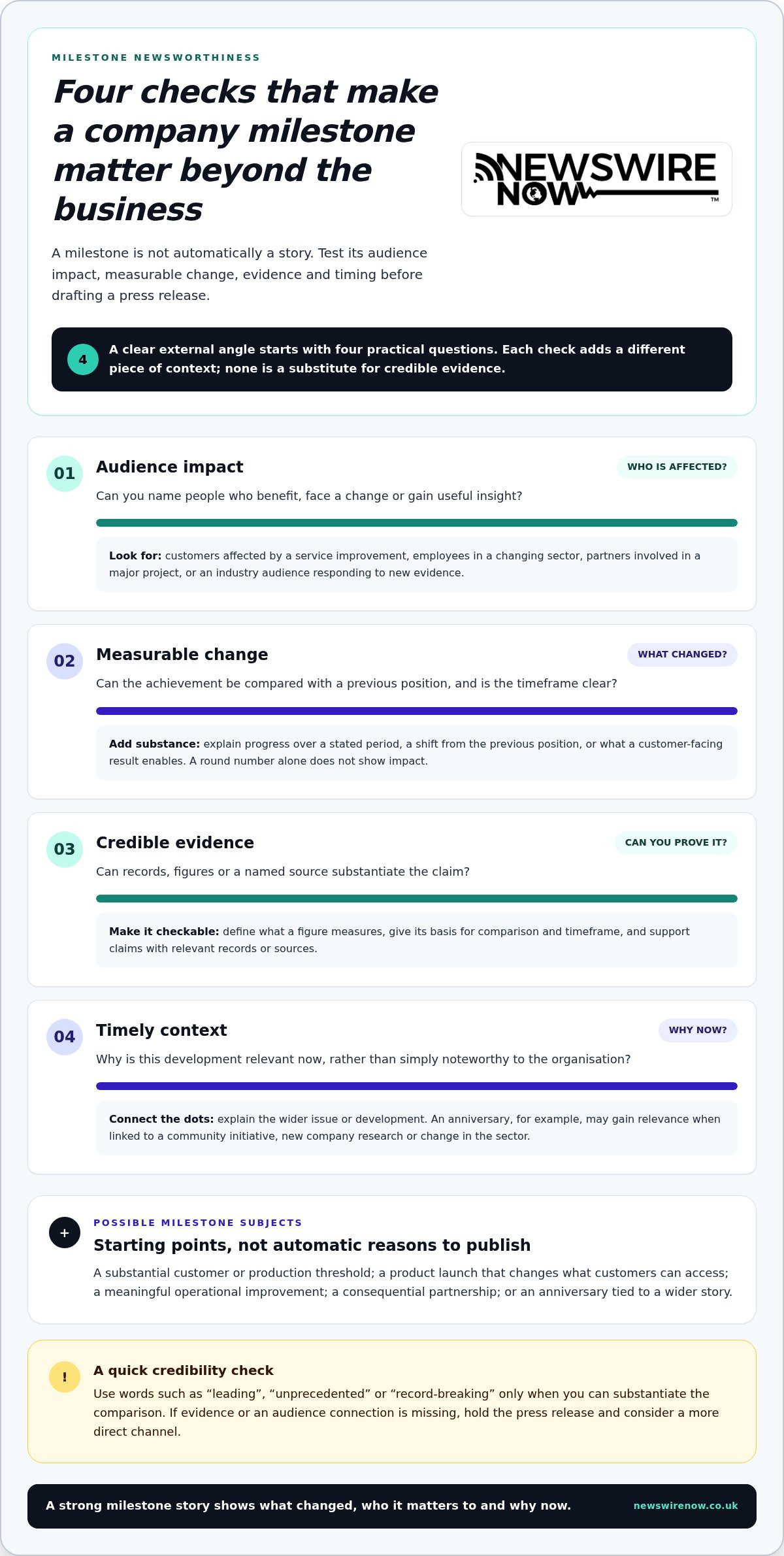
Use four questions to assess the announcement: does it affect an identifiable audience, represent a measurable change, have evidence to support it, and connect to a timely issue or development? Clear answers give you the beginnings of an external angle. A What is a press release? overview can provide useful background on the format, but whether to send one depends on the importance of your particular news.
Which company milestones can support a press release?
Potential subjects include reaching a substantial customer or production threshold, launching a product that changes what customers can access, completing a meaningful operational improvement, forming a consequential partnership, or marking an anniversary tied to a wider story. These are prompts, not automatic reasons to publish. The number of customers, for instance, says little without a timeframe, a basis for comparison or an explanation of what the growth enables.
Consider what makes the achievement distinctive. A clear shift from a previous position, progress over a stated period or a tangible result for customers can add substance. An anniversary may become more relevant if it coincides with a community initiative, new company research or a reflection on change in the sector. Without that wider dimension, the date may be better suited to an internal celebration.
Is the milestone significant to anyone outside the company?
Name the people who could reasonably care: customers affected by a service improvement, employees in a changing sector, partners involved in a major project, or an industry audience responding to new evidence. Then state what has changed and why it matters now. If the answer rests mainly on the company’s pride, the news angle probably needs more work.
Before deciding, test the claim against four practical checks:
- Audience impact: Who benefits, faces a change or gains useful insight?
- Measurable change: What can be compared, and over what timeframe?
- Credible evidence: Can records, figures or a named source substantiate the claim?
- Timely context: Why is this development relevant now, rather than simply noteworthy to the organisation?
Be cautious with words such as “leading”, “unprecedented” or “record-breaking” unless you can substantiate the comparison. A round number is not proof of impact, and a large internal achievement may still have little external relevance. If the evidence or audience connection is missing, hold the press release and consider a more direct channel for sharing the update.
What Should a Company Milestone Press Release Include?
A strong company milestone press release lets readers understand the achievement, assess the evidence and see why it matters without having to sift through promotional language. Organise the announcement in a clear sequence: headline, opening paragraph, supporting detail, context, spokesperson quote, company boilerplate and media contact details. Each part has a distinct purpose, and the key facts should stay consistent from the headline to the final paragraph.
Use the Purdue OWL Guide to Writing Press Releases as a reference for core structure and audience awareness. Then adapt the format to the milestone: a release about a verified figure may need to explain its methodology, while a partnership announcement may need to spell out what the arrangement changes.
How should the headline and opening paragraph frame the achievement?
Lead with the organisation and milestone in specific, measured language. The opening should quickly answer who achieved what and when, then explain why the development matters. If an organisation has reached a stated target, for example, make clear what the figure measures and the period it covers. Avoid vague claims such as “major success”, which tell readers little about the actual news.
Keep secondary announcements out of the lead. A useful headline and opening give the central development priority; background and related details can follow in the body. Purdue’s guidance also emphasises the value of a clear, direct press release structure.
Where do evidence, quotes and company background belong?
Use the body to substantiate the lead. Include relevant figures, dates, comparisons and the basis for any calculation, so readers can understand what the evidence represents. A quote from a named spokesperson should add interpretation, explain the next step or give the achievement human context. It shouldn’t simply restate the headline or add unsupported praise.
Close with a concise company boilerplate that describes the organisation accurately, followed by current media contact details. Keep these sections distinct: the boilerplate provides background, while the contact information enables follow-up.
Before circulating the draft, check the components together:
- Headline and opening: Do they describe the same achievement, organisation and timing?
- Evidence: Are figures supported, defined and consistent throughout?
- Context and quote: Do they clarify significance rather than repeat claims?
- Boilerplate and contact: Are the company description and media details current?
One final read-through for inflated adjectives, conflicting figures and unexplained terms can make the release more credible and easier to assess. Once the announcement is drafted, Newswire Now Media Group provides editorially reviewed press release distribution as a separate step, helping carry a checked release towards its intended audiences.
How Can You Tell a Newsworthy Milestone from a Promotional Claim?
A milestone becomes credible news when the claim is specific, supported and relevant beyond the organisation. Internal pride is understandable, but it isn’t evidence of external importance. Test the announcement with four questions: what changed, how do you know, compared with what, and who might care? If the answers are vague, the release risks reading as promotion rather than a verifiable account of progress.
A round number on its own proves very little. “We’ve reached 10,000 users” leaves readers wondering whether that means registered accounts, paying customers or people who used a service during a defined period. It also gives no basis for judging the achievement. A more informative claim defines the measure, states the timeframe and explains what the change means to customers or the relevant sector.
What evidence makes a company milestone credible?
For each material figure, identify the period covered, how it was calculated and where the information comes from. Use consistent definitions across comparisons: don’t compare all-time registrations with active users in a single month, for example. Check that customer, revenue, production or reach figures are drawn from records that support the wording. If a figure is estimated, label it; if it’s projected, don’t describe it as an achievement already reached.
Keep a simple evidence note alongside the draft. Record the source, date checked, definition and any exclusions that affect the figure. This makes it easier to spot discrepancies between the headline, body and spokesperson quote, and to explain the claim if a journalist asks how it was established. If the records don’t support the wording, revise the claim or leave it out.
How can context make a milestone relevant without overclaiming?
Context helps readers judge scale. Compare the result with a meaningful baseline or a clearly stated timeframe, then connect it to an audience need. For example, a business announcing faster service should explain what was measured and how the change affects customers, rather than relying on “industry-leading” language. External market data can add perspective when it’s reliable, relevant and attributed, but it shouldn’t imply a comparison it doesn’t support.
Separate what has happened from what the organisation believes it means and what it hopes to do next. A completed operational change is a fact if documented; a claim that it will transform an industry is interpretation; a planned expansion is a future intention. Keeping those categories distinct protects the credibility of the announcement.
- Verified fact: Supported by records and stated with a clear definition.
- Interpretation: Explained as the organisation’s view, not presented as proven impact.
- Future plan: Described as an intention, not a completed result.
Before approving a company milestone press release, ask whether an outside reader can understand the evidence, judge the change and see why it matters to them. If not, gather stronger support or reframe the announcement around the clearest confirmed fact. If no external relevance remains, hold the claim back rather than dressing it up with superlatives.
How to Draft and Check a Company Milestone Press Release
A reliable drafting process starts before the headline. Choose one achievement, establish who needs to know about it and decide what the confirmed facts show. This keeps the announcement focused and prevents secondary updates from competing with its main point. Build a company milestone press release around the strongest substantiated development, including supporting details only when they clarify its relevance.
What are the steps for drafting a milestone announcement?
Work through the draft in sequence. First, define the milestone and the audience it affects. Next, gather records and source material, including the timeframe and method behind any figures. Then identify the single reason the achievement matters to that audience. With those elements settled, write the headline and opening, followed by the supporting explanation, spokesperson quote and factual company boilerplate.
Keep a source note for each material claim as you draft. If the milestone is a completed partnership, for example, check the agreed facts with the relevant parties before describing what it changes. If a secondary development helps explain the achievement, add it as context rather than giving it a competing headline. This sequence makes gaps easier to catch before they spread through the release.
A dateline can be included when it suits the release format, but it must be accurate. Don’t add a location simply to make the announcement look complete, and never invent one. Similarly, distinguish the announcement date from the date the milestone was reached if they differ.
What should the final editorial check catch?
Review the finished release against its source material, not just for grammar. Confirm that the headline, opening and body refer to the same achievement, and that every name, date, figure, quote and attribution is accurate. Check the quote with the named spokesperson, and attribute any external information clearly.
Then edit for clarity. Remove jargon a general reader may not understand, comparisons without a sound basis, repeated claims and promotional filler. Replace vague wording with a precise fact, or remove it if you can’t verify it. Read the release aloud: awkward phrasing, buried details and unclear transitions are often easier to spot by ear.
- Accuracy: Match figures, dates, names and claims to their sources.
- Consistency: Ensure the headline, lead and body tell one coherent story.
- Readability: Cut repetition and explain essential specialist terms.
- Readiness: Check quote approval, attributions and current media contact details.
Once these checks are complete, the announcement is ready for a separate editorial review and distribution step. Newswire Now Media Group’s editorially reviewed distribution service provides that next stage.
How to Distribute and Measure a Company Milestone Press Release
A completed draft is not the final step. The announcement still needs editorial review and a distribution route suited to its intended audience. These are separate stages: review checks the release before it is distributed, while distribution carries it through relevant channels. A clear process helps keep the approved facts intact and gives your team a basis for assessing what happened next.
What happens after the release is ready to distribute?
Newswire Now Media Group provides editorially reviewed press release distribution. Its editorial review is a distinct step before distribution, and its network includes more than 40 owned publications and distribution to more than 500 trusted news outlets across 27 industry sectors and 37 professions. This provides access to a broad network, though distribution does not mean every outlet will publish every announcement.
Before selecting a route, match the release’s subject and intended audience to the distribution context. A milestone relevant to a specialist profession may call for different emphasis from an announcement aimed at customers across a wider sector. The UK press release distribution guide offers further context on distribution. Keep the approved version and supporting facts to hand so the announcement remains consistent as it moves beyond the organisation.
How can a pickup report inform the next communications step?
Set an objective for a company milestone press release so you have something specific to assess after distribution. Was the aim to reach a relevant industry audience, make customers aware of a development, or establish a public record of the achievement? Newswire Now Media Group provides a pickup report within 48 hours. Use it to review reported pickups and consider whether they align with your intended audience and communication objective.
Interpret the report carefully. Distribution to a network is not the same as publication by every outlet, and reported pickup alone won’t establish whether the announcement changed audience behaviour or met a wider business goal. Treat the report as a practical record of distribution results, then combine it with your own relevant measures, such as referral activity or enquiries, where available. This helps distinguish where the release appeared from what effect it may have had.
Use what you learn to plan sensible follow-up. If the announcement has appeared in relevant places, your team can share confirmed coverage through its own channels, keeping the wording accurate and linking to the original story where appropriate. For ideas on extending reach through social channels, see the social media news amplification guide.
The final measure is not simply how widely a release travelled. Compare its distribution and reported pickup with the audience you set out to reach, the objective you defined and the evidence available afterwards. That disciplined review can inform the next announcement, from choosing its angle to planning its route to readers.
Make your next milestone count
Your next step is to decide what the achievement should make possible in the conversation with your audience. A well-chosen company milestone press release can give customers, partners or industry readers a clear reason to pay attention, provided the announcement is grounded in evidence and framed around their interests.
When your draft is ready, Newswire Now Media Group combines editorial review with distribution and offers guaranteed placements and a money-back guarantee. Together, these provide a defined route for taking a completed announcement beyond your organisation.
Put your milestone in front of readers with a clear, credible announcement. Distribute your milestone announcement through Newswire Now Media Group.
Frequently Asked Questions
What is a company milestone press release?
A company milestone press release is a formal announcement that presents a notable business achievement in a format suitable for media and public audiences. It can cover progress such as a product launch or a completed partnership, provided the news is relevant beyond the organisation. Unlike an internal update, it gives outside readers enough information to understand the development and why the company chose to announce it.
When should a company announce a milestone in a press release?
Announce a milestone when the achievement is confirmed and there’s a timely reason for relevant audiences to hear about it. For example, a product milestone may be more useful to customers when the product becomes available than during an internal development phase. Consider whether the announcement will inform people, clarify a change or add useful perspective. If the news has no clear audience or timely angle, another channel may be a better fit.
How do you write a press release for a company milestone?
Start by deciding the one point you want readers to remember, then write a direct headline and opening around that point. Explain unfamiliar terms, provide enough detail for the achievement to make sense, and use a spokesperson quote to add insight rather than self-praise. Keep the wording accessible to someone outside your sector. A final read by a colleague unfamiliar with the project can reveal gaps in clarity.
What information should a milestone press release include?
Include the organisation’s name, what the milestone is, when it was reached and the context needed to understand it. Add relevant supporting figures, a clear explanation of how they were measured, and a quote that contributes useful perspective. For example, if announcing a new partnership, identify the parties and explain its purpose. Finish with concise company background and up-to-date contact details for media enquiries.
How can you prove a company milestone is accurate?
Keep a record that supports each factual claim, such as dated business records, signed agreements or documented product data. Check that the source covers the same period and definition used in the release. If two teams hold different figures, resolve the discrepancy before publishing. Ask someone independent of the project to compare the draft with its evidence. Remove any statement that can’t be verified or clearly attributed.
Can a small business issue a milestone press release?
Yes. A small business can announce a milestone if it has a clear reason to matter to an audience beyond the company. The achievement doesn’t need to compete with a large organisation’s scale: a product innovation, a meaningful customer service change or a partnership with practical benefits may be relevant. Explain the specific effect, avoid overstating its reach, and make the scale of the claim clear.
How soon should a company milestone press release be distributed?
Distribute it once the milestone is confirmed, the wording is approved and the announcement still has a timely angle. There’s no universal number of days that suits every milestone. A date-sensitive launch may need a carefully planned release window, while a completed long-term achievement may allow more time for preparation. Avoid sending a draft simply to meet an arbitrary deadline if key facts or approvals remain unresolved.
What happens after a milestone press release is distributed?
Track where the announcement appears and keep a copy of the final release and any resulting coverage. Make sure colleagues who handle customer or media enquiries know what was announced and can respond consistently. If coverage prompts questions, record recurring themes to inform future communications. You can also share confirmed coverage through your own channels, taking care to describe the outlet’s reporting accurately rather than implying endorsement.
Ready to get your story published?
Distribute your press release across 500+ trusted media outlets — with editorial review and a full pickup report within 48 hours.
Send Press Release →