
Common press release mistakes to avoid in writing
Even a small grammar slip can distract from the news. One of the common press release mistakes to avoid is subject-verb disagreement: a singular subject needs a singular verb, while a plural subject needs a plural verb. Put the main point early and use concise sentences so readers can quickly understand the announcement.
Correct wording matters, but a polished release can still miss its mark if key details are missing, the audience is poorly chosen or the timing clashes with a major holiday or industry event. This guide covers grammar and clarity, essential story information, audience targeting and distribution, and when to send your news. Use the practical checks to make sure your release is accurate, focused and ready for its intended audience.
Key Takeaways
- Keep the release concise, then edit for grammar, clear sentences and a single central news angle.
- Make the announcement easy to assess by including the essential organisation and story details.
- Match your release and distribution choices to journalists and channels covering the subject.
- Plan the send date around relevant events and holidays so the timing supports the news.
1. What is one common grammar mistake writers should avoid while writing?
A common grammar mistake is subject-verb disagreement: a singular subject takes a singular verb, and a plural subject takes a plural verb. For example, write “the company announces”, not “the company announce”. Also distinguish “their”, “there” and “they’re”, and check apostrophes, verb tenses and run-on sentences. A final read-through can catch errors that spellcheck misses.
Concise writing still needs enough detail to explain the news. Keep one clear purpose in view and remove sentences that don’t support it. An appointment announcement, for example, needs the person’s name, new role and relevant context, not a long account of unrelated company history. Put the main point early, use familiar language and explain technical terms when readers need context.
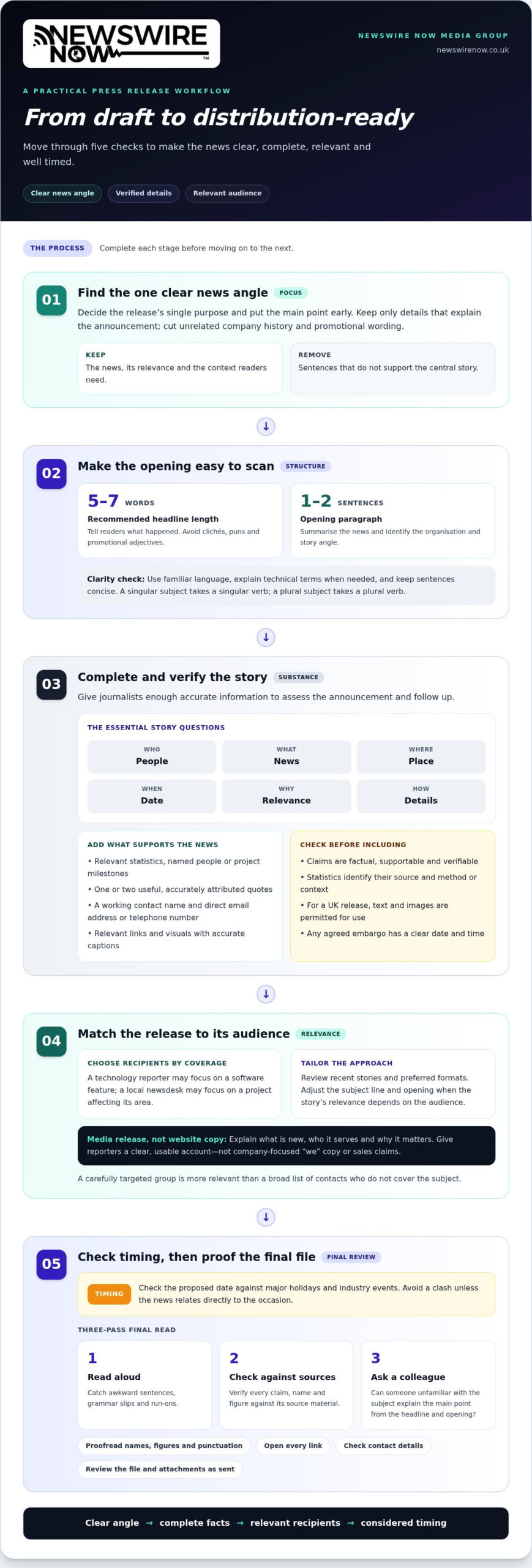
A short, engaging headline should tell readers what happened without relying on a cliché, pun or string of promotional adjectives. Aim for the recommended 5-7 words, then check that the wording reflects the release accurately. In the opening paragraph, summarise the news in 1-2 sentences and make the organisation and story angle clear. For example, name the organisation and the event before adding background.
For a UK release, use text and images you have permission to publish, and take care with personal details, factual claims and statements about identifiable people or organisations. Make sure claims are supportable and avoid wording that could unfairly damage someone’s reputation. If an embargo has been agreed, state its date and time clearly. These checks help prevent avoidable disputes and confusion.
Before sending, test the draft in three steps: read it aloud to catch awkward sentences, compare every claim and name with its source material, then ask a colleague unfamiliar with the subject to explain the news back to you. If they can’t identify the main point from the headline and opening, revise them. Check links and contact details too, so journalists can follow up.
2. Including essential company and story details
A missing date or location can make it harder for journalists to assess a story. In the opening, identify the organisation, where it is based, what has happened and why it matters. For an event announcement, include the date and venue; for a product launch, name the product and explain what is new. Add when and how readers can find out more.
Before sending, check that the release answers who, what, where, when, why and how. Include only details that explain the announcement, such as a relevant statistic, named person or project milestone. A new appointment, for example, needs the appointee’s name and role, plus brief context about the organisation. Leave out unrelated company history and unsupported claims.
Quotes should add a useful perspective, not repeat the headline. Include one or two quotes from a spokesperson or someone involved, and attribute each accurately. Keep claims factual and verifiable. If a statistic comes from a study, identify its source and explain the method or context. A percentage without a clear basis can mislead readers and weaken credibility.
Give journalists a working contact name and a direct email address or telephone number so they can request details or arrange an interview. Add relevant links to background information, event registration or product details. Broken links, vague contacts or a missing response route can obstruct follow-up and make the release less useful for media coverage.
Choose visuals that directly illustrate the story, such as a product image for a launch or an event photograph for an announcement. Add a concise caption that identifies people and places accurately. Avoid decorative images that add no context. As a final step, open every link and review the release as a journalist would, from headline to contact details. If distribution is the next step, explore press release distribution suited to your announcement.
3. Targeting relevant journalists and distribution channels
A press release written for a company website may not work for a journalist. Website copy often speaks as “we” and promotes the organisation, while a media release should give reporters a clear, usable account of the news. For a product launch, lead with what is new, who it serves and why it matters. Remove sales claims and unnecessary background that don’t help explain the story.
Choose recipients whose coverage matches the announcement. A technology reporter may be interested in a new software feature, while a local newsdesk may focus on a project affecting its area. Review each journalist’s recent stories and preferred format before sending. A carefully targeted group is more relevant than a broad list of contacts who don’t cover the subject.
Make the release easy to understand at first glance: use a concise headline, a clear opening and short paragraphs that present facts in a logical order. Explain technical terms for a general audience and keep promotional language out of the body. Journalists should be able to find the news angle, supporting details and a suitable contact without searching through unrelated material.
Formatting errors can make even a strong story harder to use. Keep fonts and heading styles consistent, avoid excessive bold or capital letters, and make sure every hyperlink opens the intended page. Proofread names, figures, spelling and punctuation in the final file, not just an earlier draft. Review it on screen and in the format you’ll send: misplaced line breaks and missing attachments are easy to overlook.
Before distribution, compare the release with the outlet’s recent coverage and consider whether its readers would care about the story. If its relevance depends on a particular angle, tailor the subject line and opening to that audience instead of sending identical copy to every contact.
4. Timing press release distribution
A strong message can lose attention if its release date clashes with a major holiday or industry event. Avoid those dates unless your news relates directly to the occasion. An announcement about a conference, for example, may suit its event dates, while an unrelated product update could be overlooked amid event coverage. Compare the proposed date with the news calendar and the audience’s likely priorities.
Timing also depends on when the news becomes useful. For an event announcement, send the release while readers can still act on the date and location. For a product launch, align distribution with when customers can learn about or access the product. Set the publication date only when spokespeople, supporting details and contact information are ready, so the message is accurate when journalists receive it.
Coordinate the release with the people responsible for the announcement. Confirm the date with the spokesperson, event organiser or product team, then make sure everyone is working from the same written version. If a change affects the launch date or availability, update the release before distribution. Conflicting dates in the headline, body and linked page can undermine credibility and make accurate coverage harder.
Set an internal schedule that leaves time for final review and distribution preparation. For an event, work backwards from its date: confirm the announcement details, approve the final copy, then schedule delivery to avoid competing news where possible. Record any agreed embargo clearly, including its date and release time, and give recipients consistent instructions. Clear timing helps journalists plan their work instead of resolving uncertainty.
Before scheduling, ask whether the date serves the story or simply suits an internal timetable. If distribution planning is the next step, arrange press release distribution around your announcement’s intended timing.
Newswire Now Media Group: Single Press Release Distribution
Newswire Now Media Group can help when your release is prepared and ready for distribution. Its Single Press Release Distribution includes editorial review and distribution to more than 500 trusted news outlets across 27 industry sectors and 37 professions. The independent media network also includes over 40 owned publications reaching millions of readers worldwide.
This is a practical next step when you want your announcement distributed beyond your own channels. After distribution, Media Pickup Reporting provides a report within 48 hours, giving you a record of placements. For organisations planning several announcements, Multi-release Distribution Bundles are another option.
Review your copy, key details and intended timing, then visit Newswire Now Media Group’s website to discuss distribution for your release.
Make your next release more deliberate
Turn the common press release mistakes to avoid into a practical checkpoint for your next announcement. Build a simple approval process: assign one person to confirm facts, another to review the copy and a final owner to approve the audience and send date. A consistent workflow helps teams handle urgent news without skipping essential decisions.
Then consider what support would make distribution more straightforward. Newswire Now Media Group offers single press release distribution, multi-release distribution bundles and editorial review for one-off announcements or planned communications. Choose the option that fits your release schedule and readiness.
Contact Newswire Now Media Group to discuss your next release. With a clear process and a focused message, you can move forward with confidence.
Frequently Asked Questions
What are the most common press release mistakes to avoid?
Common errors include treating an announcement as an advert, combining unrelated news and leaving claims unsupported. Check that every paragraph serves the same story, names and figures match approved records, and quotes reflect what the speaker actually said. For example, don’t describe a feature as “industry-leading” unless the release gives readers a clear, substantiated reason for the claim.
How long should a press release be, and what is the ideal format?
A press release should fit on one page and stay within 500 words. Use a clear headline, a short opening, concise body paragraphs and a closing section with media contact details. Put background information after the central announcement, so readers encounter the news first. If a complex story needs more space, move supporting material to a separate linked resource rather than crowding the release.
How do you avoid jargon, hype and promotional language in a press release?
Replace specialist terms with familiar words, or explain them when they first appear. Swap claims such as “revolutionary platform” for a precise description of what the platform does. Remove superlatives, repeated exclamation marks and adjectives that add no evidence. Ask someone outside the organisation to read the draft. If they can’t explain the announcement plainly, simplify the wording before distribution.
When should you send a press release, and how should you follow up with journalists?
Choose a date when the announcement is ready and relevant, avoiding major holidays or industry events unless your story connects directly to them. Before sending, check the recipient’s coverage and address the message personally. If there’s no response, send a concise, courteous follow-up with useful context rather than repeating the original email. Respect a journalist’s reply or lack of interest.
Ready to get your story published?
Distribute your press release across 500+ trusted media outlets — with editorial review and a full pickup report within 48 hours.
Send Press Release →