
What to Check After Press Release Distribution and Whether to Follow Up

Distribution begins the measurement stage; it does not prove that your story reached the right audience. Knowing what to do after a press release is distributed means checking for relevant coverage, reviewing delivery and pickup data, then following up only when there’s a clear reason. Don’t resend the same pitch if there’s no response.
It’s natural to wonder whether to follow up while you’re waiting to see if journalists have picked up your announcement. Assess the evidence first: a mention in a relevant publication may matter more than a long list of placements with little connection to your audience.
This guide explains how to assess coverage and reach, interpret distribution reports and analytics, and decide whether a follow-up could add value. You’ll also learn what to monitor after publication, so your next step is based on meaningful results rather than distribution activity alone.
Key Takeaways
- Judge coverage by its relevance to your audience and the quality of the publication, not just the number of mentions.
- Use distribution analytics as signals of activity, then compare them with actual coverage and engagement.
- Review reports for useful patterns, including which outlets and audiences your release reached.
- Follow up with a clear, relevant reason to add something new, and stop if repeated messages aren’t getting a response.
- Monitor online and offline mentions so you can assess the release’s reach and inform your next communications step.
1. Assessing media coverage, relevance, geographic reach and engagement
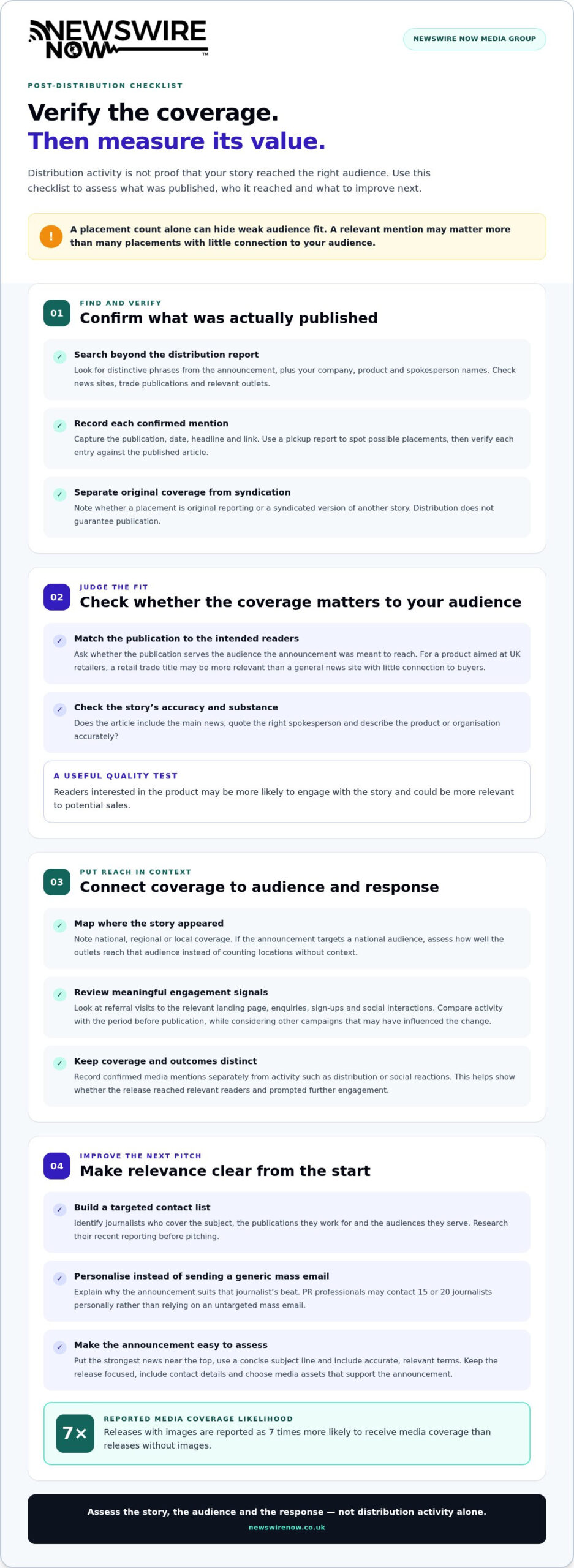
Start by checking whether the release generated editorial coverage, rather than counting distribution alone. Distribution does not guarantee that journalists will publish a story. Search for distinctive phrases from the announcement, along with your company, product and spokesperson names. Check news sites, trade publications and relevant outlets, then record each mention’s publication, date, headline and link. A pickup report can help identify placements, but verify each entry against the published article. Note whether it is original coverage or a syndicated version of another story.
Next, judge relevance. A mention matters most when the publication serves the audience your announcement is meant to reach. For a new product aimed at UK retailers, for example, a retail trade title may be more valuable than a general news site with little connection to buyers. Check whether the article includes the main news, quotes the right spokesperson and describes the product or organisation accurately. A publication with readers interested in the product may be more likely to prompt engagement and potential sales.
Put geographic reach in context. Note whether coverage appears in national, regional or local publications, and whether those audiences match your target market. If your announcement is intended for a national audience, assess how well the outlets reach that audience instead of counting locations without context. Then review engagement signals such as referral visits to the relevant landing page, enquiries, sign-ups and social interactions. Compare them with activity before publication, while considering other campaigns that may have influenced the change.
To improve the quality of future coverage, build a targeted contact list around the subject and audience. Identify journalists who cover that topic, the publications they work for and the audiences they serve. Research each contact’s recent reporting before pitching. A personalised message can explain why the announcement suits that journalist’s beat, rather than sending the same generic pitch to a broad list. PR professionals may contact 15 or 20 journalists personally, instead of relying on an untargeted mass email.
Make the pitch easy to assess. Put the strongest news near the top, use a concise subject line and include relevant terms that accurately describe the story. Keywords should clarify the subject for journalists, not be inserted repeatedly. Keep the release focused on information essential to a potential article, with contact details for requests. Include suitable media assets, such as an image that supports the announcement; releases with images are reported as 7 times more likely to receive media coverage than those without. Track which outlets respond and refine your contacts and pitch for the next announcement.
2. Using distribution software and analytics
Use distribution tools to connect delivery activity with audience response. Depending on the platform, you may be able to send and schedule a release, select industry sectors or geographic areas, and review tracking data. Record the distribution date, selected audience and release title. This creates a baseline for assessing results later, rather than relying on memory or an isolated dashboard figure.
Review available metrics separately. Delivery records show where a release was sent; email-open data shows whether recipients opened a message. Neither proves that a journalist read the full story or published it. Treat opens as a prompt for further review, then search relevant newspapers and online outlets for your company, announcement and distinctive phrases. Record confirmed coverage separately from distribution activity.
Next, connect referral activity to the release. Use your website analytics to check visits to the relevant landing page, where visitors came from and which pages they viewed. If the announcement links to a product page, compare referral traffic with enquiries or other meaningful actions. For example, rising visits without enquiries indicate a different outcome from coverage that brings fewer visitors but more relevant leads.
Social activity offers another signal. Review shares, comments and referral visits from channels such as Twitter, distinguishing reactions to the announcement from unrelated account activity. A post that gets attention but sends no visitors may support awareness, while clicks to a campaign page show a clearer route to further engagement. Record the channel, date and response in one reporting sheet to keep comparisons consistent.
Interpret results in light of your distribution choices. If a release targeted a regional audience, compare its coverage and referrals with that area, not just national totals. If it focused on a specialist topic, examine trade publications and relevant industry stories. A broad reach figure can hide weak alignment; a smaller set of targeted placements may connect more directly with your intended readers.
Use these findings to improve the next campaign. Refine the audience or geographic selection when the data shows a mismatch, and retain the channels that delivered relevant visits or coverage. Keep a record of the release, targeting, analytics and resulting stories. For a consolidated view of placements, Media Pickup Reporting can complement your own website and social analytics.
3. Following up politely and knowing when to stop
A follow-up can put a relevant story back in front of a journalist, but it should add value. First, check whether the journalist covers your subject and whether the announcement still suits their publication. If you have new evidence, an expert comment or a timely development, explain that clearly. Repeating the original pitch gives the journalist little reason to reconsider it.
Time your follow-up around the story’s deadline and the journalist’s schedule. An event announcement may need attention before the event, while a product update can remain relevant for longer. If your first email related to a scheduled feature, refer to that context. Don’t send repeated messages just because tracking shows an email was opened; an open does not confirm interest.
Make each follow-up personal and concise. Address the journalist by name, mention their relevant article or beat, and state what has changed since your first contact. For example, a company announcing a UK launch could share a confirmed launch date or a new spokesperson comment. Keep the subject line recognisable and make the next step clear, such as offering an interview or providing a relevant image.
Do not send a generic pitch to a large list, then follow it with the same release. A mass message to 200 people is not a substitute for targeted contact, and repeated identical emails can reduce the chance of coverage. If there’s no response after a relevant follow-up, stop contacting that journalist about the same story. Record the outcome and revisit the contact only when you have genuinely new information.
Send a correction or update as soon as you identify a material error or change in the distributed release. State exactly what was wrong, provide the correct wording or new fact, and identify which details remain unchanged.
When a journalist makes an enquiry, respond promptly with accurate information that answers their specific question. If they request an interview, data or an image, provide the relevant material and name a contact who can handle further questions.
Keep the exchange professional, even if the journalist declines or doesn’t reply. A brief acknowledgement respects their decision; repeated requests for reasons or coverage can damage the relationship. Track each contact, message date, response and next action so colleagues don’t accidentally send duplicate pitches.
Review follow-up outcomes alongside referral traffic and published stories. A journalist may not cover the original announcement but could return to a later development. Use that distinction to decide whether to approach them with genuinely relevant news, rather than treating every unanswered message as a reason to resend the same pitch.
4. Generating and reviewing distribution reports
Build a report for each release, using consistent fields so you can compare campaigns. Start with the announcement title, sending date, target audience, selected sectors and geographic areas. Add delivery results, confirmed placements and links to published coverage. Keep these categories separate: a release sent to an outlet is not the same as a story published by that outlet. This makes the report useful for decisions, not just record-keeping.
Review each placement individually. Record the publication name, article headline, publication date and the release details it used. Note whether the story includes the central announcement, an accurate quote and a link to your website. A mention that omits the main news may deliver less value than a full article in a publication relevant to your audience. These notes can also help you identify useful examples for future media outreach.
Then add audience response from your own channels. Compare website referral visits, enquiries and relevant campaign activity with the coverage dates. Record social media shares or comments separately, since attention on a platform does not necessarily lead to site visits. For example, a trade story that sends interested readers to a product page may support a different objective from a social post that raises general awareness.
Make the report answer the original campaign objective. If the release supported an event, note coverage that reached its intended audience and any resulting enquiries. For a product announcement, review relevant stories, referral activity and sales signals available to your team. Don’t attribute every change to distribution alone; other marketing activity, seasonal demand or news events may also affect results.
Finish with a short assessment and practical next steps. Identify which sectors or locations produced relevant coverage, where the message was missed, and whether your writing or targeting should change. For example, if regional outlets covered the announcement but national publications did not, refine the next contact list to match your intended reach. Base recommendations on the report’s evidence, not assumptions about a single placement.
Use a consistent template to make each review faster. Store the release, report, coverage links and campaign notes together, then compare them when planning the next distribution. If a report lists pickup activity, verify the published stories and record duplicate syndications separately. This gives you a clearer view of unique editorial attention, distribution reach and results your organisation can act on.
5. How to monitor press release coverage and media mentions?
Set up monitoring before distribution to establish a clear baseline. Save the release headline, company name, product names, spokesperson names and distinctive phrases in a tracking sheet. Search for exact wording and common variations, including shortened company names. For a local announcement, add the town or region; for a product launch, include its category and brand.
Check online sources as well as distribution reports. Search news sites, trade publications, regional titles and relevant blogs for published stories. A report can flag a possible pickup, but open the article to confirm the mention, publication date and context. Record its headline and link, and note whether it uses the announcement accurately or adds new information.
Monitor social platforms for posts that share or discuss the story. Search the company name, campaign phrase and product name, then record the account, post and audience response. A journalist sharing a published article offers a different signal from a user reposting your announcement. Keep these mentions separate so social discussion isn’t counted as editorial coverage.
Include offline coverage in your monitoring. Print newspapers and magazines may carry a story without an easily searchable online version. Check relevant editions directly, or ask colleagues and media contacts to flag a clipping. Log the publication and issue details alongside digital mentions. This creates a fuller record when your target audience uses both print and online sources.
Use a consistent monitoring routine. Assign responsibility for searches, set alerts for key names and phrases, and review results regularly while the announcement remains timely. Integrating distribution with media-monitoring tools can provide real-time updates. Treat alerts as leads, not verified placements: confirm each result before adding it to the coverage record.
For every confirmed mention, capture the outlet, date, format, link or clipping, key message and tone. Note whether the story includes a quote, links to your site or directs readers to a campaign page. Flag inaccuracies promptly and distinguish them from fair differences in emphasis. If the same story appears across several sites, record the original article and related syndications separately.
Finally, connect mentions to audience response without assuming one caused the other. Compare coverage dates with website referrals, enquiries and relevant social activity. A regional newspaper story followed by visits from that area may offer a useful pattern for your next campaign. Keep the evidence together and use it to refine future monitoring terms, target publications and communications decisions.
Newswire Now Media Group: Single Press Release Distribution
Newswire Now Media Group can support your next announcement when you need distribution and a clear record of pickup. Its Single Press Release Distribution includes editorial review, guaranteed placements and a comprehensive pickup report within 48 hours. Releases are distributed to more than 500 trusted news outlets across 27 industry sectors and 37 professions, helping align distribution with your intended audience.
The report gives you a basis for reviewing placements after distribution and planning future communications. If you have several announcements, Multi-release Distribution Bundles offer a way to plan distribution across multiple releases. Choose the approach that fits your release schedule and reporting needs.
To discuss distribution for an upcoming release, contact Newswire Now Media Group.
Turn the next announcement into a stronger campaign
A useful answer to what to do after a press release is distributed is to apply what you’ve learned to your next announcement. Choose one improvement, such as refining the audience, clarifying the central message or preparing a more relevant media asset. Then measure the next campaign against the same objectives, so the results can guide practical decisions.
If you’re planning another release, Newswire Now Media Group offers Single Press Release Distribution, Multi-release Distribution Bundles and Editorial Review. The right option depends on whether you’re distributing one announcement or planning several. Focus on the outcome you need: suitable distribution, a clear process and useful insight for future communications.
Contact Newswire Now Media Group to discuss your next press release. With a clear objective and a considered next step, you can keep building a more informed media strategy.
Frequently Asked Questions
Should you follow up?
Yes, if you can give the journalist a useful reason to revisit the story. A practical answer to what to do after a press release is distributed is to follow up with a new detail, such as an expert’s response to a developing news story or a confirmed change to the announcement. If you have nothing new to add, don’t send another message. Note who you contacted and what you shared.
This is all well and good, but will it get me more coverage?
A follow-up can create another opportunity for coverage when it offers a fresh, relevant angle. For example, a business announcing a service could share a customer case study or a new finding that shows why the announcement matters. That gives the journalist a distinct reason to consider the story. A repeated pitch adds no editorial value, so focus on evidence or developments that matter to their readers.
How soon should you follow up after distributing a press release?
Follow up when the journalist has had a reasonable opportunity to assess the original message and the story is still timely. The right point depends on the news cycle, the publication’s schedule and any deadline you know about. For an event announcement, contact them while there’s still time to cover it. For an ongoing business development, wait for a meaningful update rather than sending a message just to prompt a reply.
How do you pitch a press release to journalists after distribution?
Write a short, individual message explaining why the story suits that journalist’s coverage. Refer to a specific article they’ve written, then lead with the new angle and offer relevant evidence or access to a spokesperson. For example, connect a product announcement to a current issue they already cover. Make clear what’s new since distribution, and don’t attach the same pitch without adding context.
How do you measure press release results, including reach and engagement?
Separate potential reach from audience actions. Log unique publications and published articles, treating duplicated syndications as related placements rather than separate editorial stories. Then use tagged links to identify visits from a specific article, and track useful actions such as enquiries or downloads. Review social responses separately. This shows whether the release travelled, who engaged and which outcomes align with your campaign objective.
How to share a press release on social media and your website?
Share the announcement on social media to communicate with your audience, build your brand profile and direct people to relevant coverage. On your website, use a teaser paragraph linking to the media outlet that published the story instead of reposting the full press release.
Ready to get your story published?
Distribute your press release across 500+ trusted media outlets — with editorial review and a full pickup report within 48 hours.
Send Press Release →