
Press release for a UK book launch: headlines and summaries
A book launch headline needs to make the news clear at a glance. Name the book or series and say what is launching; use the summary to explain the premise, author, intended audience and relevant publication details. For a press release for a book launch in the UK, clear facts give journalists a stronger starting point than a string of promotional claims.
It’s understandable to want a headline that captures a book’s appeal, especially when a new series needs to introduce its identity as well as its first title. But readers need the core facts first to judge whether the story is relevant to them.
This article explains how to shape a concise headline and summary for a UK launch, what to prioritise when announcing a series, and how to keep the wording specific without overloading it. You’ll learn to connect the book’s central idea with clear launch information, making the announcement easier to understand and use.
Key Takeaways
- Lead with a headline that identifies the book or series and makes the launch news clear.
- Organise the release so readers can quickly find the book’s premise, author details and publication information.
- Plan your announcement around the launch date and the time journalists need to consider it.
- Match local newspapers and reviewers to the book’s subject, setting and likely readership.
- Use the ISBN, cover image and author biography to give context and useful supporting details.
Press release headline and summary
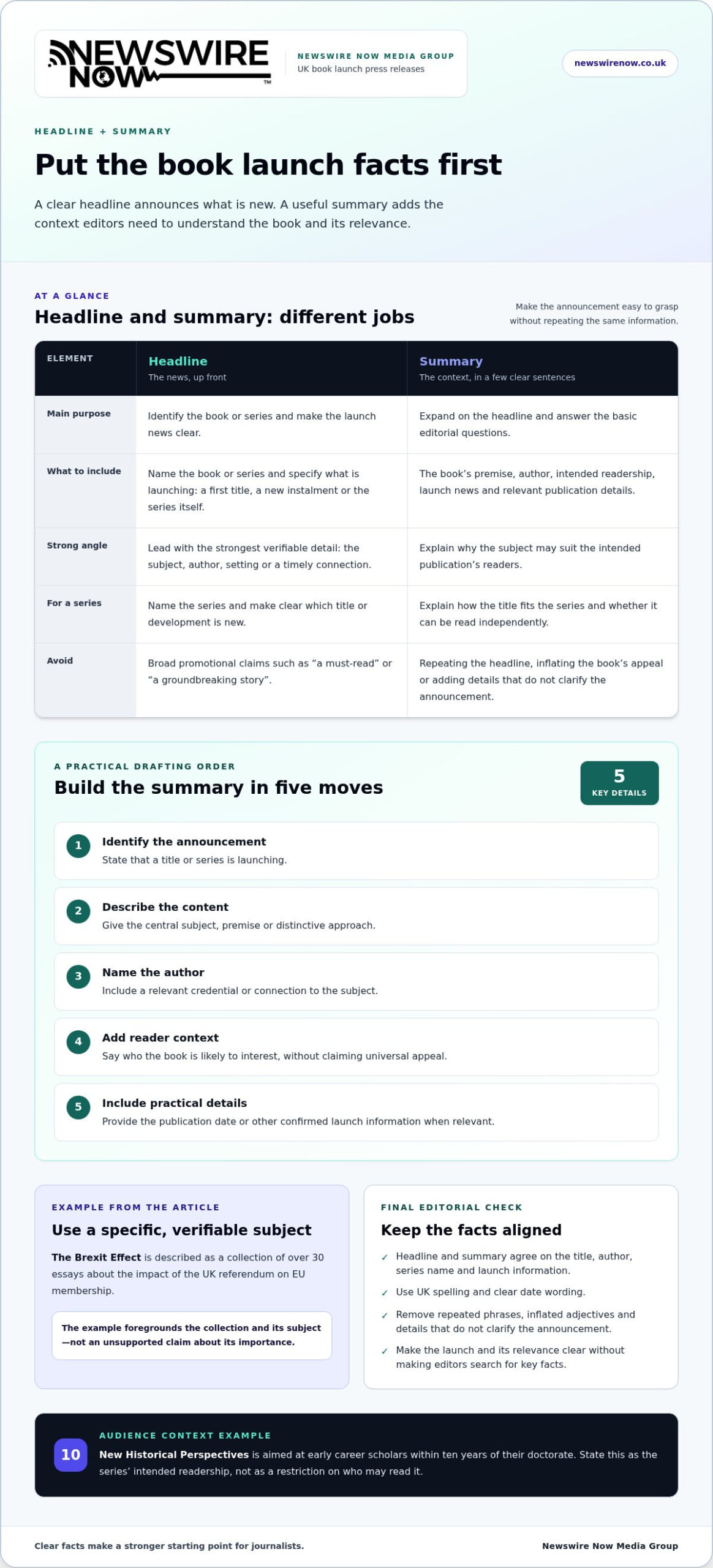
A headline should identify the book, announce the news and give editors a clear reason to keep reading. For a series launch, name the series and specify what is new: its first title, a new instalment or the series itself. Avoid broad claims such as “a must-read” or “a groundbreaking story”. They express opinion, not news.
Build the headline around the strongest verifiable detail. That might be the subject, author, setting or a timely connection. For example, The Brexit Effect is a collection of over 30 essays about the impact of the UK referendum on EU membership. An illustrative headline could foreground the collection and its subject, rather than making an unsupported claim about its importance. Keep the wording factual and relevant to the intended publication.
A useful summary expands on the headline instead of repeating it. In a few clear sentences, answer the basic editorial questions: what is the book, who wrote it, what is it about, who may find it relevant, and what is the launch news? Add publication details when available and relevant. For a series, explain how the new title fits and whether it can be read independently.
Use this sequence to draft the summary:
- Identify the announcement: state that a title or series is launching.
- Describe the content: give the central subject, premise or distinctive approach.
- Name the author: include a relevant credential or connection to the subject.
- Add reader context: say who the book is likely to interest, without claiming universal appeal.
- Include practical details: provide the publication date or other confirmed launch information.
For an academic series, the intended audience can sharpen the angle. New Historical Perspectives is aimed at early career scholars within ten years of their doctorate. If a release concerns a title in that series, the summary can state the intended readership and explain the title’s subject. Don’t imply that every reader must meet that description: it identifies the series audience, not a restriction on who may read it.
Check that the headline and summary agree on the title, author, series name and launch information. A press release for a book launch in the UK should also use UK spelling and clear date wording. Remove repeated phrases, inflated adjectives and details that don’t clarify the announcement. An editor should understand what is launching and why it may suit their readers without searching for key facts.
UK press release format and length for a book launch
Use a clean structure that lets editors scan the announcement quickly. Put the headline first, followed by a short summary, the release date and the main body. Finish with author or publisher details and a contact route for follow-up. For example, a release announcing the opening title in a crime series should make that launch clear before describing the plot.
Keep the layout simple in a document or email. A clear subject line can identify the book and news, while the headline inside the release adds context. Avoid decorative fonts, complicated columns and promotional artwork inserted between paragraphs. These can distract from the text or make it harder to reuse. Use short paragraphs, clear spacing and consistent title formatting instead.
Arrange the content logically. Start with the announcement and its strongest news angle, then provide information that helps readers understand the book. Add the author’s relevant background, publication details and any genuine comment that supports the story. A quote should come from an identified person and be approved for publication. Don’t invent a quote to make the release sound more authoritative.
There’s no single word count that suits every book launch. A debut novel with a straightforward publication announcement needs less explanation than a series launch involving a new setting, subject or publishing initiative. Judge length by whether each paragraph adds a useful fact. Cut sentences that repeat the synopsis or offer unsupported praise. Keep the synopsis distinct from the release: describe the book clearly, but don’t reproduce extensive jacket copy.
A practical format can include these elements:
- Subject line: name the book and the announcement, such as a launch or publication date.
- Headline and summary: state the news, then give the central subject and relevant context.
- Release details: identify the author, publisher and publication information that readers need.
- Main text: explain the story, series connection or distinctive subject in concise paragraphs.
- Notes and contact: add useful author information and a named contact for editorial enquiries.
Before sending, check that the book title, author name, series description and publication details match across every part of the release. A mismatch between the headline and body can create avoidable confusion. Read the text aloud to catch long sentences, then remove any line that does not clarify the launch. If the copy is ready, consider how your finished release can reach media as part of the launch plan.
When should you send a book launch press release in the UK
Send the announcement when the publication details are firm and editors have time to consider the story. The right moment depends on the launch date, the publication’s planning schedule and whether reviewers need an advance copy. A release sent after the book is available can still announce its arrival, but misses the chance to support pre-publication coverage.
Work backwards from the book’s publication date. Confirm the title, author, publisher, availability information and any launch event before preparing the release. Then decide whether the announcement aims to secure advance coverage, mark publication day or report a later event. Each angle has a different useful moment: a reviewer may need time with the book, while a local paper may focus on an author event in its area.
For a series, distinguish the first announcement from later instalments. The first release can introduce the series premise and explain what makes its opening title newsworthy. A later release can focus on a new development, such as the next book’s subject or a public event. Repeating the same announcement without new information weakens its relevance.
Use an embargo only when there’s a clear editorial reason, such as coordinating coverage with a publication date or scheduled event. State the embargo date and time prominently, and give every recipient the same instruction. If an embargo isn’t necessary, state the release date clearly and avoid wording that could be mistaken for a restriction.
Book-industry events can shape the calendar. The next London Book Fair is scheduled for 16-18 March 2027 at Excel London. Its conference programme runs across all three days, with over 100 sessions each year and more than 34,000 publishing professionals invited to attend. A launch connected to the fair should explain the specific news and its relevance, rather than relying on the event name alone.
Before sending, use this sequence:
- Confirm the date: align the release with publication, an author event or another genuine news point.
- Set the purpose: decide whether you are seeking advance attention or announcing availability.
- Prepare supporting material: have the synopsis and any review copy ready for relevant recipients.
- Check timing and wording: make embargo instructions explicit, or remove them entirely.
A press release for a book launch in the UK works best when its timing supports the story’s actual news value. For example, an author appearing at the London Book Fair can connect the announcement to that appearance, while a release without an event should focus on the publication itself. Match the send date to what editors can act on, and reserve later communication for genuinely new developments.
How to find UK local newspapers and book reviewers for a book launch
Begin with the book’s strongest local connection. A writer’s home town, a story’s setting or a subject linked to a particular community can give a local newspaper a clear angle. For example, a novel set in a recognisable part of the UK may interest publications serving that area more than titles without a local link.
Build a focused list by searching for newspapers that cover the relevant town, county or region. Review each publication’s recent arts, books and community coverage. Note whether it features author interviews, local launches, reviews or event listings. A newspaper that regularly covers cultural events is a more relevant target for an author appearance than one whose coverage focuses elsewhere.
Check the publication’s website for editorial contact details and submission guidance. Identify the appropriate books, culture or news contact rather than sending the same message to every department. If a named journalist has covered a similar subject, briefly refer to that work and explain its connection to your book. Keep each pitch specific to the publication’s readership.
Apply the same relevance test to reviewers. Look at the books they cover, the genres they prefer and the format of their reviews. A reviewer focused on historical fiction is unlikely to be the best match for a practical business title. For a new series, explain the first book’s genre and whether it stands alone so the reviewer can quickly assess its fit.
Organise prospects in a simple media list. Record the publication or reviewer, coverage area or subject, contact name, preferred contact route and reason for inclusion. Note any deadline or event connection. This prevents duplicate pitches and helps you tailor each approach, such as linking a local author to a nearby launch event.
- Match location: connect the author, setting or launch event to the publication’s coverage area.
- Match subject: compare the book’s genre and themes with the reviewer’s recent coverage.
- Personalise the pitch: explain why the announcement suits that specific outlet or reviewer.
- Track replies: update the media list when a journalist requests details or a review copy.
For a book with a Scottish literary focus, the Edinburgh International Book Festival offers relevant cultural context. The festival has brought writers and thinkers from around the world together with audiences for over forty years. That connection may support a pitch when the book, author or event genuinely relates to Scotland’s literary community. It doesn’t replace a clear explanation of the news.
Before sending, check that each contact still covers the relevant subject and that your message identifies the book and its local or editorial relevance. A targeted list gives a UK launch announcement a clearer route to the publications and reviewers most likely to understand its story.
Do UK press releases need an ISBN, book cover image, or author biography
An ISBN, cover image and author biography can strengthen a book announcement, but each has a different purpose. The ISBN identifies a particular book edition and format; the cover gives editors a visual reference; the biography provides context about the author. Include details that help recipients identify, understand or assess the title.
ISBN: include the number if it has been assigned and the release concerns a specific edition. It can distinguish a paperback from an ebook, or one edition from another. It doesn’t explain the book’s subject, so pair it with the title, author and format. If an ISBN isn’t relevant to the announcement, the headline and summary can still communicate the launch clearly.
Book cover: a cover image can help an editor recognise the title and assess its presentation. Use the final artwork where possible, and make sure the image matches the book named in the release. For a series, identify which instalment the cover represents. If you’re announcing a forthcoming title before its cover is ready, say so rather than presenting temporary artwork as final.
Keep the image file separate from the main release text unless the recipient requests another format. Use a clear filename, such as book-title-cover, so the image remains identifiable when saved. Add a short caption with the title, author and publisher where relevant. This gives editors useful context if the image is separated from the email or document.
Author biography: include a concise biography when the author’s experience or connection adds context. A local writer could mention a relevant connection to the town; a historian might note a specialism directly related to the book. Avoid a full career history. Choose details that support the announcement, and keep the biography consistent with other author information in the release.
Use this checklist before sending:
- Match the ISBN to the named edition and format.
- Check that the cover belongs to the announced title and series instalment.
- Write the biography in the third person and confirm names and details.
- Label each attachment so recipients can identify its contents.
For example, a release announcing a debut historical novel could include its assigned paperback ISBN, final cover and a short biography mentioning the author’s relevant research background. A new poetry collection might benefit more from a clear author note and cover than from an ISBN in the main text. Choose materials to suit the announcement, not a fixed checklist.
With the release details and supporting materials organised, submit your book announcement for distribution.
Newswire Now Media Group: Single Press Release Distribution
Newswire Now Media Group is a practical next step when your book announcement is ready and you want distribution beyond your own channels. Its Single Press Release Distribution includes editorial review before release distribution to more than 500 trusted news outlets across 27 industry sectors and 37 professions. The company also operates an independent media network of over 40 owned publications reaching readers worldwide.
For a single title or launch announcement, Single Press Release Distribution provides a route to share the release. If you’re planning announcements for several books or series instalments, Multi-release Distribution Bundles may suit that broader schedule. Media Pickup Reporting helps you review coverage after distribution.
To discuss distribution for your book announcement, visit Newswire Now Media Group.
Put your book announcement into motion
A press release for a book launch in the UK is one part of a wider publishing plan. Once your announcement is ready, decide how it should reach its intended audience and whether one launch or several upcoming titles need support. That decision shapes the next step without changing the story your release tells.
Newswire Now Media Group offers Single Press Release Distribution for a standalone announcement, Multi-release Distribution Bundles for a series of releases, and Editorial Review. These options support different launch plans, from introducing a first title to coordinating announcements across a developing series.
Keep the focus on a clear, accurate announcement and a distribution approach that fits your publishing schedule. To discuss the next step for your release, contact Newswire Now Media Group. Your book’s launch story is ready to move forward.
Ready to get your story published?
Distribute your press release across 500+ trusted media outlets — with editorial review and a full pickup report within 48 hours.
Send Press Release →