
Measuring Press Release ROI: A Practical Framework for 2026

Could a press release earn strong coverage and still leave you unable to show whether it was worth the investment? That’s the challenge of measuring press release ROI: distribution and pickup figures show what happened in the media, but they don’t automatically prove business impact. And when people encounter your news through several channels, connecting a later enquiry or sale to one announcement can be difficult.
If your team is working with different metrics, or lacks an agreed objective and baseline, a simple return figure may be hard to defend. The answer isn’t to dismiss coverage, but to separate outcomes you can attribute from the wider contribution a release may make.
This practical framework shows how to choose measures that match each announcement, assess direct results alongside broader signals, and report findings with appropriate care. You’ll see how a pickup report can provide useful distribution evidence without being mistaken for proof of revenue, and how consistent measurement can help refine future distribution and reporting decisions.
Key Takeaways
- Start measuring press release ROI by matching each metric to the announcement’s purpose, rather than relying on a single headline figure.
- Distinguish direct responses, such as tracked visits and enquiries, from media outcomes like relevant coverage and message inclusion.
- Learn why attribution has limits when audiences encounter your news through overlapping channels or act later.
- Use a structured workflow to set a baseline, prepare tracking and report results with clear context.
- Compare performance with the original objective to identify what to refine in your next distribution decision.
What does measuring press release ROI actually tell you?
Measuring press release ROI means assessing what a campaign returned in relation to what it cost. The basic formula is (measured return minus campaign cost) divided by campaign cost. For a financial calculation, the return should be a documented monetary outcome, such as attributable revenue. The result can be expressed as a percentage, but only if the inputs are comparable and the assumptions are clear.
Not every useful result is financial. Relevant media pickups, audience reach, message inclusion, referral visits and engagement can indicate visibility or influence, but they are not revenue by themselves. Treat them as performance indicators, not monetary returns, unless you have a transparent method for valuing them. The Barcelona Principles for PR Measurement reinforce the need to evaluate communication against objectives and outcomes, rather than relying on Advertising Value Equivalency.
A pickup count alone cannot establish press release ROI: it shows that coverage appeared, not whether it produced a measurable business outcome. A media pickup report is useful evidence of distribution and coverage. For example, Newswire Now Media Group provides a pickup report within 48 hours, which can support a wider assessment but cannot, on its own, prove revenue or audience response.
What belongs in a press release ROI calculation?
Define the campaign cost consistently before calculating. Include relevant distribution and preparation costs, and apply the same rules across campaigns so comparisons remain useful. Avoid omitting cost categories in one report and including them in another. Where revenue can be linked to the release through reliable tracking or records, state how you made that connection and what period you assessed.
If the objective is awareness or reputation, report the evidence directly, such as relevant coverage or a change against a defined baseline. Don’t assign a pound value to those signals without a documented, credible valuation method. If a financial return can’t be established, say so and present the measured outcomes separately rather than implying they are revenue.
Why should objectives come before metrics?
The announcement’s purpose determines which results matter. A launch may aim to build awareness among a defined audience; a reputation announcement may focus on accurate message inclusion and relevant coverage; a lead-generation campaign may track enquiries; and a stakeholder update may prioritise reach among specific groups. Agree the objective first, then select measures that show progress towards it.
- Set a baseline: record relevant existing traffic, enquiries or coverage before distribution.
- Define the measurement period: decide in advance when you’ll assess immediate activity and any later outcomes.
- Document the method: note which results count, how they’ll be attributed and any limitations.
These decisions also help put distribution choices in context. The UK press release distribution guide provides background for considering how distribution fits into a campaign. With the objective, baseline and measurement period agreed, you can interpret the results against the purpose of the announcement, rather than treating every pickup or visit as the same kind of return.
Which press release ROI metrics reveal meaningful performance?
Useful measurement separates evidence into three groups: direct audience action, media performance and wider contribution. They answer different questions, so don’t combine them as if a tracked visit, a media pickup and a sale were equivalent. A practical rule is: choose metrics according to the announcement’s stated objective, then report what each measure can and cannot demonstrate.
Which metrics show direct audience action?
Start with activity that can be connected to links or actions you control. Tagged links can identify visits from a release link, while analytics can show what visitors did next. Assess the quality of that activity, not just its volume: a smaller number of relevant visits that lead to a meaningful action may matter more than a larger group that leaves immediately.
- Visits: track visits from tagged release links and compare them with your baseline.
- Enquiries and sign-ups: record completed forms or registrations, not just page views.
- Sales: include only transactions with a defensible connection to release activity.
For leads or sales, record the attribution method and any gaps, such as a later purchase through another channel. The PRSA Guide to Measuring Public Relations ROI offers further guidance on evaluating outcomes and selecting measures that fit campaign goals.
How should media coverage and wider signals be reported?
Assess pickups for relevance, not just quantity. Record which outlets published coverage, whether it included the announcement’s key messages, and whether it linked to a useful destination. Audience fit matters: coverage in an outlet your intended audience uses can be more pertinent than a larger pickup count with little connection to your goal.
- Media evidence: relevant pickups, message inclusion, links and outlet-audience fit.
- Contribution signals: branded search activity, social discussion and assisted conversions.
- Context: the period measured, the baseline and any known tracking limitations.
Reach, mentions and search activity can indicate increased visibility or interest, but they don’t automatically prove that the release caused a sale. Assisted conversions may show that a release was one touchpoint in a longer journey; describe it as a contribution unless the evidence supports direct attribution. For campaigns focused on trust and perception, pair coverage and discussion with defined reputation measures. This online reputation management guide provides context for considering reputation outcomes.
Keep the categories distinct in your report: direct-response measures show recorded actions, media metrics show the nature of coverage, and contribution indicators show related changes that may have several causes. A pickup report, such as the report provided within 48 hours by Newswire Now Media Group, can support the media-performance view, but it isn’t proof of revenue. Once your measures are agreed, consider editorially reviewed distribution with pickup reporting as part of a campaign built around those objectives. This distinction is central to measuring press release ROI credibly.
Can you measure press release ROI precisely? Separate attribution from contribution
Sometimes, but rarely in a way that captures every influence on a decision. A tagged link can show that someone visited after clicking through from a release. It can’t show whether they had already seen coverage elsewhere, heard about the announcement from a colleague or returned later through a search engine. Treat the evidence with care, not as a reason to abandon measurement.
Directly attributable activity
What the tracking or records connect to a release, such as a tagged visit or a recorded conversion from that visit. This is evidence of tracked activity, not proof that the release was the only influence.
Assisted or contextual contribution
Signals that may reflect a release’s role alongside other influences, such as an assisted conversion, a change in branded search or a relevant enquiry following coverage. These support a contribution claim, not sole attribution.
What can attribution data prove, and what can it suggest?
Tagged visits and recorded conversions establish what your tracking captured. They don’t represent every reader or every route to purchase. Links may be shared without their tags, people may encounter the news through several channels, and decisions can take time. In a report, reserve “attributed” for activity connected by your stated method; describe other plausible effects as “assisted” or “indicative”.
This distinction protects the credibility of executive summaries and client reporting. “Tagged release visits led to recorded enquiries” describes observed evidence. “The release caused an increase in sales” makes a stronger causal claim, which needs evidence that separates the release’s effect from other activity. A timing overlap alone isn’t enough.
How should teams handle longer-term brand effects?
Brand effects are harder to isolate, but disciplined comparison can still reveal useful patterns. Track branded search, relevant enquiries or audience response against a baseline set before the announcement. Use consistent measurement periods, and record other campaigns or events that could affect the same indicators. Describe a rise after coverage as a change observed during the period, not automatically as an outcome caused by the release.
For example, if branded searches rise after an announcement while paid media is also running, report the increase alongside that context. Don’t assign the full change to the release or convert estimated reach into pounds without a documented valuation method. In measuring press release ROI, a transparent estimate with stated limits is more useful than a precise-looking figure built on assumptions.
Imperfect attribution doesn’t make measurement pointless. It changes what conclusions you can responsibly draw. Separate evidence into three clear labels:
- Observed: directly recorded activity, such as tagged visits or tracked enquiries.
- Assisted: a release appears in a journey that included other known touchpoints.
- Indicative: a related change, such as increased branded search, that may have several explanations.
This framework helps teams identify patterns, compare campaigns consistently and improve tracking over time. It also makes uncertainty visible, so readers can distinguish what the data demonstrates from what it reasonably suggests.
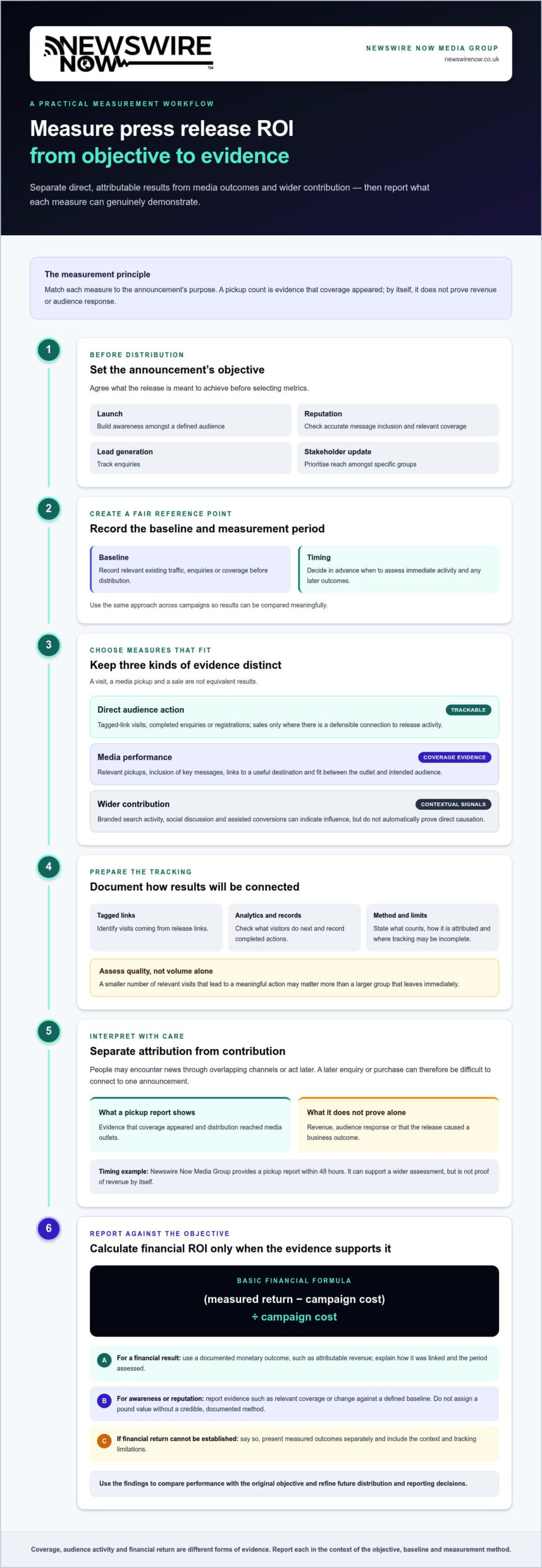
How to measure press release ROI from planning to reporting
A reliable process starts before distribution. Set the measurement rules in advance, then collect coverage evidence and digital activity against the same objective. This makes it easier to explain what the campaign achieved, what can be attributed to it and where the evidence has limits.
- Define the objective. Choose one primary goal, such as generating qualified enquiries, and a small set of supporting indicators. Avoid trying to make one announcement accountable for every marketing outcome.
- Set the baseline. Record the relevant starting measures, such as typical referral visits, enquiries or branded search activity. Note the period covered and use a comparable timeframe for your review.
- Prepare tracking. Create consistent campaign tags for links you control, such as a link in your newsroom or email. Check that analytics records visits and meaningful actions, and agree how enquiries or sales will be connected to the campaign.
- Record campaign costs. Apply a consistent approach to relevant distribution and preparation costs. The UK distribution and pricing guide can help put distribution choices and cost inputs in context. Record costs in pounds and note what you have included.
- Monitor activity. Review tagged-link traffic and on-site actions alongside media coverage and pickup records. Check that pickups are relevant and record whether they include key messages or links. Keep the evidence sources distinct.
- Analyse and report. Compare results with the baseline and original objective. Apply the ROI formula only where the return and campaign costs are documented; otherwise report the outcomes separately and explain the limits.
What should be prepared before distribution?
Keep the setup practical: name the objective, select a few supporting indicators, record the baseline, apply consistent tags and confirm analytics is capturing the intended events. Set the review period before launch, including when you’ll assess early activity and any later outcomes. This prevents teams from changing the success criteria after seeing the results.
What belongs in a useful ROI report?
Give readers a clear record of the objective, distribution evidence, tracked actions, campaign costs and calculation assumptions. Separate directly recorded outcomes from assisted results and longer-term indicators. State data gaps plainly, including untagged links or activity that can’t be connected to the release, then recommend one evidence-led improvement for the next campaign, such as better link tagging or clearer conversion recording.
Consistent preparation turns measurement into a repeatable process, not a retrospective search for favourable numbers. If your campaign objectives and tracking criteria are set, explore editorially reviewed press release distribution as a next step in planning a measurable campaign.
How can press release ROI guide your next distribution decision?
Judge distribution against the objective you set before the campaign, not against a single headline figure. If the goal was to reach a relevant audience, assess outlet fit and message inclusion; if it was to generate enquiries, look for credible evidence of audience action. Strong distribution evidence with few tracked responses may still indicate that the announcement reached outlets, but it also prompts a closer look at the message, audience and next step.
Diagnose the result before changing the plan. Weak performance may reflect audience mismatch, a message that didn’t prompt action, tracking gaps, timing or factors beyond distribution. Separate these possibilities using the evidence available, then change the part of the campaign the evidence points to. Don’t discard useful distribution simply because a separate conversion measure is weak, or assume distribution succeeded commercially because placements were recorded.
How can results improve the next campaign?
Retain measures that answer the original business question and remove vanity metrics that don’t inform a decision. Compare coverage relevance with tracked audience actions: relevant coverage but few visits may point to a weak call to action or an untracked route, whilst visits from the wrong audience may suggest a targeting issue. Keep assumptions consistent so comparisons across campaigns remain meaningful.
- Relevant coverage, low response: review the message, destination and call to action.
- Irrelevant pickups: reassess whether the distribution audience matches the announcement’s purpose.
- Little recorded activity, uncertain tracking: improve link tagging and analytics before drawing conclusions.
- Useful actions with incomplete attribution: report what was observed, note the gap and strengthen measurement for next time.
These are diagnostic prompts, not automatic verdicts. Record the rationale for each adjustment, along with the objective, chosen metrics, review period and any attribution assumptions. That gives the team a consistent basis for comparing future results and shows decision-makers why the next distribution plan has changed.
What distribution evidence can Newswire Now Media Group provide?
Newswire Now Media Group distributes editorially reviewed press releases through a network of more than 40 owned publications and more than 500 trusted news outlets. The service includes guaranteed placements and a pickup report within 48 hours. Use that report to assess distribution and recorded pickups; combine it with your own objective-aligned measures to evaluate audience response and business outcomes.
Editorial review and network distribution are evidence about the campaign’s distribution component, not proof of revenue or audience action. For a defensible evaluation, compare those records with relevant coverage, tracked activity and the original goal. Measuring press release ROI becomes more useful when findings guide a specific next step rather than reduce the decision to one number. Explore press release distribution as part of a campaign planned around clear objectives and measurement criteria.
Make your next distribution decision evidence-led
The value of measuring press release ROI isn’t limited to proving a return after the fact. It gives your team a stronger basis for choosing what to measure, what to refine and where to focus the next campaign. Use each report to test one clear question: did the announcement reach the audience it was intended for, and did the evidence support the outcome you set out to achieve?
Keep the next step practical. Carry forward the measures that informed a decision, improve any tracking that left results uncertain, and record why you’re changing or retaining your approach. Over time, this creates a more consistent view of performance without forcing every campaign into a single definition of success.
When your objectives and measurement criteria are ready, consider distribution that fits the campaign. Explore press release distribution and plan your next announcement with a clearer basis for assessing its results. Each well-measured campaign can make the next decision more confident.
Frequently Asked Questions
How do you calculate press release ROI if there are no direct sales?
If there are no documented sales, don’t present a financial ROI figure as though a monetary return has been proven. Measure the outcome that matches the campaign instead, such as qualified enquiries, registrations or relevant coverage, and report it alongside campaign cost. You could calculate cost per recorded enquiry, for example, but label it clearly as a unit-cost measure, not ROI. This keeps measuring press release ROI credible when revenue isn’t the right available measure.
Can you measure press release performance without UTM parameters?
Yes, although it may be harder to isolate visits from release activity. Review referral data in your analytics, compare activity on a dedicated landing page, and check enquiry forms or customer records for people who mention the announcement. A short post-enquiry question about how someone heard about you can add useful context. Treat these sources as supporting evidence: without consistent tagging, some visits may be missed or attributed to another channel.
How long should you track a press release after distribution?
Set the review window before distribution and match it to the expected pace of the outcome. Check early referral visits and coverage soon after publication, then monitor later actions such as enquiries or sales over a longer period. A 90-day window can provide a practical view of delayed responses, but it isn’t a universal rule. Record the same window for comparable campaigns, and note any major activity during that period that could affect results.
What is the difference between press release ROI and media reach?
Media reach estimates how many people may have had the opportunity to encounter coverage; it doesn’t show how many actually read, remembered or acted on it. ROI compares a measured return with campaign cost, and a financial ROI requires a documented monetary return. Reach can help explain the scale of distribution, but it shouldn’t be reported as revenue. Keep the measures separate so managers can see exposure and business outcomes without conflating them.
Should earned media value count as press release revenue?
No, not as revenue. Earned media value, or AVE, assigns an estimated monetary equivalent to coverage, but it doesn’t demonstrate income generated by the release. The Barcelona Principles reject AVE as a valid measure of communication value. Report coverage quality and relevant audience response directly instead. If your organisation uses an estimated value for internal comparison, disclose the method and keep it separate from sales, profit or any financial return calculation.
What should a press release ROI report show to a manager?
Give a manager enough context to make a decision: the campaign objective, reporting period, distribution evidence, recorded outcomes and relevant costs. Show how any return was calculated, identify which results are directly recorded versus estimated, and flag tracking gaps that could affect interpretation. End with a clear recommendation, such as retaining an effective audience approach or improving conversion tracking. A concise report should make both the evidence and its limitations easy to assess.
Ready to get your story published?
Distribute your press release across 500+ trusted media outlets — with editorial review and a full pickup report within 48 hours.
Send Press Release →