
How to Use a Press Release for a Brand Awareness Campaign in 2026

A press release for brand awareness campaign activity can do more than announce company news. It can introduce your business to relevant audiences, but distribution alone will not make a story memorable. The announcement needs a clear news angle, relevant reach and a way to assess whether visibility improved.
It is reasonable to question whether a release can build awareness. Reach and pickup counts do not show who noticed or remembered your brand. The difference lies in treating the release as one part of a planned campaign, rather than an isolated media send.
This guide sets out a practical workflow, from defining an awareness objective and shaping an audience relevant announcement to choosing distribution and measuring results. You will learn how to distinguish delivery metrics, such as placements and pickup reports, from stronger signs of audience response, including referral traffic, branded search activity and engagement. The aim is to connect a newsworthy story with the right channels and clear measures of visibility.
Key Takeaways
- Set one primary awareness objective before shaping the announcement, so each campaign decision supports a clear outcome.
- Build a press release for brand awareness campaign around timely news that matters to the audience, not a sales message dressed up as an announcement.
- Compare newswire distribution, direct media outreach and owned channel amplification by audience fit, editorial handling, reporting and control.
- Use placements and pickups to assess distribution activity, then look for audience and brand response signals to understand what happened next.
- Editorial review and sector coverage can help align distribution with the people you want to reach.
What a press release can, and cannot, do for brand awareness
Brand awareness is the familiarity and recognition your business has among a relevant audience. People may know your name, recognise what you offer or recall your organisation when a need arises. A press release can contribute by putting your brand and its news in front of people who may not have encountered it before. Think of it as an introduction, not a shortcut to lasting recognition.
A press release follows a recognised format for sharing an official announcement with the media. For an awareness campaign, it gives an organisation a structured way to explain what has happened, why it matters and who is involved. The announcement might cover a product launch, new research, a partnership or a leadership appointment, provided the news has clear relevance beyond the company itself.
Keep the stages distinct. Distribution sends the release through selected channels; publication means an outlet has carried it. Readership describes the people who may encounter that publication, while attention depends on whether they notice and engage with the story. Audience response comes later, when someone remembers the brand, searches for it or takes another relevant action.
Potential visibility is not guaranteed audience recognition.
When a press release is a credible awareness tactic
Start with a meaningful development, then connect it to an audience need or wider industry change. A partnership could matter because it makes a useful service available to a new group; research could reveal an issue that professionals need to understand. Explain the significance in plain terms and make the brand’s role clear. An announcement without a timely angle or audience relevance can read like self promotion, giving editors and readers little reason to pay attention.
Set expectations before choosing press release distribution
Distribution is one channel in a broader brand programme, not a replacement for consistent communications, useful content or ongoing engagement. Newswire Now Media Group distributes editorially reviewed releases through more than 40 owned publications and over 500 trusted news outlets across 27 industry sectors and 37 professions. This network can create opportunities for relevant audiences to encounter an announcement, but exposure alone does not establish familiarity or recall.
Be precise about what a placement commitment means. Guaranteed placements concern publication on specified outlets or networks; they do not guarantee that people will read a story, remember the company or become customers. Treat awareness as the intended outcome, and use the release to earn an introduction through news that deserves attention. The sections below explain how to assess campaign activity separately from signs of audience response.
Plan a press release campaign around one clear awareness objective
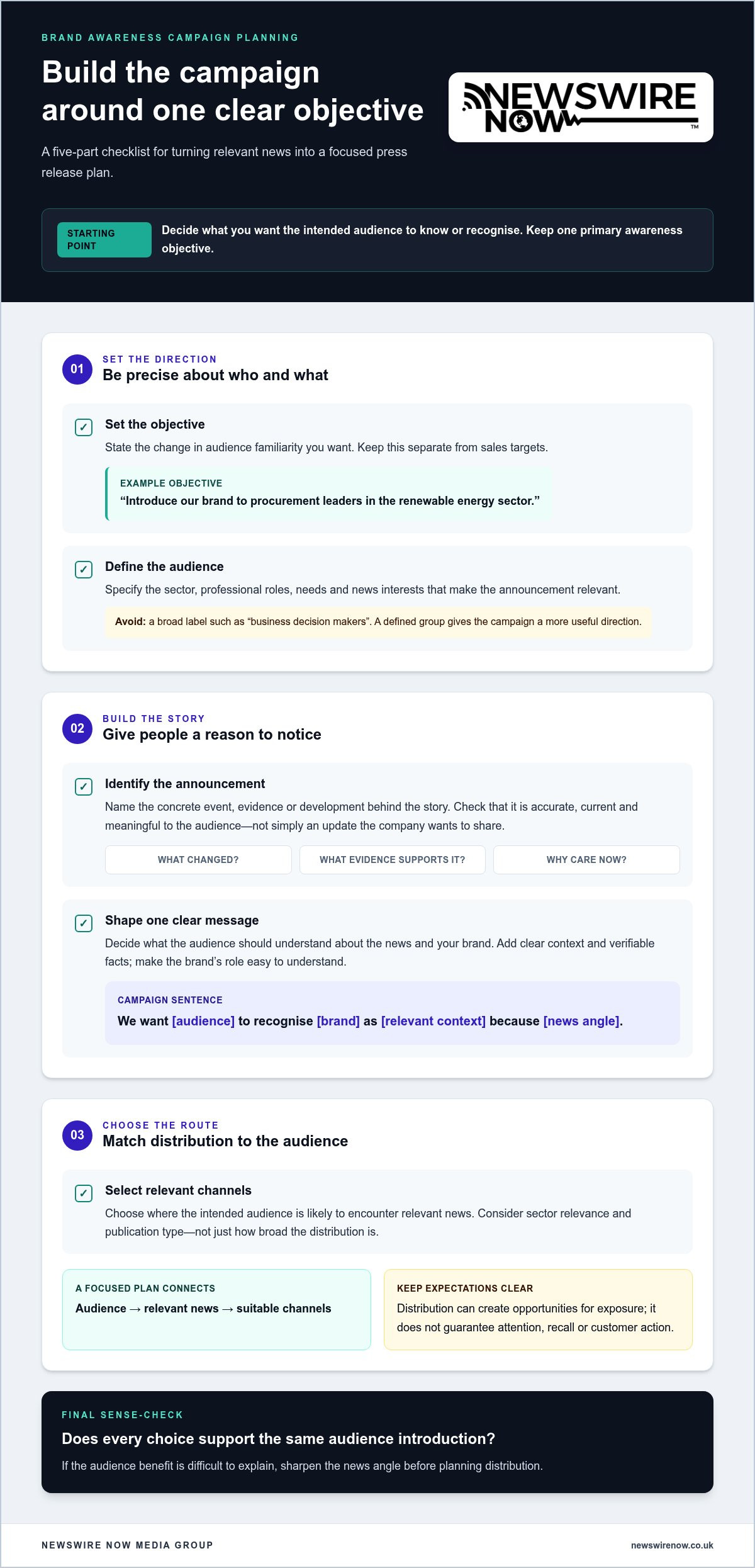
A focused plan connects the news to the people you want to reach, then matches distribution to that audience. Before preparing a press release for brand awareness campaign, decide what you want the intended audience to know or recognise. Keep one primary objective, such as introducing your brand to a new professional audience. This gives the announcement and channel choices a clear test: do they support that introduction?
Use this sequence to turn the objective into a practical campaign brief:
- Set the objective. State the intended change in audience familiarity. For example: “Introduce our brand to procurement leaders in the renewable energy sector.” Keep this distinct from sales targets, which may involve other activity.
- Define the audience. Specify the sector, professional roles, needs and news interests that make the announcement relevant. “Business decision makers” is too broad. A defined group, such as procurement leads looking for supply chain developments, gives you a more useful direction.
- Identify the announcement. Name the concrete event, evidence or development behind the story. Check that it is accurate, current and meaningful to the audience, rather than simply an update the company wants to share.
- Shape the message. Decide what the audience should understand about the news and your brand. Support that central point with clear context and verifiable facts.
- Select distribution. Choose channels based on where the intended audience is likely to encounter relevant news. Consider sector relevance and publication type, not just the breadth of distribution.
Choose an announcement that gives audiences a reason to notice
Make the news specific. What has changed, what evidence supports the announcement, and why should the intended audience care now? A new piece of research, for instance, needs a clear finding and an explanation of its relevance to the people it concerns. Avoid presenting routine promotion as editorially significant news. If the audience benefit is difficult to explain, sharpen the angle before planning distribution.
Build a consistent message before distribution
Write one central message and support it with accurate details, a concise explanation of your brand’s role and a headline that says what happened without overstating it. Keep your website and social posts aligned with the release, but adapt them for each channel instead of copying the full announcement everywhere.
A useful campaign sentence links the three essentials: “We want [audience] to recognise [brand] as [relevant context] because [news angle].” For example: “We want procurement leaders in renewable energy to recognise our brand as a source of supply chain insight because our new research identifies a change affecting their sector.” Use this as a planning prompt, not as a substitute for evidence in the release.
Once the brief is clear, editorial review and sector focused distribution can help align the announcement with its intended audience. Explore press release distribution options as you turn the campaign plan into a channel decision.
Compare distribution and amplification options for brand awareness
Choose channels according to the job each needs to do. Newswire distribution submits an announcement across a network of publications and outlets. Direct media outreach puts a tailored pitch in front of selected journalists or editors. Owned channels let your organisation explain the news and guide audiences to further information. A coordinated press release for brand awareness campaign can use more than one route, but each has different strengths and limits.
| Option | Audience fit | Editorial handling | Reporting | Scale | Campaign control |
|---|---|---|---|---|---|
| Newswire distribution | Useful for reaching audiences through outlets and sector networks relevant to the announcement. | May include editorial review; each publisher retains its own editorial approach. | Can provide placement or pickup reporting, depending on the service. | Can distribute across multiple publications and outlets at once. | Control the release and targeting choices, but not how each outlet presents it. |
| Direct media outreach | Highly focused on journalists or editors whose coverage matches the story. | Editors decide independently whether to pursue or publish a pitch. | Track responses, follow ups and any resulting coverage. | Depends on the relevance and number of contacts approached. | Tailor each pitch, while accepting that publication decisions sit with the outlet. |
| Owned-channel amplification | Reaches existing subscribers, followers and website visitors. | Your organisation controls the presentation and publishing schedule. | Use channel analytics to review delivery and interactions. | Depends on the size and activity of your established audiences. | High control over wording, timing and follow up content. |
Match each channel to the job it needs to do
Use distribution when the priority is submitting news across a publication network. Use direct outreach when a specific journalist or editor is especially relevant to the story and a tailored approach makes sense. Use owned channels to add context, answer likely questions and direct interested readers to the full announcement or supporting information. A UK press release distribution guide can help clarify how distribution approaches differ.
Plan supporting activity without confusing reach with impact
Follow up activity can extend the announcement’s visibility, but assess it on its own terms. The social media news amplification guide offers ideas for sharing news beyond its initial publication. Remember that delivery, placements and estimated reach show distribution activity, not proof of attention, awareness or recall.
Measure press release campaign performance beyond the pickup count
A pickup count tells you whether distribution produced recorded placements. It does not show whether the intended audience saw those placements, understood the announcement or remembered your brand. For a press release for brand awareness campaign, assess performance in layers: first confirm delivery, then look for audience activity and signs of brand response.
A pickup report can establish where a release was recorded as published, but it cannot prove that people noticed, remembered or acted on it. Impressions and potential reach need the same care. They estimate possible exposure, not attention or recall. Interpret each measure according to what it actually records.
Create a measurement plan before the release goes out
Write down the campaign objective and intended audience, then record a baseline before distribution. Choose an evaluation period in advance and use it consistently when reviewing results. This gives you a fairer comparison than selecting a timeframe after seeing the numbers. For a related view of how public coverage can shape a brand narrative, consult this online reputation management decision guide.
Select indicators that match the campaign, rather than collecting every available figure:
- Delivery: placements and pickups recorded in distribution reporting.
- Website: visits to relevant pages, referral sources and engagement with campaign information.
- Search: changes in searches for your brand name, considered against the baseline.
- Social: relevant interactions, shares and discussion around the announcement.
- Enquiries: questions or contact activity that refers to the news or campaign.
Where appropriate, use tagged links in campaign materials to identify visits associated with a channel. They can help distinguish some referral activity, but will not capture every exposure or prove what prompted someone to visit. People may encounter a story in one place and search for the brand later, or reach your website through another route.
Interpret pickup reports alongside wider campaign signals
Read placement records as evidence of distribution outcomes, not as a measure of brand recognition. Newswire Now Media Group provides a pickup report within 48 hours, which can help you review recorded coverage promptly. Compare website visits or branded search trends with the baseline, while considering other activity that could have influenced them, such as social posts, email campaigns or separate company news.
Look for patterns across indicators rather than treating one increase as proof of impact. If visits rise after publication, that is a useful observation; by itself, it does not establish that the release caused the change. Record what you can verify, note plausible influences and use the findings to refine the next campaign. To align distribution reporting with your awareness objectives, explore press release distribution.
Turn the campaign plan into a press release distribution next step
A clear campaign brief makes the move from planning to distribution more straightforward. Confirm the awareness objective, finalise the news, define the intended audience, select relevant distribution and review the reported outcomes. Connect each decision to the same purpose: helping a particular audience discover or better understand your brand through a credible announcement.
Prepare the release and campaign details for distribution
Before submitting a press release for brand awareness campaign, organise the final release alongside accurate organisation details, a suitable media contact and a clear description of the audience you want to reach. Check names, dates, figures, quotations and other supporting facts against their original sources. Consistency matters: conflicting details can distract from the announcement and undermine confidence in the message.
Make the sector connection explicit. Identify which industry or professional audience has a reason to care about the news, and keep the primary awareness objective visible in the brief. Editorial review can help assess whether the announcement is clear and suitable for distribution; sector coverage helps align the release with relevant audiences and outlets. Newswire Now Media Group distributes editorially reviewed releases through an independent network of more than 40 owned publications and over 500 trusted news outlets.
Use this final sequence to keep the campaign focused:
- Confirm the objective. State what the audience should learn or recognise about the organisation.
- Finalise the news. Ensure the announcement is timely, relevant and supported by accurate information.
- Select the audience. Match sector and professional relevance to the campaign’s intended reach.
- Distribute the release. Choose a route that fits the announcement and audience.
- Review the outcomes. Check reported placements, then compare delivery with the wider indicators in your measurement plan.
Once the objective, announcement and target audience are aligned, explore press release distribution as a practical next step for putting the campaign into motion.
Review delivery and decide what the campaign needs next
After distribution, use the pickup report, provided within 48 hours, to review recorded placements and other reported delivery outcomes. Treat it as one part of the assessment, not a verdict on brand awareness. Compare those findings with the website, search, social and enquiry indicators selected before the release went out. Note what the evidence supports, where it is incomplete and what may warrant follow up.
The review can guide the next move: amplify a useful announcement through owned channels, develop a related story or refine audience targeting for a future release. Keep the decision grounded in the campaign objective rather than assuming that more placements automatically mean greater recognition. To put a considered distribution plan into action, discuss your next press release.
Make your next announcement count
Brand familiarity is built over time. Give your next announcement a defined role in that process: decide which audience you want to reach and what you want them to understand, then make sure the story earns their attention. A press release for brand awareness campaign should be more than a one off burst of exposure; it can provide a credible starting point for consistent communication with the people who matter to your organisation. For businesses looking to sustain that momentum, partnering with a digital agency like I Search Marketing can help align strategic branding and creative messaging across wider growth channels.
Use what you learn from each campaign to sharpen the next one. Which audience engaged with the story? What questions followed? Did the announcement give people a clearer sense of your organisation’s work? These insights can guide future news angles and help keep your brand message relevant, rather than simply repeating the same announcement across channels.
When your next story is ready, align its objective and audience with a distribution plan designed for visibility. Explore press release distribution for your next campaign, and take the next step towards making your brand more recognisable to the right people.
Frequently Asked Questions
Can a press release increase brand awareness?
Yes, a press release can help introduce a brand to people who may not know it, particularly when the announcement gives a relevant audience a clear reason to pay attention. For example, a specialist firm sharing a new finding about a problem its customers face has a stronger awareness opportunity than one simply promoting its services. Coverage can create an introduction, but lasting familiarity usually depends on what audiences encounter and learn about the brand afterwards.
How do you write a press release for a brand awareness campaign?
Start with a clear news angle, then write for the reader who needs to understand it, not only for people already familiar with your organisation. Use a headline that states the development plainly, followed by an opening that explains what happened and why it matters. Add enough context to make the brand’s role understandable. For a press release for brand awareness campaign, remove jargon and unsupported superlatives that could make the announcement harder to trust.
What should a brand awareness press release include?
Include the essential facts a reader or editor needs to assess the announcement: what has happened, who is involved, when it happened and why it matters. Attribute quotations to named spokespeople and provide context for any figures or claims. Make the organisation’s role clear without turning the release into a product catalogue. A media contact and concise company background can help readers follow up or understand the source of the news.
How do you measure brand awareness from a press release?
For a stronger indication of recognition, ask a defined sample of the intended audience whether they recognise your name or can recall what your organisation does. Compare responses with a similar baseline where practical, and keep the questions consistent. You can also review relevant branded search activity and audience feedback, but treat them as supporting signals. A rise in visits alone will not tell you whether people remember the brand or understand its offer.
Are press release placements the same as audience reach?
No. A placement records that a publication carried the release; reach or impressions estimate how many people might have had an opportunity to see it. Those estimates do not confirm that every person saw the story, and repeated copies of an announcement do not necessarily represent distinct individuals. Use placement records to understand where the news appeared, and avoid adding potential audience figures together as if they were verified, unique readers.
How long does it take to see results from a press release campaign?
There is no single reliable timetable for awareness results. Publication may be recorded soon after distribution, while changes in familiarity or recall can take longer to detect and may require audience research. Set review points that fit your campaign and compare them with a baseline, rather than expecting every indicator to move at once. Keep track of other marketing activity during the same period, since it can also influence search, visits and enquiries.
Can a small business use a press release for brand awareness?
Yes. A small business can focus on a specific announcement and a clearly defined audience instead of trying to appeal to everyone. For instance, a new partnership may be relevant to a particular professional community if it addresses a need that group recognises. Make the business’s contribution easy to understand, and choose distribution that fits the story. A focused campaign can be more useful than a broad announcement with little audience relevance.
Ready to get your story published?
Distribute your press release across 500+ trusted media outlets — with editorial review and a full pickup report within 48 hours.
Send Press Release →