
Online Reputation Management Tools: What Professionals Actually Use in 2026
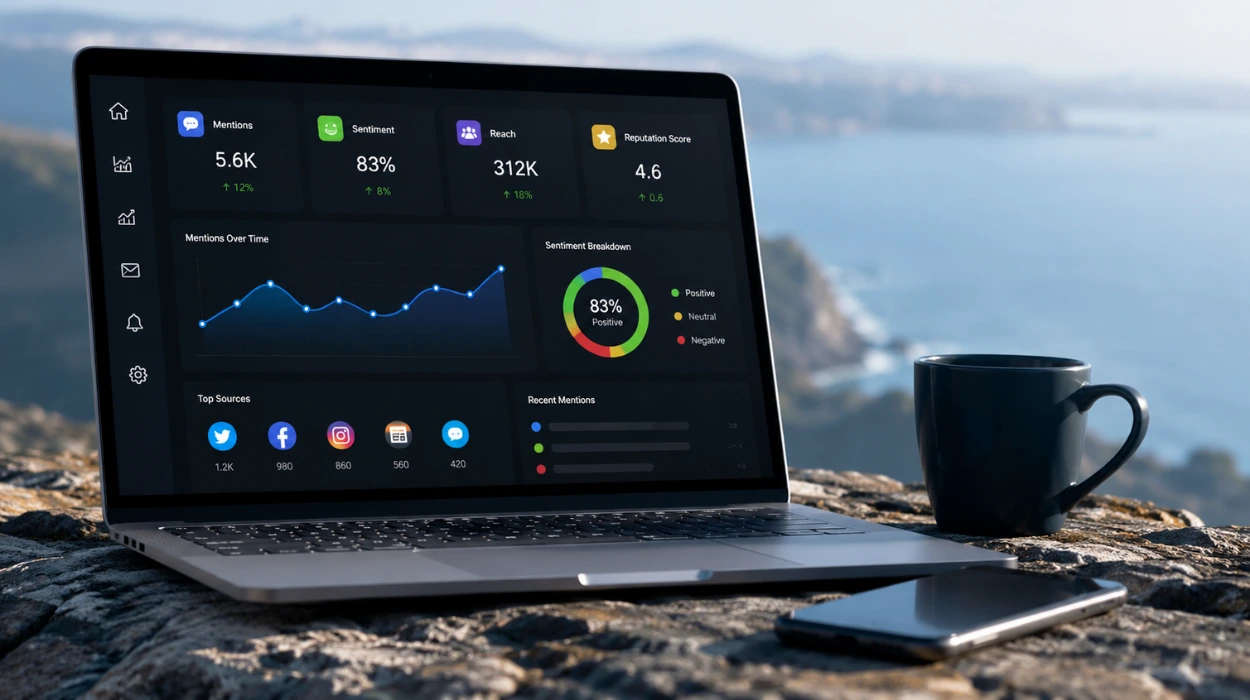
Professional reputation teams use a combination of monitoring software, review management systems, media intelligence, search tracking, and structured response workflows. No single tool covers every reputation signal.
The strongest 2026 approach evaluates tools by channel coverage, alert speed, reporting depth, review management, media visibility, and their ability to support search-result control.
What type of online reputation management tool provides the broadest coverage?
A multi-channel reputation management platform provides the broadest coverage because it combines reviews, mentions, social conversations, news coverage, and search visibility within one monitoring framework.
Online reputation management tools differ mainly by the channels they monitor and the actions they support. Broad platforms track reviews, social conversations, news mentions, forums, and search results, while specialist tools focus on one reputation signal.
Reputation monitoring starts with visibility. A professional team needs to know where a company appears online before deciding how to respond. Review management software focuses on customer feedback and response workflows. Social listening software tracks public conversations and sentiment. Media monitoring systems analyse articles, broadcasts, and editorial mentions. Search monitoring focuses on the results people see when they search a company, product, executive, or issue.
This distinction matters because reputation problems rarely remain inside one channel. A negative customer experience can begin as a review, become a social discussion, and later attract editorial attention. A misleading article can also gain visibility through search results even when review sentiment remains positive. Professionals therefore evaluate channel coverage before evaluating individual features.
A broad platform offers efficiency through centralised monitoring. A specialist platform offers greater depth within its specific channel. The appropriate choice depends on whether the organisation needs general visibility or detailed control over a particular reputation surface.
The decision should begin with the question, “Where does reputation risk appear?” The answer determines which type of monitoring technology deserves priority.
Are reputation management tools more useful than manual monitoring?
Reputation management tools outperform manual monitoring when an organisation needs continuous tracking, structured alerts, historical reporting, and consistent response workflows.
Automated reputation monitoring reduces repetitive checking by tracking defined keywords, mentions, reviews, and conversations. Manual monitoring remains useful for context, verification, and sensitive issues that require human judgement.
Manual monitoring has one clear advantage: human interpretation. A communications professional can understand sarcasm, context, emerging narratives, and subtle criticism that automated systems can misclassify. Manual searches also help verify whether an alert represents a genuine reputation issue.
The limitation is scale. Checking search results, review pages, news coverage, forums, and social platforms individually creates an inconsistent monitoring routine. Important mentions can appear outside normal working hours. A delayed response can allow a developing issue to gain additional visibility.
Automated tools solve the repetition problem. They can monitor predefined keywords and deliver alerts when new activity appears. Many current systems also classify sentiment and organise mentions by source, topic, location, or campaign.
Automation does not eliminate human review. It changes the professional role from searching for every mention to analysing the mentions that matter. That distinction makes automated monitoring particularly valuable for organisations with multiple products, executives, locations, or markets.
The most practical model combines automated discovery with human verification. Technology finds signals. Professionals determine meaning and action.
Which is better for customer reviews: specialist review software or broader ORM platforms?
Specialist review software is stronger for review-heavy operations, while broader ORM platforms are better when reviews form only one part of a wider reputation programme.
Review-focused systems prioritise review collection, alerts, response management, rating analysis, and location-level reporting. Broader reputation platforms extend monitoring into social media, news, search, forums, and wider brand conversations.
Review management requires a different workflow from media monitoring. A customer review needs acknowledgement, investigation, and often a service recovery process. A news article requires narrative analysis and media relations. Treating both signals as identical can create inefficient workflows.
Specialist review software usually provides deeper review functionality. Teams can organise incoming feedback, assign response responsibilities, monitor rating changes, and analyse recurring customer complaints. This structure suits organisations where customer reviews directly influence purchasing decisions.
Broader ORM platforms provide greater context. A sudden increase in negative reviews can be analysed alongside social conversations or media coverage. This helps professionals determine whether the problem represents isolated dissatisfaction or a wider reputation issue.
The choice therefore depends on operational priority. A business managing hundreds of customer reviews across multiple locations may require specialist review functionality. A corporate communications team monitoring public perception across several channels may value broader coverage.
Neither model automatically replaces the other. Review management and reputation intelligence solve related but distinct problems.
For organisations beginning with customer feedback, a structured approach to responding to negative reviews on Google can establish the response principles before wider monitoring is introduced.
Which approach provides better visibility into media coverage?
Media intelligence platforms provide deeper visibility into editorial coverage because they are designed to identify, classify, and report on mentions across news and publishing environments.
Media monitoring differs from general reputation tracking because it focuses on editorial coverage, publication sources, journalists, topics, sentiment, reach, and changes in media attention. This makes it particularly relevant to PR and communications teams.
Media coverage carries different characteristics from customer-generated content. An editorial article has a publication source, author, topic, date, and potentially significant search visibility. A professional monitoring system must therefore capture more than the existence of a mention.
Media intelligence helps teams identify coverage patterns. It can reveal which publications discuss an organisation, which topics generate attention, and how frequently a narrative appears. Historical reporting also allows communications teams to compare media activity across campaigns.
General ORM software can still detect news mentions. Its advantage is integration. A team can view media coverage alongside reviews, social conversations, and search activity.
The difference becomes important during reputation events. A company facing a sudden media story needs to understand both the article and the wider conversation surrounding it. Media-specific monitoring provides editorial detail, while broader ORM provides cross-channel context.
Professionals should therefore evaluate whether their primary objective is media intelligence or general reputation visibility. The two objectives overlap, but their reporting requirements differ.
Is press release distribution more effective than direct journalist outreach for reputation visibility?
Press release distribution provides broader information dissemination, while direct journalist outreach provides more targeted relationship-driven communication.
Press release distribution and journalist outreach serve different media objectives. Distribution prioritises structured reach and publication availability, while direct pitching prioritises relevance, editorial interest, relationship quality, and individual journalist engagement.
A press release gives an organisation a controlled statement that can be distributed across a defined media network. It creates a public record of an announcement and can support broader visibility. The format also provides consistent wording across participating outlets.
Direct journalist outreach operates differently. A communications professional identifies a journalist whose coverage matches the announcement and develops a tailored pitch. The journalist decides whether the story has sufficient editorial value for their audience.
Distribution therefore emphasises reach. Outreach emphasises relevance. A release can reach more publishing destinations without guaranteeing substantial editorial attention. A successful pitch can generate deeper coverage but requires stronger news value and greater preparation.
The two methods also differ in measurement. Distribution can be evaluated through placements, pickup, reach, and visibility. Journalist outreach can be evaluated through responses, interviews, editorial articles, relationships, and resulting coverage.
Reputation teams should treat these methods as complementary rather than interchangeable. The correct approach depends on whether the immediate objective is broad announcement visibility or targeted editorial engagement.
Which is more reliable: guaranteed placement or syndication-based distribution?
Syndication-based distribution provides wider potential circulation, while guaranteed placement models provide greater certainty about specified publishing outcomes when the service explicitly defines what is guaranteed.
Guaranteed placement and syndication represent different distribution models. Guaranteed placement focuses on defined publication outcomes, while syndication distributes content through participating networks without making every secondary pickup equivalent to independent editorial coverage.
The word “guaranteed” requires careful evaluation. A genuine guarantee should define the exact publication, placement, timing, format, and conditions. Without those details, the term provides limited decision-making value.
Syndication has a different structure. A release enters a distribution network and may appear across participating websites or feeds. The resulting visibility depends on the network and the receiving publication’s publishing practices.
The distinction also affects credibility. A syndicated release should not automatically be interpreted as independent editorial endorsement. Professionals separate paid distribution, syndicated publication, earned coverage, and independently reported journalism when analysing reputation results.
Cost comparison also requires the same distinction. A lower-priced distribution package may deliver extensive syndication but limited editorial engagement. A more targeted media programme may cost more because it involves research, pitching, relationship management, and editorial coordination.
The correct evaluation therefore focuses on deliverables rather than labels. Buyers should identify exactly what is guaranteed, what is syndicated, and what requires independent editorial acceptance.
Does Google News optimisation matter more than generic web distribution?
Google News visibility matters when news discovery and search visibility form part of the objective, but optimisation cannot substitute for genuine news value, technical accessibility, or credible publication.
Google News optimisation focuses on making legitimate news content discoverable through appropriate publishing structures, topical relevance, timeliness, and technical signals. Generic web distribution creates broader online availability without necessarily producing news visibility.
News discovery depends on more than publishing a press release online. Search systems evaluate content quality, relevance, freshness, source signals, technical accessibility, and the broader context surrounding a story.
Generic distribution can increase the number of locations where a release appears. That creates additional discoverable pages and reference points. It does not automatically mean the content will appear prominently in news search environments.
Google News optimisation therefore belongs within a broader publishing strategy. The announcement must have genuine news value. The headline must accurately describe the event. The content should provide clear factual information rather than excessive promotional language.
Professionals also evaluate whether distribution creates durable visibility. A release that appears briefly across syndicated pages may produce short-term exposure. A relevant editorial article can generate longer-lasting search visibility because it exists within an independently produced publication context.
This makes measurement important. Teams should distinguish publication count from search visibility, editorial coverage, referral activity, and branded search performance.
Which approach is more suitable for enterprise-level reputation control?
Enterprise-level reputation control requires an integrated system that combines monitoring, content development, media visibility, review management, search analysis, and governance rather than relying on one ORM tool.
Enterprise reputation management operates across multiple stakeholders, markets, executives, locations, and search environments. Effective systems therefore combine monitoring and response capabilities with content, media, SEO, reporting, permissions, and escalation workflows.
Enterprise reputation is structurally different from small-business reputation. A large organisation may have multiple brands, regional teams, executives, products, and customer-facing locations. Each entity can generate separate reputation signals.
Governance becomes essential at this scale. Teams need defined approval processes, response ownership, escalation rules, reporting standards, and access controls. Without governance, automation can create inconsistent responses or duplicate work.
Search visibility also becomes more important. Senior stakeholders may be evaluated through branded search results, media articles, professional profiles, interviews, company pages, and other authoritative sources. Reputation management therefore intersects with digital PR and search strategy.
This is where enterprise-level SERP control becomes a separate evaluation category. It focuses on the composition of search results rather than simply monitoring mentions. The objective is to understand which assets appear, which sources influence visibility, and which reputation signals require attention.
Enterprise teams should consequently assess reputation management as an ecosystem. Software provides monitoring and workflow infrastructure. PR creates earned visibility. Content builds controlled information assets. Search strategy influences discoverability.
How should professionals evaluate online reputation management tools in 2026?
Professionals should evaluate reputation management tools against channel coverage, alert speed, workflow capability, reporting, integration, scalability, and search visibility rather than choosing solely by feature count.
The strongest evaluation framework starts with reputation objectives and then measures each tool against monitoring coverage, response workflows, analytics, integrations, governance, scalability, and search visibility. Feature quantity alone does not establish suitability.
Start by mapping the reputation surfaces that require monitoring. Separate customer reviews from social conversations, editorial coverage, forums, and search results. This identifies the gaps that a tool must address.
Then evaluate operational requirements. Determine who receives alerts, who approves responses, how issues are escalated, and how performance is reported. A tool with extensive monitoring capabilities can still create operational problems if workflows remain unclear.
Next, assess reporting depth. Useful reporting should show changes over time rather than simply produce a list of mentions. Reputation professionals need trend analysis, source analysis, sentiment patterns, response activity, and visibility indicators.
Finally, evaluate scalability. The system should support additional markets, brands, locations, users, keywords, and reporting requirements without creating excessive manual administration.
The final decision should reflect the organisation’s reputation model. A review-focused business needs different functionality from an international organisation managing media coverage, executive visibility, customer feedback, and search results.
Online reputation management in 2026 is therefore less about finding one “best” tool and more about matching technology to the reputation signals that matter most.
The evaluation should connect monitoring with action. Software can identify a problem, but reputation outcomes depend on the quality of the response, the credibility of the content, the relevance of media coverage, and the authority of the information appearing in search.
That distinction also explains why enterprise-level SERP control belongs within the wider reputation conversation. Search visibility is not simply another monitoring metric. It represents the public information environment that customers, investors, journalists, employees, and other stakeholders encounter when researching an organisation.
The most complete reputation strategy therefore combines technology with human judgement. Monitoring tools identify signals. Review systems organise customer feedback. Media intelligence analyses editorial attention. PR distribution expands information availability. Journalist outreach creates opportunities for independent coverage. Search strategy evaluates what audiences actually discover.
No single method provides complete reputation control. The appropriate combination depends on the organisation’s channels, risk profile, objectives, operational capacity, and required level of search visibility.
Ready to get your story published?
Distribute your press release across 500+ trusted media outlets — with editorial review and a full pickup report within 48 hours.
Send Press Release →