
What Are the Key Steps to Building a Successful Shopify Store?
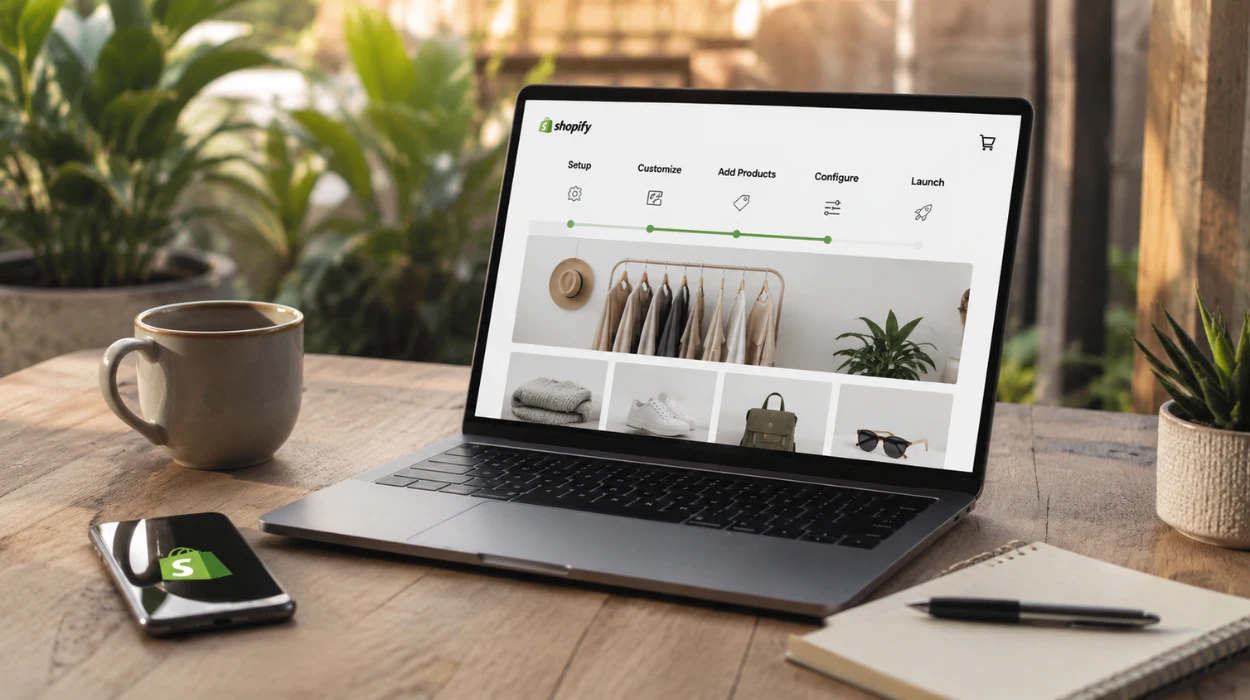
The key steps are defining the target market, selecting products, building a conversion-focused Shopify store, configuring payments and fulfilment, optimising search visibility, and measuring performance.
A successful Shopify store also needs a structured digital PR strategy that builds visibility, earns media coverage, and supports long-term brand discovery.
What should you establish before building a Shopify store?
Establish the market, audience, product offer, pricing model, and commercial objective before designing the store.
Define the target customer, analyse competing Shopify stores, validate product demand, establish pricing, and document the store’s commercial objective before selecting a theme or building product pages.
Start by defining the target market and customer profile. Identify the problem that the product solves. Analyse competing stores such as Gymshark and Allbirds to understand positioning, pricing, navigation, and content. Establish a measurable commercial objective, such as generating 500 orders in the first 90 days. Document the product range, average order value, gross margin, and expected acquisition cost. This foundation determines later decisions across design, marketing, fulfilment, and public relations.
Which Shopify store structure creates the strongest customer journey?
A simple structure with clear categories, focused product pages, and friction-free checkout creates the most measurable customer journey.
Organise Shopify stores around clear navigation, logical collections, informative product pages, visible trust signals, and a short checkout process so customers can move from discovery to purchase without unnecessary steps.
Build navigation around customer intent rather than internal business terminology. Create collections that group products according to use, category, audience, or problem. Develop product pages with precise titles, specifications, pricing, imagery, delivery information, and returns details. Add trust signals such as customer reviews, payment options, guarantees, and contact information. Keep checkout focused on completing the transaction. Test the journey on mobile devices because mobile shoppers interact differently with menus, product images, forms, and payment screens.
Which approach produces stronger Shopify store visibility: SEO or paid acquisition?
SEO builds discoverable assets over time, while paid acquisition produces controlled traffic through advertising budgets.
Shopify SEO improves organic discovery through product, category, technical, and content optimisation, while paid acquisition provides faster traffic through platforms such as Google Ads and Meta Ads.
Optimise product titles around relevant search terms. Create descriptive collection pages that explain product categories and customer needs. Improve page speed, internal linking, metadata, image optimisation, and structured data. Publish useful content that answers product-related questions and supports commercial pages. Paid acquisition differs because advertisers control targeting, budgets, creative formats, and campaign timing. A balanced strategy evaluates acquisition cost, conversion rate, average order value, and customer lifetime value instead of measuring traffic alone.
Which method builds stronger authority for a new Shopify store: owned content or earned media?
Owned content provides publishing control, while earned media can expose the store to audiences through independent publications and editorial coverage.
Owned content strengthens a Shopify store’s information architecture, while earned media expands external visibility through editorial mentions, interviews, features, and news coverage from relevant publications.
Publish product guides, buying guides, educational articles, comparison pages, and customer resources on owned channels. These assets allow the business to control messaging and update information. Earned media follows a different model. Journalists and publications decide whether a story has sufficient relevance, evidence, timing, or public interest. A product launch, funding announcement, sustainability initiative, research report, or significant partnership can create a stronger news angle than a generic product promotion. The two approaches therefore serve different visibility functions.
Businesses developing their initial ecommerce presence can first build a successful Shopify store before evaluating how external visibility supports the wider acquisition strategy.
Which is more effective for media coverage: wire distribution or direct journalist outreach?
Wire distribution provides broader simultaneous dissemination, while direct journalist outreach enables more targeted communication with individual reporters and publications.
Wire distribution prioritises scale and speed, whereas direct journalist outreach prioritises relevance, personalisation, and editorial relationships with specific reporters covering defined subjects or industries.
Prepare a release for distribution when the announcement has broad news relevance. A wire can place the same announcement across multiple distribution destinations at once. Direct outreach requires identifying relevant journalists and tailoring the pitch to their coverage areas. A technology journalist covering ecommerce infrastructure needs a different angle from a retail journalist covering consumer trends. Evaluate both methods against reach, relevance, response rate, editorial control, and reporting requirements. Neither method represents the same type of media engagement.
Which media coverage model provides stronger evidence of editorial exposure?
Editorial coverage provides stronger evidence of independent media interest than syndication alone, but syndication offers measurable distribution across multiple publishing destinations.
Evaluate whether a service reports syndicated publication, editorial pickup, journalist engagement, or confirmed media placement because each outcome represents a different level of external visibility and editorial involvement.
Distinguish between distribution and editorial selection before comparing providers. Syndication distributes supplied content through participating outlets or publishing networks. Editorial coverage involves a publication or journalist independently deciding to cover the subject. Review reports that identify publication names, URLs, publication dates, and coverage outcomes. Treat vague claims such as “massive exposure” as insufficient evidence. A clear report allows the business to compare actual media outcomes with its original campaign objective.
Which approach is more suitable for Google News visibility: news optimisation or generic web distribution?
News optimisation focuses on relevance, structure, timeliness, and publisher signals, while generic web distribution focuses on broader online publication.
Google News visibility depends on newsworthiness, clear article structure, publisher signals, freshness, and technical accessibility rather than distribution volume alone, making optimisation different from generic web publication.
Create news content around a specific event, announcement, development, or data point. Use descriptive headlines and accurate publication information. Separate factual reporting from promotional language. Maintain clear authorship and publisher information where appropriate. Generic distribution can increase the number of online appearances without producing equivalent news visibility. Evaluate services according to how clearly they distinguish news publication, syndication, indexing, and editorial coverage in their reporting.
Which PR distribution option is more cost-effective for different Shopify growth stages?
Cost-effectiveness depends on the campaign objective, required reach, media relevance, and measurable outcome rather than the lowest distribution price.
Compare PR distribution options by total cost, media reach, reporting quality, editorial relevance, publication outcomes, and campaign objective instead of selecting a service solely because its headline price is lower.
Calculate the full campaign cost before comparing packages. Include writing, distribution, media research, journalist outreach, creative production, and reporting. A product launch may require broad awareness across several markets. A specialist B2B Shopify application may need targeted journalist outreach instead. Compare the cost per meaningful media outcome rather than the cost per publication count. Review whether reports show actual placements, syndication, audience information, and relevant publication details.
What should you evaluate when comparing Shopify-focused digital PR strategies?
Evaluate audience relevance, newsworthiness, distribution method, media quality, reporting transparency, and alignment with the store’s commercial objective.
A strong digital PR evaluation examines whether the strategy reaches relevant audiences, creates a credible news angle, uses an appropriate distribution method, reports verifiable outcomes, and supports measurable brand visibility goals.
Assess the story before assessing the distribution channel. A weak announcement cannot become newsworthy through distribution volume alone. Compare whether the campaign targets ecommerce, retail, technology, finance, lifestyle, or another relevant media category. Examine whether the strategy supports branded search, referral traffic, authority signals, or wider awareness. Review reporting standards after publication. This evaluation separates campaign quality from distribution scale.
Which steps should you complete before seeking media exposure for a Shopify store?
Complete the store foundation, establish the news angle, prepare evidence, identify relevant media, and define measurable campaign outcomes before distribution.
Prepare the Shopify store, verify the announcement, identify the target media, develop supporting evidence, select the distribution method, and establish reporting metrics before launching a digital PR campaign.
Use this sequence:
- Define the announcement and its news value.
- Verify product, company, market, and performance data.
- Identify relevant publications such as Retail Dive or TechCrunch.
- Develop supporting assets, including original research, images, executive commentary, or data.
- Select wire distribution, journalist outreach, owned publishing, or a combined approach.
- Measure publication outcomes, referral traffic, branded search activity, engagement, and qualified enquiries.
This process prevents media distribution from becoming an isolated activity. It connects public relations with the broader ecommerce growth system. It also creates clearer criteria for comparing providers and campaign methods.
How should Shopify businesses evaluate media exposure after distribution?
Evaluate media exposure through verifiable coverage, referral behaviour, brand visibility, engagement, and campaign-specific outcomes.
Measure media exposure using confirmed publication records, referral traffic, branded search activity, engagement, backlinks where relevant, audience relevance, and commercial outcomes linked to the campaign.
Record every confirmed publication and distinguish editorial coverage from syndicated copies. Analyse referral sessions in analytics platforms using campaign-specific tracking. Monitor branded search trends around major announcements. Review engagement on articles, interviews, and social posts where data is available. Compare outcomes against the original objective rather than against an arbitrary publication count. This creates a repeatable framework for deciding whether future campaigns require broader distribution, more targeted outreach, stronger content, or different media categories.
For businesses assessing the next stage of ecommerce visibility, media exposure strategies can be evaluated alongside owned content, direct outreach, syndication, and other earned-media approaches.
What does a balanced Shopify store growth strategy look like?
A balanced strategy combines conversion-ready ecommerce infrastructure with search visibility, owned content, paid acquisition, and appropriately selected earned-media methods.
Successful Shopify growth requires coordinated store optimisation, organic search, paid acquisition, content development, and earned media, with each channel evaluated according to its role, cost, reach, and measurable contribution.
Build the store before scaling traffic. Optimise the customer journey before increasing acquisition spend. Establish organic content before expecting search visibility to compound. Create newsworthy announcements before distributing press releases. Select direct journalist outreach when individual editorial relevance matters. Select broader distribution when simultaneous dissemination is the primary objective. The evaluation should remain centred on business goals, audience relevance, evidence, and measurable outcomes.
The strongest Shopify strategy is therefore not defined by one promotional channel. It is defined by how effectively different methods solve different visibility and acquisition problems. Store optimisation improves the destination. Search and paid campaigns improve discoverability. Owned content builds information depth. Earned media creates external exposure. Comparing these functions creates a clearer basis for investment decisions without treating distribution volume as a substitute for relevance or editorial value.
Ready to get your story published?
Distribute your press release across 500+ trusted media outlets — with editorial review and a full pickup report within 48 hours.
Send Press Release →