
How to Evaluate Shopify Stores Before Buying an Online Business
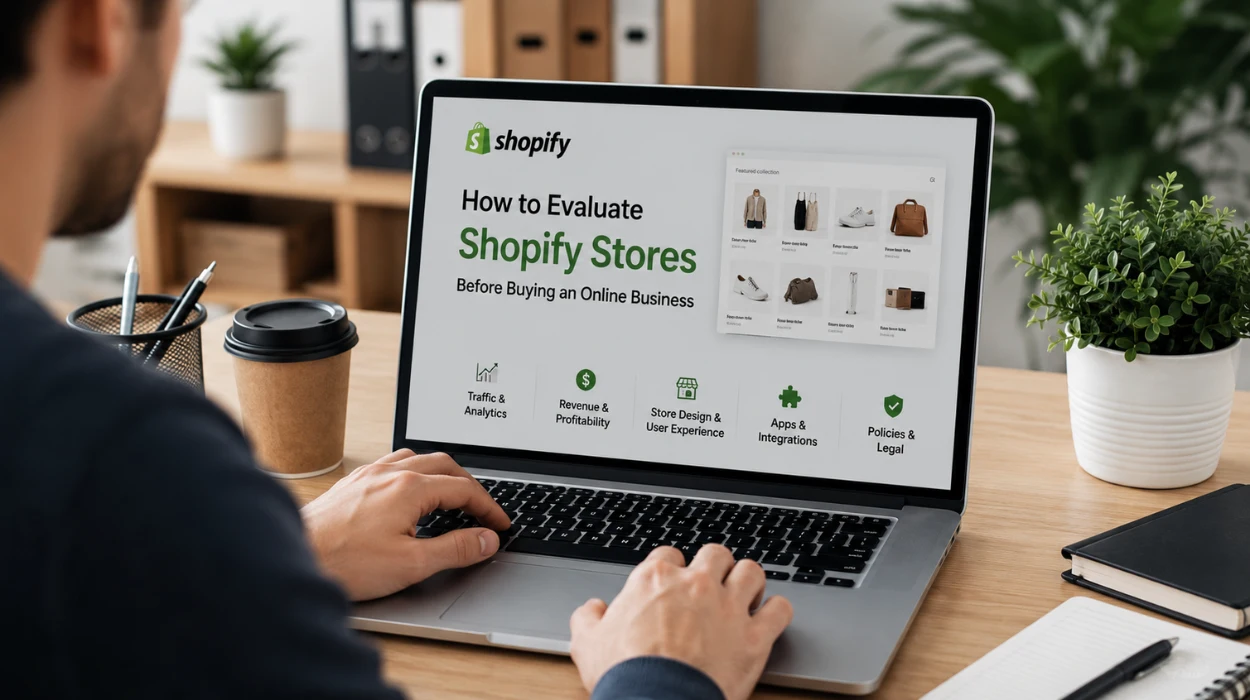
Evaluate a Shopify store by checking its verified financial performance, traffic sources, customer quality, operating costs, supplier relationships, and growth potential. Compare these factors against the asking price before deciding whether the online business warrants further due diligence.
What financial metrics should you compare before buying a Shopify store?
Compare verified revenue, profit, margins, cash flow, and expenses rather than relying on sales revenue alone. A Shopify store with £500,000 in annual sales can be less attractive than one generating £300,000 when the first business has weaker margins, higher advertising costs, or unstable cash flow.
Evaluate a Shopify store through verified revenue, net profit, gross margin, operating expenses, cash flow, and owner earnings. Compare at least 12 months of financial records with the asking price to determine whether the acquisition has sustainable economics.
Revenue and profit
Request monthly profit-and-loss statements covering the previous 12 months. Compare gross revenue with refunds, discounts, payment processing fees, advertising costs, fulfilment expenses, software subscriptions, and payroll.
Calculate the seller’s discretionary earnings after normal operating costs. Separate genuine business profit from expenses that disappear after acquisition. Personal expenses should not be treated as recurring operating costs without verification.
Margin quality
Analyse gross margin by product and sales channel. A store selling private-label products may report higher margins than a retailer relying on third-party brands. Inventory costs can also change substantially when supplier prices or shipping rates increase.
Compare customer acquisition cost with average order value. A store that depends on expensive paid advertising requires a different valuation from one generating repeat purchases through email, organic search, or direct traffic.
Asking-price relationship
Calculate the purchase-price-to-annual-profit ratio. Compare that ratio with the store’s growth rate, risk profile, customer concentration, and operational workload. A higher multiple requires stronger evidence of sustainable earnings.
Do not evaluate valuation from revenue alone. Profitability, recurring demand, transferable assets, and owner dependence determine how much economic value transfers with the business.
How can you verify whether a Shopify store’s traffic is sustainable?
Analyse traffic sources, conversion rates, customer acquisition costs, and historical trends across at least 12 months. Sustainable traffic normally shows identifiable sources and consistent commercial behaviour rather than depending on a single campaign, platform, influencer, or temporary trend.
Verify Shopify store traffic through Google Analytics, Shopify reports, advertising platforms, search visibility, conversion data, and customer acquisition metrics. Compare monthly performance to identify dependence on paid traffic, seasonal demand, social platforms, or individual marketing campaigns.
Traffic source concentration
Identify the percentage of sessions generated by organic search, paid search, social media, email, direct traffic, referrals, and marketplaces. Compare these sources across the previous 12 months.
A store receiving 80% of traffic from one advertising platform carries greater channel risk than a store distributing acquisition across organic search, email, referrals, and paid campaigns.
Conversion performance
Compare sessions with transactions and revenue. Calculate conversion rate by device, country, traffic source, and product category where the data supports the calculation.
Analyse whether conversion rates remain stable during promotional periods and normal trading periods. A store that converts only during heavy discounting may have weaker pricing power.
Traffic verification
Request read-only access to relevant analytics accounts. Match reported traffic with Shopify orders and payment records. Investigate unexplained spikes, sudden declines, unusual referral domains, and traffic that generates sessions without meaningful commercial activity.
Traffic should be treated as an operating asset only when it produces measurable business outcomes.
Which customer metrics matter most when evaluating a Shopify store?
Prioritise repeat purchase rate, customer acquisition cost, average order value, customer lifetime value, refund rate, and customer concentration. These metrics reveal whether the store owns a durable customer base or continually replaces customers through expensive acquisition campaigns.
Evaluate customer quality through repeat purchases, average order value, lifetime value, acquisition cost, refund rates, and customer concentration. Strong customer economics can support future growth, while weak retention increases dependence on continuous advertising spend.
Retention and repeat purchases
Calculate the percentage of customers who purchase more than once. Compare repeat purchase behaviour across product categories and customer cohorts.
Consumable products often create different retention economics from one-time purchases such as furniture, electronics, or specialist equipment. The business model determines how frequently customers can realistically return.
Customer acquisition economics
Compare customer acquisition cost with customer lifetime value. Examine the advertising spend required to generate each new customer and the revenue generated from subsequent purchases.
If the seller reports a high lifetime value but provides no cohort-level evidence, treat the figure as unverified. Customer lifetime value should come from actual purchasing behaviour rather than a theoretical forecast.
Refunds and complaints
Review refund rates, chargebacks, product complaints, and customer-service records. High refund activity can reduce reported profitability and create operational problems after acquisition.
Also analyse customer reviews and support tickets. Recurring complaints about product quality, shipping delays, or inaccurate descriptions can indicate problems that financial statements do not reveal.
How should you assess a Shopify store’s products and suppliers?
Evaluate product demand, supplier reliability, inventory requirements, intellectual property, and competitive differentiation before valuing the catalogue. Product revenue has limited acquisition value when suppliers are unreliable or when competitors can reproduce the same offer immediately.
Assess products by analysing demand, margins, inventory turnover, supplier contracts, intellectual property, product differentiation, and fulfilment reliability. Confirm that the buyer can legally and operationally continue selling the same products after the transaction.
Product demand
Compare sales by SKU across the previous 12 months. Identify the products responsible for the largest share of revenue and profit.
A store generating 70% of revenue from one product faces concentration risk. A broader catalogue can distribute revenue across multiple demand sources, although additional products also create inventory and management complexity.
Supplier relationships
Review supplier agreements, payment terms, minimum order quantities, production times, and geographic dependencies. Confirm whether agreements can transfer to a new owner.
Supplier concentration also matters. One manufacturer controlling the entire catalogue can become a major operational risk if prices rise or production stops.
Intellectual property
Verify ownership of trademarks, product designs, photographs, written content, packaging, and domain assets. Confirm that these assets form part of the proposed transaction.
Dropshipping stores require additional scrutiny because product listings may not represent proprietary assets. Private-label businesses can carry stronger defensibility when trademarks, designs, and supplier relationships transfer correctly.
Which Shopify store operating costs should buyers investigate?
Compare fulfilment, software, advertising, staffing, payment processing, returns, inventory, and owner labour separately. A business can appear profitable until the buyer accounts for the real cost of replacing work previously performed by the owner.
Analyse operating costs by separating fulfilment, inventory, advertising, software, payroll, payment processing, returns, and owner labour. Recalculate profit using realistic post-acquisition expenses to determine the store’s sustainable earnings.
Owner dependence
Document every recurring task performed by the seller. Include product sourcing, customer support, advertising, order management, supplier communication, content production, bookkeeping, and website maintenance.
Assign a realistic replacement cost to each essential responsibility. A store requiring 50 hours of owner work each week has different economics from one operated for 10 hours.
Technology costs
Review Shopify subscription costs alongside apps, email platforms, analytics tools, customer-service software, fulfilment systems, and automation services.
Check whether the business depends on custom applications or third-party integrations. Removing a critical application after acquisition can disrupt order processing or customer communication.
Inventory and working capital
Determine the inventory value included in the transaction. Compare inventory turnover with purchasing cycles and seasonal demand.
Calculate how much working capital the buyer needs after completion. The purchase price does not represent the total capital requirement when inventory replenishment and supplier deposits require additional cash.
How can you compare Shopify stores with different business models?
Compare stores according to their revenue model, acquisition channels, margins, operational workload, and transferability rather than using one valuation method for every business. A dropshipping store, private-label brand, subscription business, and wholesale retailer have different risk structures.
Compare Shopify businesses by revenue model, margins, customer retention, inventory exposure, acquisition channels, supplier dependence, and owner workload. Different operating models require different due-diligence priorities and valuation assumptions.
Dropshipping stores
Assess supplier reliability, fulfilment times, product quality, advertising dependence, and platform risk. The buyer should verify whether suppliers can maintain service levels after ownership changes.
Private-label stores
Analyse trademarks, product differentiation, manufacturing relationships, inventory levels, packaging, and repeat purchase behaviour. These assets can create stronger barriers to direct imitation.
Subscription stores
Examine churn, recurring revenue, payment failures, customer retention, and subscription cancellation rates. Recurring revenue requires cohort analysis because headline subscriber numbers do not reveal retention quality.
Wholesale or retail stores
Evaluate inventory turnover, supplier terms, purchase orders, warehouse costs, and customer concentration. Larger inventory commitments can increase working-capital requirements.
What due-diligence process should you follow before buying a Shopify store?
Follow a documented sequence that verifies financials, traffic, customers, products, suppliers, operations, legal assets, and the transaction structure before signing the final agreement. A structured process reduces the chance of valuing an asset that cannot transfer successfully.
Complete Shopify acquisition due diligence in stages: verify financial records, analyse traffic, inspect customer data, confirm suppliers and intellectual property, document operations, review legal obligations, and reconcile every major claim with source evidence.
Build a verification checklist.
- Request 12 months of Shopify sales reports and bank statements.
- Reconcile revenue with payment processor records and accounting statements.
- Analyse traffic by source, country, device, and conversion rate.
- Inspect customer retention, refunds, chargebacks, and repeat purchases.
- Verify supplier agreements, inventory records, trademarks, and domain ownership.
- Document recurring operating tasks and their replacement costs.
- Review advertising accounts and historical campaign performance.
- Confirm outstanding liabilities, contracts, disputes, and regulatory obligations.
- Compare the asking price with verified sustainable earnings.
- Record every asset included in the transaction agreement.
This process also provides context when reviewing available Shopify stores for sale, because listing information normally represents the seller’s initial presentation rather than completed due diligence.
Which warning signs should make buyers question a Shopify acquisition?
Question any acquisition with unverifiable financial claims, unexplained traffic growth, concentrated revenue, weak customer retention, supplier dependence, incomplete records, or excessive owner involvement. Each warning sign changes the level of evidence required before valuation.
Watch for unverifiable revenue, unexplained traffic spikes, single-channel dependence, high refund rates, supplier concentration, declining margins, weak retention, missing contracts, and seller-controlled operations that cannot transfer efficiently.
Common warning indicators
- Verify sudden revenue increases against payment and advertising records.
- Investigate traffic spikes that lack corresponding order growth.
- Compare reported profits with bank statements and accounting records.
- Examine products responsible for more than half of total revenue.
- Question unusually high lifetime-value calculations without cohort evidence.
- Check suppliers controlling most or all product availability.
- Calculate the replacement cost of seller-performed work.
- Review liabilities that remain after the transaction closes.
These indicators do not automatically invalidate an acquisition. They identify areas requiring stronger evidence and more detailed analysis.
How should media and acquisition news affect confidence in an online business?
Treat media coverage as supporting evidence rather than proof of business performance. Articles, press releases, interviews, and acquisition announcements can establish public context, but buyers should verify commercial claims through primary financial, operational, and customer data.
Evaluate acquisition-related media coverage by checking whether published claims match primary business evidence. News coverage can provide context around growth, funding, partnerships, or transactions, but it should not replace financial and operational due diligence.
Separate publicity from evidence
Review coverage for statements about funding, partnerships, product launches, revenue milestones, and acquisitions. Compare those statements with documents supplied during due diligence.
A published announcement can confirm that an event was publicly reported. It cannot independently confirm the underlying profitability or future performance of the Shopify business.
For broader context, review store acquisition news alongside the company’s own records. This creates a distinction between publicly reported events and transaction-level evidence.
The same principle applies when evaluating an acquisition announcement as a standalone information source. The announcement describes the transaction, while due diligence determines the quality of the underlying asset.
What makes a Shopify store acquisition evaluation reliable?
A reliable evaluation connects verified financial performance with traffic quality, customer economics, product durability, operational requirements, and transferable assets. No single metric establishes acquisition quality because each business model carries different dependencies and risks.
A reliable Shopify acquisition evaluation combines verified financial records, traffic analysis, customer economics, supplier checks, product assessment, operating costs, legal review, and valuation. Buyers should reconcile seller claims with independent evidence before completing a transaction.
A store with strong revenue but weak margins requires a different analysis from a smaller store with stable recurring customers. A high-traffic business may still underperform when acquisition costs consume most of its gross profit. A private-label store may carry transferable intellectual property that a generic reseller lacks.
The evaluation should therefore compare economic quality rather than headline size. Financial records establish historical performance. Customer and traffic data explain how that performance was generated. Operational and legal reviews determine whether those assets can continue producing value after ownership changes.
For readers assessing the broader transaction environment, the Store Acquisition News service can be treated as a separate source of public acquisition information rather than a substitute for private due diligence.
The central comparison is not simply between cheap and expensive Shopify stores. It is between businesses with different levels of verified earnings, customer durability, channel dependence, operational complexity, and transferable assets. A disciplined evaluation connects those variables before assigning value.
Ready to get your story published?
Distribute your press release across 500+ trusted media outlets — with editorial review and a full pickup report within 48 hours.
Send Press Release →