
How to Build a Review Generation System That Gets You 5 Stars Without Asking Awkwardly
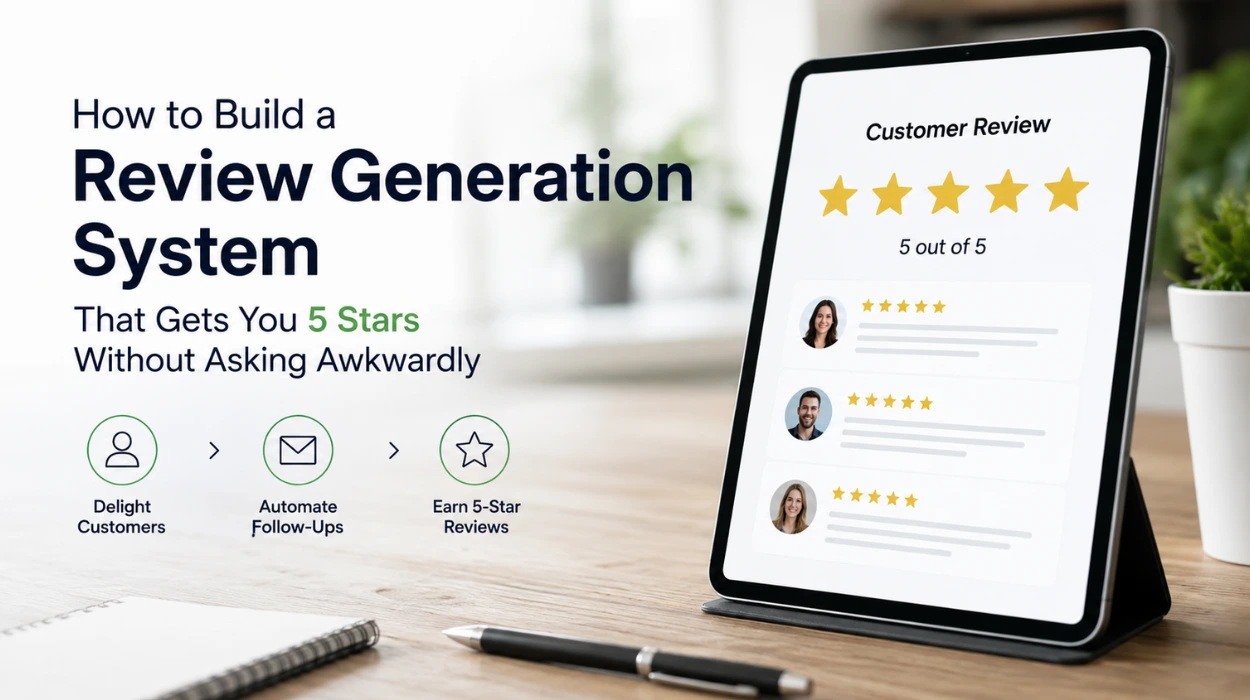
A review generation system combines automated timing, low-friction request channels, and structured feedback routing. It removes the need to ask customers directly while still producing consistent 5-star results.
Most businesses treat reviews as a favour they must beg for. That approach fails because timing, channel, and phrasing all affect outcomes, and manual asking controls none of them. A system replaces guesswork with a repeatable sequence: trigger, request, filter, publish. This article evaluates the components of that sequence and compares the methods businesses use to build it, without recommending a single fixed approach.
What is a review generation system?
A review generation system is a structured process that triggers review requests automatically after a defined customer action, rather than relying on staff to ask in person. It typically includes three components: a trigger event, a delivery channel, and a feedback filter that separates public reviews from private complaints.
Standalone definition: A review generation system automates the timing and delivery of review requests using triggers such as purchase completion, appointment closure, or delivery confirmation, replacing manual, inconsistent, in-person asking.
The trigger event matters because it sets the emotional context for the request. A customer asked immediately after a positive resolution responds differently to one asked three weeks later. Systems typically use one of four triggers:
- Trigger on payment completion — works for retail and e-commerce, exemplified by a Shopify checkout flow that sends a review link 48 hours post-delivery.
- Trigger on appointment closure — suits service businesses, exemplified by a dental clinic sending a request the moment a patient checks out.
- Trigger on support ticket resolution — suits SaaS companies, exemplified by Zendesk closing a ticket and firing a satisfaction survey.
- Trigger on delivery confirmation — suits logistics-dependent businesses, exemplified by a courier scan event that releases the request.
Choosing the correct trigger determines whether the request lands during peak satisfaction or after it has faded.
Which review request channel converts best: SMS, email, or QR code?
SMS converts at higher rates than email or QR codes for immediate, service-based transactions, while email performs better for delayed, considered purchases. QR codes work only when a physical touchpoint exists at the moment of highest satisfaction, such as checkout or exit.
How does each channel perform under different conditions?
Each channel suits a different customer context, and businesses evaluating which to use should match the channel to the transaction type rather than defaulting to one option.
- Send SMS for same-day services — appropriate for hairdressers, car repair shops, and food delivery, exemplified by Domino’s sending a post-order text within the hour.
- Send email for considered purchases — appropriate for B2B software, furniture, and travel bookings, exemplified by Booking.com emailing a review request after checkout.
- Place QR codes at physical exit points — appropriate for restaurants and retail counters, exemplified by a printed code on a receipt or table tent.
- Combine channels for multi-stage journeys — appropriate for healthcare and financial services, exemplified by an SMS reminder following an unopened email.
No single channel outperforms the others universally. The transaction speed and the customer’s device habits at that moment decide which method produces a response.
Should you use review gating or open feedback funnels?
Review gating routes dissatisfied customers to a private feedback form instead of a public platform, while open feedback funnels send every customer to the same public review link regardless of their sentiment. Google’s guidelines prohibit gating that selectively suppresses negative reviews, so businesses must evaluate the compliance risk against the reputational control it offers.
What are the trade-offs of each funnel type?
The decision affects both review volume and platform compliance, so the two models carry different risks and benefits.
- Gated funnels increase average star ratings because only satisfied customers reach the public link, but they reduce total review count and may breach platform terms.
- Open funnels increase review authenticity because every customer, regardless of sentiment, reaches the same public page, producing a rating that better reflects actual service quality.
- Hybrid funnels ask a private satisfaction question first without blocking anyone from the public link afterwards, balancing compliance with early complaint detection.
A hybrid approach, where every customer eventually reaches the public review option but internal alerts flag dissatisfaction first, avoids the compliance risk while still catching problems before they become public complaints. This is one area where a wider PR and reputation management strategy determines how review data feeds into broader brand monitoring.
How soon after service should you request a review?
Review requests sent within 24 hours of a positive interaction produce higher completion rates than requests sent after 72 hours, because recall of specific details fades quickly. The exact window varies by industry: retail purchases benefit from a 48-hour delay to allow product experience, while service-based interactions perform best within 2 hours.
Consider three industry patterns when setting request timing:
- Send immediately for service completions — a plumber or electrician job, where satisfaction peaks at job completion.
- Delay 48 hours for physical products — an online clothing order, where the customer needs time to try the item.
- Delay 7 days for subscription software — a SaaS trial, where usage patterns take longer to form an opinion.
Testing the delay window against actual completion rates, rather than assuming a single fixed schedule, produces the most accurate timing for a specific business type.
Which review platforms matter most for local reputation?
Google Business Profile carries the most weight for local search visibility, followed by industry-specific platforms such as Trustpilot, Yelp, or Healthgrades depending on the sector. A business evaluating platform priority should weigh search visibility against where its specific customers already look for recommendations.
How do platform priorities differ by sector?
- Prioritise Google Business Profile for local service businesses, exemplified by a plumbing company that depends on map pack visibility.
- Prioritise Trustpilot for e-commerce brands, exemplified by an online retailer building trust before checkout.
- Prioritise Healthgrades or Zocdoc for medical practices, exemplified by a clinic where patients research providers before booking.
- Prioritise G2 or Capterra for B2B software, exemplified by a SaaS company selling to procurement teams.
Splitting review requests across two platforms, rather than concentrating all effort on one, reduces dependency risk if a single platform changes its algorithm or removes reviews without explanation.
How do you automate follow-ups without sounding robotic?
Automated follow-ups avoid sounding robotic when they reference the specific transaction, use conversational phrasing, and limit the sequence to two touches maximum. A generic, repeated message sent three or more times reduces response rates and increases unsubscribe requests.
- Reference the specific purchase or appointment in the message body, not just the business name.
- Limit the sequence to one initial request and one reminder, spaced 3 to 5 days apart.
- Vary the phrasing between the first and second message so the reminder does not read as an identical repeat.
- Stop the sequence immediately once a review is detected, avoiding a redundant final message.
Systems that violate these limits generate short-term volume but longer-term platform fatigue, where customers begin ignoring or blocking the business’s messages entirely.
What role does reputation management play in review generation?
Review generation is one input into a broader reputation management process that also includes response management, sentiment monitoring, and correction of inaccurate public information. A high volume of 5-star reviews does not offset unanswered negative reviews or outdated business listings elsewhere online.
Businesses evaluating whether to build review generation in isolation or as part of a wider system should consider that reviews alone do not control how a brand appears in press coverage, search snippets, or third-party directories. A dedicated reputation management service for small businesses typically combines review generation with response monitoring and listing accuracy checks, since the three functions influence the same public perception outcome.
For businesses without in-house resources to manage this continuously, a structured Reputation Management service handles the monitoring and response layer that automated review requests alone cannot cover.
Building a review generation system requires evaluating trigger timing, channel selection, funnel compliance, and platform priority as separate decisions rather than a single bundled choice. SMS suits immediate service transactions, email suits considered purchases, and QR codes suit physical touchpoints. Gated funnels raise average ratings but carry compliance risk, while open and hybrid funnels balance authenticity with early problem detection. No single configuration works for every business; the correct combination depends on transaction speed, customer channel habits, and sector-specific platform weight.
Ready to get your story published?
Distribute your press release across 500+ trusted media outlets — with editorial review and a full pickup report within 48 hours.
Send Press Release →