
How Seed Companies Build Industry Trust Through Press Releases
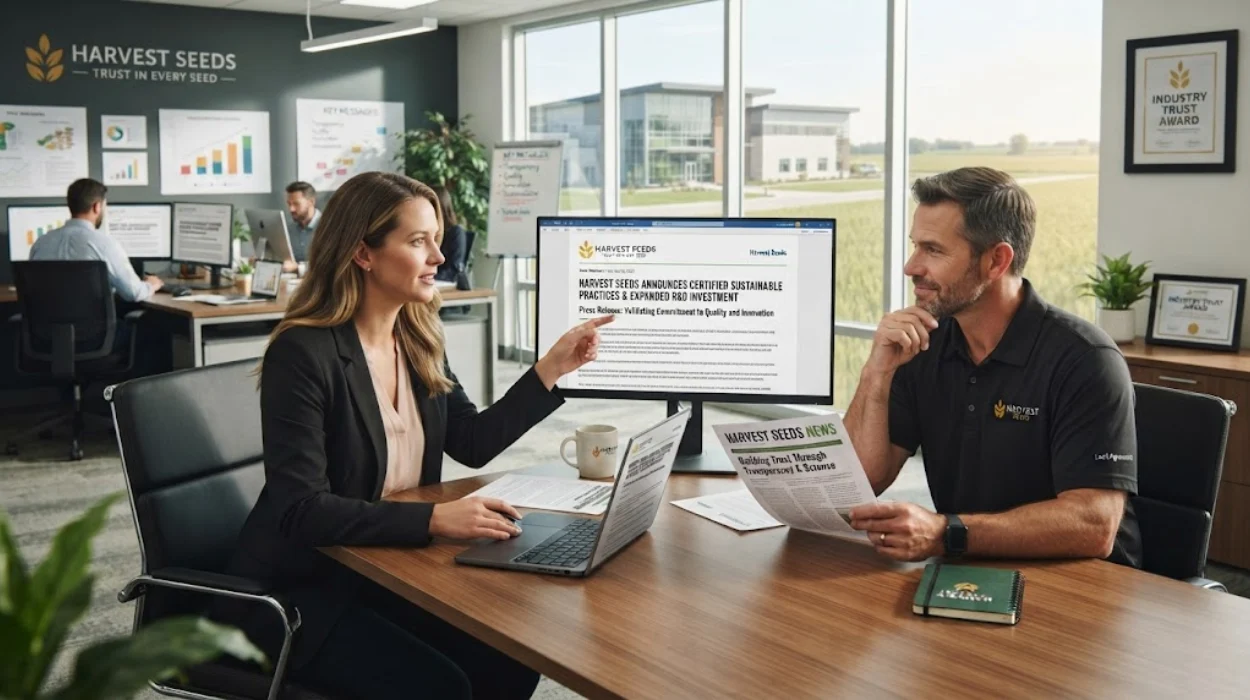
Seed companies build industry trust through press releases by publishing verifiable developments, expert information, research findings, partnerships, product launches and regulatory milestones.
A structured press release strategy gives buyers, growers, distributors and agricultural media a consistent source of factual company information.
Why do press releases help seed companies establish industry trust?
Press releases establish trust by converting company developments into structured, verifiable information that industry audiences can assess.
Seed companies operate in a market where purchasing decisions depend on performance, reliability, research and technical evidence. A press release gives these businesses a controlled format for communicating important developments. It can explain a new seed variety, breeding programme, research partnership or distribution agreement. The format also separates factual announcements from promotional advertising. This distinction matters when agricultural audiences evaluate unfamiliar companies.
Trust develops when communications contain specific evidence rather than broad claims. A release can identify researchers, trial locations, partner organisations, product names and publication dates. These details allow readers to understand what happened and why it matters. Consistent reporting also creates a searchable record of company activity. Over time, this record can strengthen familiarity across agricultural media and industry audiences.
Seed companies can also use press releases to explain technical developments in accessible language. Complex breeding processes can become difficult for non-specialist readers to understand. A well-structured announcement identifies the development, explains its agricultural relevance and provides supporting context. This approach makes scientific progress easier to evaluate. It also gives journalists a clearer basis for deciding whether a story has editorial value.
Companies beginning their communications strategy can first understand the fundamentals through seed company press releases. That foundation helps distinguish a genuine news announcement from content created primarily for advertising purposes.
Which press release topics create the strongest evidence of seed company credibility?
Research, product development, partnerships, trials and measurable agricultural milestones provide stronger credibility signals than general corporate announcements.
The subject of a release directly influences how much trust it can generate. A statement about a completed field trial contains more useful information than a general statement about future ambitions. Agricultural audiences can evaluate the specific event, participants and results. The same principle applies to breeding programmes and research collaborations. Specific developments create stronger evidence than unsupported positioning statements.
Useful announcement categories include:
- Report completed field trials with named crops, locations and relevant dates.
- Explain new breeding programmes by identifying the crop, development objective and research organisation.
- Announce distribution agreements by naming the participating companies and geographic market.
- Document regulatory milestones by identifying the relevant approval, registration or certification.
- Present product launches with technical characteristics, intended agricultural applications and availability details.
A release about a partnership between a seed company and Wageningen University & Research, for example, provides identifiable entities and a defined subject. A release concerning a new wheat variety can identify the variety, target growing conditions and trial stage. These details allow agricultural journalists to assess relevance before deciding whether to report the development.
Product announcements still require factual discipline. Statements such as “best-performing seed” create a credibility problem when the release provides no supporting comparison. A stronger approach identifies the measured attribute and explains how it was evaluated. This creates a distinction between a marketing claim and an evidence-based industry announcement.
Is press release distribution more effective than direct journalist outreach for building trust?
Press release distribution and direct journalist outreach serve different trust-building functions, with distribution providing broader information access and outreach providing targeted editorial engagement.
Distribution places an announcement across a network of publications and media channels. It creates wider exposure from one structured source. This approach works when the objective involves establishing a documented company development across multiple relevant audiences. It also creates opportunities for secondary discovery by journalists, analysts and industry professionals.
Direct journalist outreach operates differently. It involves identifying reporters who cover agriculture, seed technology, crop science, biotechnology or food production. The company then presents a specific story angle to each relevant journalist. This approach can produce deeper editorial engagement because the communication is tailored to the journalist’s coverage area.
The two methods differ across several practical factors:
| Factor | Distribution | Direct journalist outreach |
|---|---|---|
| Reach | Broad | Targeted |
| Editorial relationship | Limited | Direct |
| Information control | High | Moderate |
| Journalist targeting | General or segmented | Individual |
| Scalability | High | Lower |
| Follow-up | Structured | Personalised |
Neither method automatically creates trust. Distribution without substantive news can generate visibility without meaningful credibility. Outreach without a compelling story can produce limited journalist interest. The strongest evaluation therefore considers the news value, audience relevance and evidence within the announcement before selecting the communication method.
A seed company announcing a new drought-tolerant maize variety may benefit from both approaches. Distribution can establish a public information record, while direct outreach can target agricultural journalists interested in climate adaptation. The methods complement different stages of media engagement rather than functioning as interchangeable alternatives.
Does guaranteed media placement build more trust than syndication?
Guaranteed placement provides predictable publication, while syndication creates broader distribution opportunities without making every publication an independent editorial endorsement.
Guaranteed placement and syndication represent different media visibility models. A guaranteed placement model typically defines where the supplied content will appear before publication. This creates greater certainty about the distribution outcome. It can support campaigns where a company requires a documented presence on specified platforms.
Syndication distributes the same announcement through participating channels. The content can appear across multiple websites or feeds. However, publication does not necessarily mean that every outlet has independently reviewed or endorsed the announcement. Readers can therefore interpret syndicated coverage differently from original editorial reporting.
For seed companies, this distinction affects how media results should be evaluated. A published release demonstrates that information reached a media environment. It does not automatically demonstrate that an agricultural journalist independently validated the company’s claims. Trust depends on the quality of the underlying information and the nature of the publication.
Companies should therefore separate three outcomes:
- Verify where the announcement was published.
- Distinguish syndicated publication from independent editorial coverage.
- Measure subsequent journalist, customer or industry engagement.
This distinction is particularly important for technical claims. A statement concerning seed performance should remain supported by trial data regardless of how widely the announcement is distributed. Media visibility amplifies information. It does not replace evidence.
Which press release elements make agricultural claims more credible?
Specific evidence, named sources, measurable results and transparent context make agricultural press releases more credible than broad performance claims.
Agricultural audiences often assess information through technical details. A seed announcement should therefore explain the evidence behind important claims. This can include trial conditions, crop varieties, geographic locations, testing periods and research partners. Clear attribution also shows readers where information originated.
Numbers become more useful when their context is stated. A claim that a seed variety increased yield by 12% means little without explaining the comparison, crop, trial conditions and measurement period. A more useful announcement identifies the control, location and methodology. This allows readers to interpret the figure rather than accepting it as an isolated marketing statement.
Named experts can strengthen technical communication when their roles are relevant. A plant breeder, agricultural scientist or research director can explain why a development matters. Their comments should add information rather than simply repeat corporate messaging. Independent institutions can provide additional context when they are genuinely involved in the research or testing.
Press releases should also distinguish established results from future objectives. A completed trial and a planned trial represent different stages of evidence. Treating them as equivalent can weaken credibility. Precise language helps readers understand what has already happened and what remains under development.
A credible structure often follows this sequence:
- Identify the development and its agricultural relevance.
- Quantify measurable results where reliable data exists.
- Attribute technical information to named experts or organisations.
- Explain the methodology or conditions behind important findings.
- Clarify whether the information describes completed results or plans.
This structure gives journalists enough context to evaluate the announcement before deciding whether additional reporting is appropriate.
How can seed companies use Google News visibility without confusing it with editorial authority?
Google News visibility can increase discoverability, but search exposure should be evaluated separately from independent editorial authority and journalist-generated coverage.
Search visibility and editorial credibility are related but distinct outcomes. A press release that becomes discoverable through news-search systems can reach readers who are already researching a company or agricultural development. This improves information accessibility. It does not mean that a search engine has independently verified every statement in the release.
News-oriented visibility depends on several factors, including content quality, technical accessibility, publication context and the overall news ecosystem. A clear headline helps users understand the subject immediately. A factual opening paragraph communicates the development without unnecessary promotional language. Structured information also helps readers identify the entities, event and agricultural relevance.
Seed companies should therefore measure search visibility alongside other indicators. A rise in branded searches may show increased awareness. Referral traffic can reveal whether readers engage with the announcement. Media citations can demonstrate that journalists used the information as part of independent reporting.
The distinction becomes important when reporting campaign performance. “The release appeared in search results” describes discoverability. “An agricultural publication independently reported on the development” describes editorial coverage. These outcomes should not be combined into one media metric.
A balanced measurement framework can include:
- Track indexed announcement pages and relevant search visibility.
- Measure referral visits generated by published releases.
- Record independent media stories that reference the announcement.
- Compare branded search activity before and after major announcements.
- Analyse journalist enquiries, citations and follow-up coverage.
This approach prevents search visibility from becoming a substitute for genuine media relationships. It also gives seed companies a clearer understanding of which communication activities generate awareness, information access and independent coverage.
Which press release strategy suits seed companies at different stages of growth?
Early-stage seed companies need documented credibility, established companies need consistent evidence, and expanding businesses need targeted communication around markets, partnerships and technical developments.
A seed company’s communication requirements change as its market presence develops. A new company may need to establish a credible public record. Its releases can focus on research partnerships, founders, technology, trial activity and regulatory milestones. These announcements give unfamiliar audiences concrete information with which to assess the organisation.
An established seed company has a different communication challenge. It already has recognition but must demonstrate continuing activity. Its releases can document new varieties, research programmes, distribution agreements and sustainability initiatives. Regular factual communication creates continuity rather than relying on occasional promotional campaigns.
An expanding company may need to communicate developments across several markets. Geographic expansion, new distributors and regional trials can become relevant announcement subjects. Each release should identify the market, crop, partners and business development involved. This makes the information more useful to local agricultural audiences.
The strategy can therefore be evaluated according to business context:
| Business stage | Primary communication need | Suitable release emphasis |
|---|---|---|
| New entrant | Establish credibility | Research, trials, partnerships |
| Established company | Demonstrate ongoing activity | Product development, results, innovation |
| Expanding company | Explain market development | Distribution, regional trials, market entry |
| Research-led company | Communicate technical progress | Studies, breeding, scientific collaboration |
The choice of distribution method should follow the communication objective. Broad distribution can support information accessibility. Direct outreach can support targeted editorial relationships. Owned channels can provide the complete corporate record. Combining these approaches requires clear measurement so each activity has a defined purpose.
For organisations evaluating specialist support, services for seed companies can be reviewed as a separate consideration-stage resource. The relevant criteria include industry understanding, factual handling, distribution scope, media targeting and reporting transparency.
What should seed companies evaluate before choosing a press release distribution approach?
Seed companies should evaluate distribution reach, media relevance, publication transparency, evidence handling and reporting before selecting a press release approach.
The number of distribution outlets alone does not establish quality. A larger network can create greater reach, but agricultural relevance determines whether that reach reaches useful audiences. A smaller targeted network can produce more relevant exposure for a specialist seed technology announcement. The evaluation should therefore focus on audience composition as well as publication volume.
Transparency also matters. Companies should understand whether a service provides syndication, guaranteed placement, journalist outreach or a combination of methods. These activities produce different outcomes. Clear reporting should distinguish publication from independent editorial coverage. It should also identify where content appeared and what measurable engagement followed.
Evidence handling is particularly important in the agriculture sector. Technical claims require accurate terminology and appropriate context. A distribution process cannot compensate for unsupported performance statements. The underlying release must remain factually precise regardless of the publication model.
A practical evaluation framework should examine:
- Compare the stated distribution model with the intended media objective.
- Check whether agricultural and seed-sector publications are relevant to the target audience.
- Verify how publication and syndication results are reported.
- Assess whether technical claims receive appropriate factual treatment.
- Separate guaranteed publication from independent editorial coverage.
- Measure search visibility, referral traffic and subsequent media engagement.
The final choice depends on the company’s objective. A product announcement may prioritise broad information access. A technical research development may require targeted journalist engagement. A regulatory milestone may require precise documentation and specialist coverage.
Press releases can strengthen industry trust when they create a consistent, factual record of meaningful seed-sector developments. Distribution expands access to that information, while journalist outreach can create more targeted editorial relationships. Google News visibility improves discoverability but does not replace independent reporting. Syndication increases publication opportunities but should not be treated as universal editorial endorsement.
The most reliable evaluation separates visibility, evidence, publication and independent coverage into distinct outcomes. Seed companies can then determine which communication method matches each announcement. Research findings require technical evidence. Partnerships require identifiable participants. Product developments require specific characteristics and supporting context. This evidence-led approach gives agricultural audiences clearer information with which to evaluate the company.
Ready to get your story published?
Distribute your press release across 500+ trusted media outlets — with editorial review and a full pickup report within 48 hours.
Send Press Release →