
How the Film Industry Works from Production to Distribution
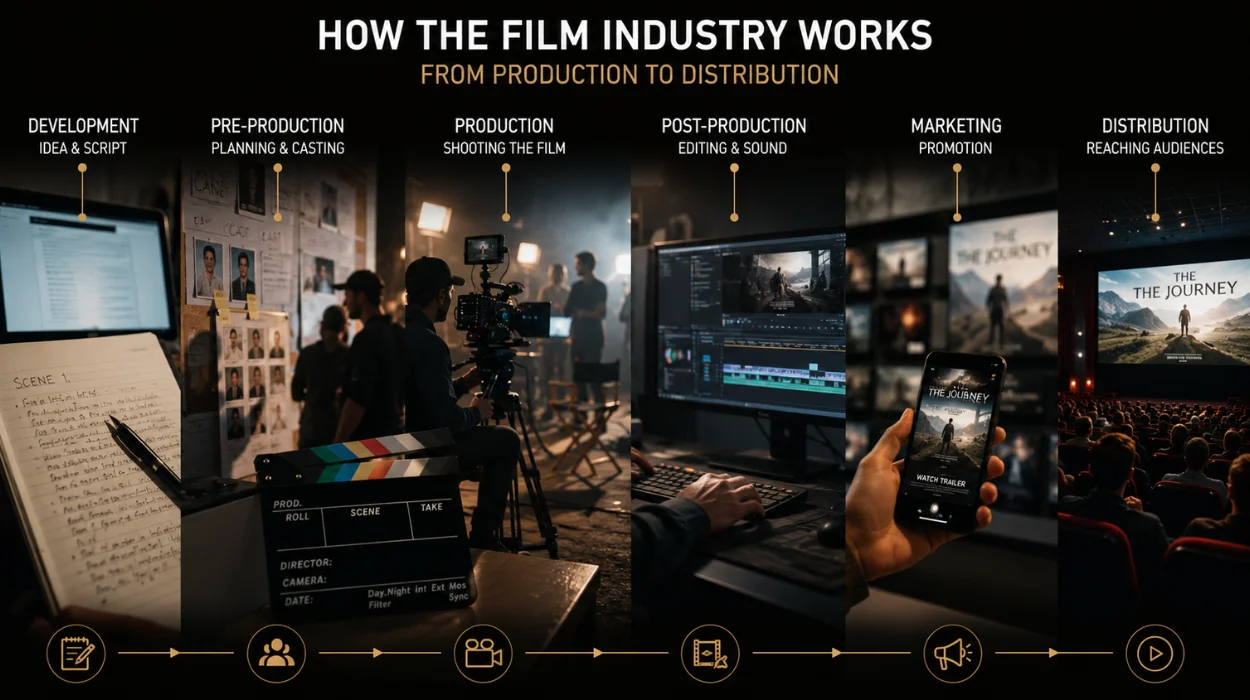
The film industry operates through a structured pipeline that moves a project from concept development to audience delivery. Each stage—production, post-production, and distribution—connects to distinct media, publicity, and release strategies that influence visibility and commercial performance.
How does production strategy influence distribution outcomes?
Production decisions directly shape distribution reach, media interest, and release timing.
A film’s production phase defines its market positioning before distribution begins. Budget allocation, casting choices, and filming locations influence how distributors categorise the film. High-budget productions exceeding $100 million, such as global franchise films, secure pre-arranged distribution agreements across 60+ territories. Independent films under $5 million rely on festival circuits for exposure. Production scale determines whether distribution follows a theatrical-first or digital-first model. Projects with recognised actors generate early media coverage, increasing press release pickup rates. Films without recognisable talent require stronger narrative hooks to attract journalist outreach.
How do budget tiers affect distribution pathways?
Budget tiers determine access to distribution channels and promotional intensity. Films above $50 million secure wide theatrical releases across 2,500+ screens. Mid-budget films between $10 million and $50 million often combine limited theatrical release with streaming deals. Low-budget films under $5 million depend on festival premieres and niche streaming platforms. Larger budgets enable coordinated global press campaigns across 100+ media outlets. Smaller budgets rely on targeted outreach to 10–25 niche publications.
Which distribution model is faster: theatrical release or digital-first release?
Digital-first distribution reaches audiences within weeks, while theatrical distribution requires months of scheduling and logistics.
Theatrical distribution involves complex timelines, including cinema bookings, regional licensing, and marketing rollouts. This process typically spans 90 to 180 days before release. Digital-first distribution allows films to launch on streaming platforms within 30 to 45 days after post-production. Streaming platforms distribute content instantly across 190+ countries. Theatrical releases depend on physical availability across cinemas, limiting immediate global reach. Digital releases also enable simultaneous media announcements, increasing press visibility in a shorter timeframe.
What operational steps differ between the two models?
- Schedule cinema slots in chains like AMC or Cineworld for theatrical releases
- Negotiate platform licensing with services like Netflix or Amazon Prime Video for digital releases.
- Coordinate regional marketing campaigns across 15–40 countries for theatrical launches.
- Deploy global press releases simultaneously for digital-first launches
Which media coverage method generates wider visibility: wire distribution or direct journalist outreach?
Wire distribution delivers volume across hundreds of outlets, while journalist outreach secures fewer but more authoritative placements.
Wire distribution syndicates press releases to 200–500 online publications within minutes. These include regional news sites and aggregators indexed by search engines. Direct journalist outreach targets 10–30 reporters, resulting in 3–8 in-depth articles. Syndicated content increases visibility through quantity. Editorial coverage improves credibility through depth and narrative storytelling. Wire services support rapid dissemination, while outreach builds long-term media relationships. Both methods influence how a film’s release gains traction in search and news ecosystems.
How do coverage outcomes differ in measurable terms?
- Distribute content widely across 300+ syndicated sites through wire networks.
- Pitch tailored stories to 20 journalists specialising in film and entertainment
- Achieve high indexing frequency on Google News through syndicated releases
- Secure feature articles in publications like Variety or The Hollywood Reporter
Which approach is more cost-effective: paid distribution or owned-media publishing?
Owned-media publishing reduces upfront costs, while paid distribution delivers faster and broader exposure.
Paid distribution involves fees ranging from $150 to $8,700 per release depending on reach and placement guarantees. Owned-media publishing uses internal platforms such as company blogs or social channels with minimal cost. Paid services ensure placement across established news domains with domain authority scores above 70. Owned media builds long-term assets but requires sustained audience growth. Paid distribution accelerates visibility within 24 hours. Owned channels may take 6 to 12 months to achieve comparable reach. Each approach differs in speed, scalability, and control over messaging.
What are the operational trade-offs?
- Pay for guaranteed placement on 100+ media sites through distribution networks.
- Publish directly on owned platforms such as websites and social channels
- Track immediate reach using analytics from paid campaigns
- Build gradual authority through consistent owned content publishing
Which strategy improves search visibility: Google News optimisation or general web distribution?
Google News optimisation increases discoverability in news ecosystems, while general web distribution supports broader but less targeted visibility.
Google News indexing requires structured content, publisher authority, and compliance with editorial standards. Articles indexed in Google News appear in Top Stories and news-specific search results within hours. General web distribution places content across blogs and non-news platforms, which may take days to index. News-optimised releases generate higher click-through rates due to placement in prominent search features. Generic distribution supports backlink diversity but lacks prioritised visibility. Films promoted through news indexing gain faster recognition during release cycles.
How do technical requirements differ?
- Structure content for news algorithms using schema markup and editorial formatting
- Distribute across standard websites without strict editorial requirements
- Achieve indexing within hours through Google News inclusion
- Wait for standard crawling cycles of 24–72 hours for general web pages
Which distribution approach suits independent films versus studio productions?
Independent films benefit from targeted outreach and festivals, while studio productions rely on mass distribution and global campaigns.
Independent films operate with limited budgets and prioritise niche audiences. Festival screenings at events like Sundance or Cannes generate initial media coverage. Studio productions deploy global campaigns across 50+ countries simultaneously. Independent films focus on 5–10 key markets, while studios target worldwide audiences. Distribution scale influences media strategy, with studios using both wire distribution and journalist outreach at large scale. Independent filmmakers prioritise storytelling angles to secure editorial interest.
How do campaign structures differ?
- Submit films to festivals such as Sundance Film Festival for independent exposure.
- Launch global campaigns across 70+ markets for studio films
- Target niche publications for independent film coverage
- Coordinate multi-channel distribution including cinemas and streaming for studios
How do press releases integrate with film distribution strategies?
Press releases act as the communication bridge between production milestones and audience-facing distribution.
Press releases announce casting, production updates, and release dates. During production, they generate early awareness among industry publications. At the distribution stage, they inform audiences and media about release availability. A single film campaign may involve 5 to 12 press releases across its lifecycle. These releases align with trailers, festival premieres, and platform launches. Effective integration ensures consistent messaging across all distribution channels. For broader context on visibility strategies, refer to building global recognition.
What timing patterns define effective press release usage?
- Announce production start with cast and crew details
- Release trailers alongside media announcements
- Promote festival premieres with targeted outreach
- Confirm distribution dates across theatres or platforms
Which factors define a strong film distribution strategy?
A strong strategy combines timing, channel selection, and media alignment to maximise reach and engagement.
Distribution success depends on synchronising release timing with audience demand. Seasonal releases, such as summer blockbusters, attract higher attendance. Platform selection determines accessibility, with streaming reaching global audiences instantly. Media alignment ensures coverage matches target demographics. Campaigns with coordinated press releases and media outreach outperform isolated efforts. Evaluation of these factors allows producers to refine distribution approaches without relying on a single method.
What criteria should be analysed when comparing strategies?
- Assess release timing based on audience trends and seasonal demand
- Select distribution channels such as cinemas or streaming platforms
- Align media outreach with target audience demographics
- Measure performance metrics including viewership and media mentions
How do evolving trends reshape film distribution and PR strategies?
Technological advancements and audience behaviour continue to redefine distribution and media engagement models.
Streaming platforms have increased global accessibility, reaching over 1 billion users collectively. Social media amplification accelerates content discovery within hours of release. Data-driven targeting enables precise audience segmentation across 25+ demographic categories. Traditional theatrical windows have shortened from 90 days to 45 days in many markets. Hybrid release models combine cinema and streaming simultaneously. These trends influence how press releases and media campaigns are structured. For deeper evaluation of service-level execution, explore film industry press release services.
What emerging methods influence current strategies?
- Adopt hybrid release models combining cinema and streaming launches
- Leverage data analytics to target audiences across platforms like YouTube and TikTok
- Shorten release windows to align with digital consumption habits
- Integrate social media campaigns with traditional PR efforts
The film industry operates through interconnected stages where production decisions shape distribution strategies and media outcomes. Each approach—whether theatrical or digital, wire distribution or journalist outreach—presents distinct advantages and limitations. Evaluation depends on budget, audience, timing, and desired visibility. No single method dominates across all scenarios. Strategic alignment across production, distribution, and media engagement defines overall success.
Ready to get your story published?
Distribute your press release across 500+ trusted media outlets — with editorial review and a full pickup report within 48 hours.
Send Press Release →