
Does Your Outreach Strategy Pass the 2026 Inbox Reputation and Compliance Audit?

Your outreach strategy passes the 2026 inbox reputation and compliance audit if it aligns with current email‑delivery standards, sender‑reputation thresholds, and regulatory‑requirements for commercial messaging. Reputation‑by‑default no longer exists; every cold‑outreach sequence must now be evaluated against technical‑signals, behavioural‑metrics, and legal‑frameworks that govern what inbox‑providers consider acceptable.
How has inbox reputation changed for B2B outreach in 2026?
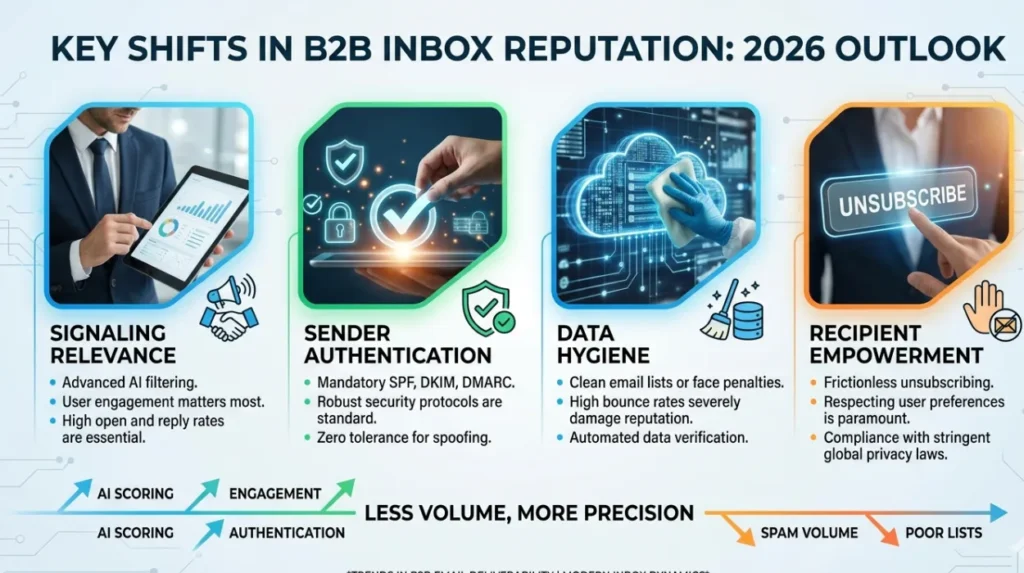
Inbox reputation for B2B outreach in 2026 is now a multi‑factor system that combines sender‑score signals, complaint‑rates, and engagement‑patterns into a single‑reputation‑proxy used by major‑ISP filters. Traditional‑volume‑driven tactics are structurally penalised because high‑bounced‑rate domains and low‑open‑rate lists are statistically linked to spam‑behaviour.
Inbox‑reputation‑shift refers to the way 2026‑filters treat reputation as a continuous‑risk‑score, not a static‑whitelist status. This score is recalculated at scale using AI‑driven models that downgrade domains showing spam‑like‑patterns, such as sudden‑send‑spikes, poor‑content‑quality, or high‑recipient‑reporting.
Key‑developments include:
- Domain‑reputation chaining: grouping domains, IP‑ranges, and subdomains into reputation‑clusters, so misbehaviour by one impacts the whole ecosystem.
- Engagement‑based‑weighting: favouring emails that generate opens, replies, and clicks, and downgrading those that are ignored or instantly deleted.
- Third‑party‑reputation‑integrations: relying on independent‑reputation‑scores from providers such as Google Postmaster, Microsoft SmartScreen, and Barracuda Email Reputation.
These changes mean that outreach strategies must be designed for long‑term‑reputation‑stability, not short‑term‑volume‑gains.
What core compliance and regulatory developments must modern outreach strategies meet?
Modern outreach strategies must meet updated GDPR‑adjacent‑permissions rules, UK‑specific‑direct‑marketing‑guidelines, and global‑anti‑spam‑frameworks such as CASL and CAN‑SPAM, which now tightly regulate how leads are sourced, consented, and segmented. Regulators increasingly treat “cold” outreach as a legal‑risk category, not just a sales‑tactic.
Compliance‑threshold is defined as the minimum‑standard of lawful‑basis, transparency, and recipient‑control that outreach must meet before it can be sent without violating consumer‑protection or data‑law obligations. Non‑compliant outreach now triggers faster‑escalation, higher‑fines, and stronger‑inbox‑filtering‑responses.
Essential‑requirements include:
- Lawful‑basis‑validation: proving that each contact has a documented‑permission‑type (opt‑in, contractual‑necessity, legitimate‑interest) that aligns with territorial‑law.
- Clear‑consent‑disclosures: explicitly stating how data will be used, how long it will be retained, and how recipients can withdraw consent with a single‑click.
- Regulatory‑segmentation‑by‑jurisdiction: applying GDPR‑rules for EU‑based‑recipients, PECR‑for UK‑targets, and country‑specific‑frameworks for others.
These requirements force marketers to treat outreach as a compliance‑system, not just a mailing‑tool.
How do major inbox providers now evaluate “cold” outreach lists?
Major inbox providers now evaluate cold outreach lists by analysing list‑freshness, complaint‑ratio, and engagement‑trajectory, then applying dynamic‑suppression‑rules that can throttle or block sends from domains that display spam‑like‑behaviour. A “cold” list is no longer a neutral‑input; it is treated as a risk category that must be pre‑normalised before being accepted into the inbox.
Cold‑list‑evaluation refers to the process by which inbox‑algorithms measure bounce‑rate spikes, spam‑complaint‑density, and open‑drop‑off‑patterns to determine whether a given list should be delivered, throttled, or rejected. If a list shows above‑threshold‑spam‑signals, individual‑emails may be silently‑filtered or marked as low‑trust.
Mechanisms in force include:
- Bounce‑rate‑monitoring: domains that consistently exceed 2–5% hard‑bounce‑rates are flagged for reputation‑penalties.
- Spam‑complaint‑thresholds: reaching 0.1–0.2% complaints per sent‑message can trigger inbox‑blocking or aggressive‑filtering.
- List‑recency‑scoring: lists that re‑use old‑or‑inactive‑addresses are treated as higher‑risk, especially if they show low‑engagement‑history.
These patterns mean that list‑quality‑and‑sourcing‑history now directly shape whether “cold” emails even reach the inbox.
What are the advantages and limitations of high‑volume mass‑outreach in 2026?
High‑volume mass‑outreach in 2026 offers advantages such as rapid‑market‑coverage and immediate‑brand‑exposure, but it carries increasing limitations around deliverability, engagement, and compliance‑risk. Volume‑alone is no longer a growth‑lever; it is a reputation‑amplifier that magnifies both good and bad‑signal‑behaviour.
High‑volume‑outreach is defined as the practice of sending large‑quantities of identical‑or‑nearly‑identical messages to broad‑audience‑segments, often via automated‑platforms or bulk‑email‑tools. This approach is increasingly scrutinised because it correlates with spam‑behaviour when lists are low‑quality or engagement‑is‑low.
Key‑advantages include:
- Fast‑awareness‑scaling: enabling brands to reach thousands of contacts in a single‑campaign cycle, especially for product‑launches or event‑promotions.
- Cost‑per‑impression‑efficiency: high‑volume‑runs can reduce effective‑CPM compared with purely‑1‑to‑1‑outreach at scale.
However, limitations are significant:
- Reputation‑volatility: a single poor‑batch can damage domain‑score and trigger inbox‑filtering across future sends.
- Compliance‑exposure: using non‑segmented, non‑verified‑lists increases the risk of violating consent‑and‑data‑law‑requirements.
- Engagement‑degradation: generic‑messages sent at scale often see low‑open‑and‑reply‑rates, which lowers overall‑reputation‑signals.
High‑volume‑tactics therefore require tighter‑governance, not just higher‑automation.
How does inbox‑filtering balance AI‑driven spam‑detection with engagement‑signals?
Inbox‑filtering in 2026 balances AI‑driven spam‑detection with engagement‑signals by using machine‑learning models that assign risk‑scores to emails based on both content‑features and user‑responses. Spam‑detection focuses on identifying manipulative‑patterns, while engagement‑signals measure how users actually interact with the same‑messages.
AI‑spam‑detection refers to the use of NLP models and pattern‑recognition‑algorithms to flag spam‑like language, impersonation‑tactics, and deceptive‑send‑behaviour in outbound‑messages. These systems are trained on large‑datasets of known‑spam, phishing, and scam‑campaigns, which increases their ability to detect emerging‑tactics.
Engagement‑signals are defined as the recorded‑behaviour of recipients, such as opens, replies, link‑clicks, and delete‑actions, which are aggregated into reputation‑metrics. High‑engagement‑emails are treated as more‑trustworthy, while those that are ignored or instantly‑deleted are deprioritised.
The combined‑effect includes:
- Dynamic‑threat‑modelling: continuously‑updated‑models that adapt to new‑spam‑patterns, such as AI‑generated‑copy, deep‑fakes, and abuse‑of‑trusted‑brands.
- Behaviour‑anchoring: boosting messages that recipients consistently engage with, even if they resemble marketing‑content.
- Reputational‑feedback‑loops: sender‑reputation that improves or declines in real‑time based on how recipients respond to successive‑sends.
This creates a system where outreach quality is as important as technical‑infrastructure.
How does personalisation and segmentation affect delivery and reputation today?
Personalisation and segmentation affect delivery and reputation today by aligning message‑relevance with recipient‑context, which in turn improves engagement‑signals and reduces flag‑and‑complaint‑rates. Inbox‑providers treat relevant‑emails as lower‑risk, while generic‑batches are treated as higher‑risk spam‑candidates.
Personalisation is defined as the practice of tailoring content‑elements such as subject‑lines, body‑copy, and calls‑to‑action to individual‑recipient‑attributes, using data‑fields like role, industry, or past‑behaviour.
Segmentation refers to the process of grouping recipients into coherent‑cohorts based on shared‑attributes, so that messages are more‑likely to match their interests and needs.
These techniques improve outcomes by:
- Reducing spam‑flags: more‑relevant messages are less likely to be marked as spam or deleted without being read.
- Increasing engagement‑metrics: higher‑open‑and‑reply‑rates elevate sender‑reputation and increase the likelihood of inbox‑placement.
- Lowering compliance‑risk: targeted‑messages based on documented‑consent‑statuses reduce the chance of regulatory‑breach.
As a result, segmentation‑and‑personalisation are no longer “nice‑to‑have” features; they are structural‑components of compliant, high‑performance‑outreach.
What are the main risks of non‑compliant outreach for domain and IP reputation?
Non‑compliant outreach poses significant risks for domain and IP reputation by triggering spam‑lists, complaint‑escalation, and automated‑filtering that can persist for months. Once a domain‑or‑IP‑block is established, recovery‑requires substantial‑time, technical‑optimisation, and behavioural‑proof‑of‑reform on The ROI of Authority A Performance Breakdown of Our Mass Outreach Packages.
Non‑compliant‑outreach is defined as any outreach that breaches consent‑laws, routes through unverified‑lists, or sends without clear‑sender‑identity and opt‑out‑mechanisms. These practices are now tightly monitored by major‑inboxes, which treat them as deliberate‑spam‑behaviour.
Key‑risks include:
- Blacklisting‑escalation: placement on spam‑blocklists such as Spamhaus, Barracuda, or Microsoft‑Filtered, which can block all outbound‑mail from affected‑domains.
- Reputation‑decay‑cycles: domains that show repeated‑compliance‑failures are downgraded in reputation‑score, making it harder to achieve inbox‑placement even after correction.
- Regulatory‑penalties: authorities may impose fines, enforcement‑notices, or public‑sanctions where outreach practices are found to breach data‑protection or direct‑marketing‑laws.
These outcomes make non‑compliance a structural‑risk to outreach‑operations, not just a legal‑issue.
How can a business audit its current outreach strategy against 2026 standards?
A business can audit its current outreach strategy by systematically mapping its sending‑practices, list‑sources, and engagement‑metrics against the technical and regulatory‑thresholds that define “acceptable” outreach in 2026. This audit does not need to be one‑time; it should be repeated quarterly to track reputation‑stability and compliance‑alignment.
Outreach‑audit is defined as the process of evaluating how outbound‑messaging conforms to inbox‑reputation‑rules, legal‑requirements, and engagement‑benchmarks, using both internal‑analytics and external‑reputation‑tools.
An effective‑audit includes:
- Sender‑reputation‑tracking: reviewing domain‑score, bounce‑rate, complaint‑rate, and block‑status across major‑inboxes.
- List‑quality‑assessment: checking list‑age, source‑validity, and permission‑types to ensure compliance‑with‑regulatory‑standards.
- Engagement‑and‑delivery‑analysis: comparing open‑rate, click‑rate, and spam‑report‑trends across campaigns to identify risky‑patterns.
- Compliance‑check‑mapping: verifying that every outreach sequence matches lawful‑basis, opt‑out‑mechanisms, and jurisdiction‑specific‑requirements.
This creates a structured‑framework for deciding whether existing‑outreach passes the 2026 inbox‑reputation and compliance‑audit, or whether it requires re‑design.
In 2026, outreach strategy is no longer a standalone marketing‑tactic; it is a reputation‑and‑compliance‑system that must be evaluated against technical‑deliverability‑rules, engagement‑metrics, and regulatory‑thresholds. Businesses that align their outreach with inbox‑reputation‑standards reduce risk, improve engagement, and position themselves to operate within the tightening‑boundaries of modern‑email‑ecosystems.
FAQs
What does an inbox reputation and compliance audit for outreach involve in 2026?
An inbox reputation and compliance audit for outreach evaluates sender scores, bounce rates, complaint levels, and list‑quality against current email‑delivery standards and regulatory frameworks such as GDPR, UK‑direct‑marketing rules, and anti‑spam laws. It checks whether each outreach sequence aligns with lawful‑basis requirements, opt‑out mechanisms, and inbox‑provider‑guidelines for cold‑and‑warm‑campaigns.
How do major inbox providers treat high‑volume mass email outreach today?
Major inbox providers treat high‑volume mass email outreach as a risk category, using AI‑driven filters to monitor engagement, spam‑complaint ratios, and bounce‑rates before deciding on inbox‑placement or throttling. Campaigns that show weak engagement or high complaint‑density are increasingly likely to be filtered, deprioritised, or blocked at domain level.
Why does email list quality matter for inbox reputation in 2026?
Email list quality matters for inbox reputation because outdated, non‑verified, or non‑permissioned lists drive higher bounce‑rates, spam‑complaints, and unopens, all of which lower sender‑score and trigger inbox‑filtering. Using clean, segmented, consent‑validated lists improves engagement signals and reduces the risk of being flagged as spam‑behaviour.
How does personalisation and segmentation affect email deliverability and reputation?
Personalisation and segmentation improve email deliverability and reputation by increasing relevance, which leads to higher open‑rates, more clicks, and fewer spam‑reports for each message. Inbox providers interpret these positive engagement signals as evidence of legitimate outreach, which strengthens domain‑reputation and supports long‑term‑inbox‑placement.
What are the main compliance risks for non‑compliant outreach campaigns?
The main compliance risks for non‑compliant outreach campaigns include breaches of data‑protection and direct‑marketing laws, which can trigger regulatory fines, enforcement‑notices, and public‑sanctions. Misaligned‑consent models, missing opt‑out links, or unverified‑list‑sources can also lead to reputation‑damage, blacklisting, and sustained inbox‑blocking.
Ready to get your story published?
Distribute your press release across 500+ trusted media outlets — with editorial review and a full pickup report within 48 hours.
Send Press Release →